
Dependent Care FSA: Eligible Expenses, Limits, and Employer Guide
Key Takeaways A Quick Summary
Key Takeaways
- A dependent care FSA (DCFSA) lets employees set aside pretax dollars for eligible childcare and adult dependent care, reducing taxable wages for both employees and employers and lowering payroll tax exposure.
- The 2026 OBBBA permanently raised the annual dependent care FSA limit to $7,500 for single filers and married filing jointly (and $3,750 for married filing separately); employers must formally amend their Section 125 plan, payroll systems, and enrollment materials to offer the higher limit.
- Eligible expenses include work-related childcare for children under 13 (licensed daycare, preschool, before/after-school programs, summer day camps, nanny/babysitter wages) and custodial care for qualifying adult dependents if IRS rules are met; purpose (enabling work) determines eligibility and some items (overnight camps, academic tutoring, medical services) are excluded or treated differently.
- Key usage rules: both spouses generally must have earned income (limited exceptions for students/incapable spouses), contributions cannot exceed the lower-earning spouse’s income, elections are made during open enrollment or after a qualifying life event, and dependent care FSA reimbursements are limited to amounts actually contributed to date.
- Employer considerations and compliance: a DCFSA must be offered through a Section 125 cafeteria plan, employers may optionally contribute (which reduces employees’ available election room), plans must pass four IRC §129 nondiscrimination tests, and DCFSA amounts cannot be used simultaneously with the Dependent Care Tax Credit for the same dollars; DCFSA rules also differ from healthcare FSAs on fund availability and carryover.
A dependent care flexible spending account (DCFSA) can help reduce costs for both employees and employers when employees participate. Employees can set aside pretax dollars for eligible childcare and adult dependent care expenses, while employers may lower payroll tax exposure on participating employees' contributions.
For employers, the 2026 contribution limit changes make plan details especially important. This employer guide breaks down dependent care FSA eligible expenses and limits so you can offer, administer, or upgrade a dependent care FSA with confidence.
What Does a Dependent Care FSA Cover?
A dependent care FSA covers a wide range of care expenses, but not all expenses qualify. Knowing these limits helps you set clear expectations during open enrollment and answer claim questions with confidence.
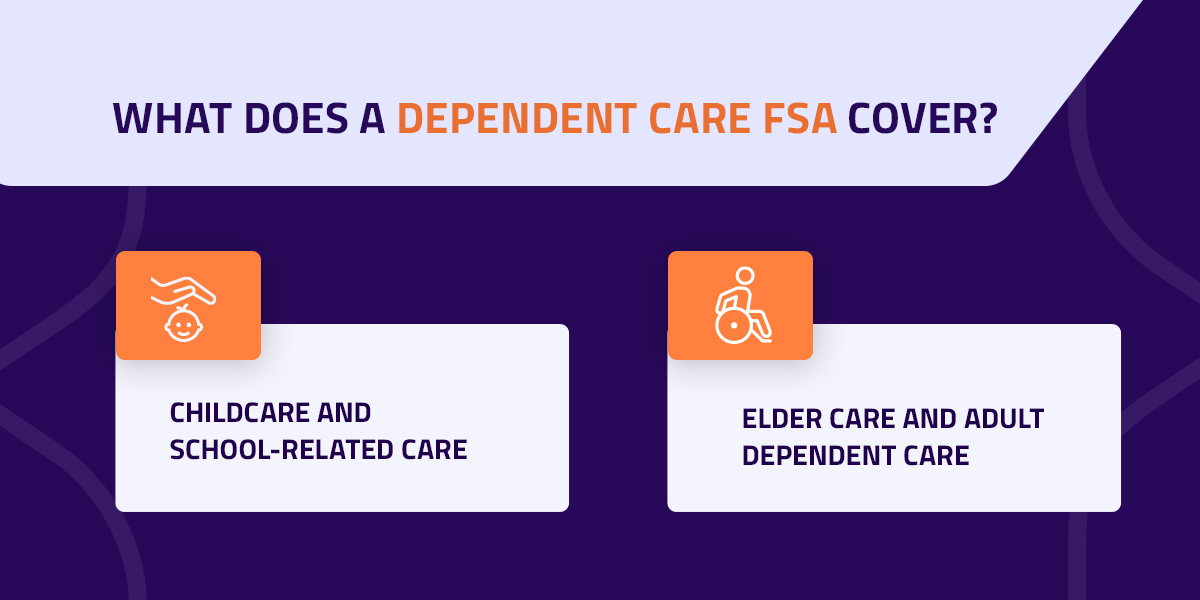
1. Childcare and School-Related Care
A dependent care FSA covers care for children under age 13 when that care allows an employee or their spouse, if filing jointly, to work or look for work. This includes licensed daycare centers, nursery school and preschool, before- and after-school programs, summer day camps, and wages paid to a nanny, au pair, or babysitter. Overnight camps and academic tutoring, however, generally fall outside the scope of what qualifies.
During open enrollment, employers should emphasize that purpose determines eligibility, not the type of care itself. For instance, a babysitter hired so a parent can work qualifies, while the same babysitter hired for a night out does not.
2. Elder Care and Adult Dependent Care
Adult dependents who are physically or mentally incapable of self-care may be covered under a dependent care FSA if they meet IRS qualifying-person rules. A spouse or relative, such as an aging parent, may qualify, but eligibility depends on factors such as residency, incapability, and dependent status. For example, an aging parent may need to live with the employee for more than half the year and meet dependent-status requirements to qualify.
Eligibility also hinges on the type of care provided. As a general illustration, care like bathing assistance or meal preparation tends to fall on the custodial side. In contrast, care such as administering medication or providing wound care tends to fall on the medical side, and IRS Publication 503 treats only the custodial portion as an eligible dependent care expense.
2026 Dependent Care FSA Contribution Limits
The dependent care FSA contribution limit changed for 2026, giving employers a new limit to consider before open enrollment. To make the higher limit available, employers need to update plan documents, payroll systems, and enrollment materials before employees can elect the increased amount.
The New $7,500 Limit Under the OBBBA
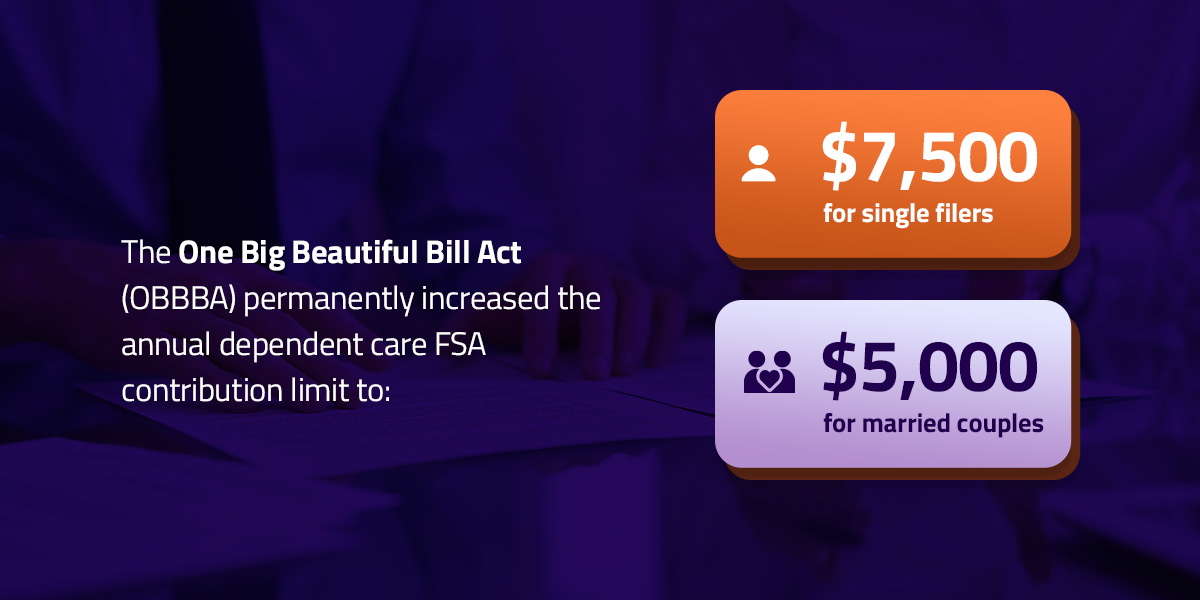
The One Big Beautiful Bill Act (OBBBA) permanently increased the annual dependent care FSA contribution limit to $7,500 for single filers and married couples filing jointly, up from $5,000. For married couples filing separately, the new limit is $3,750, up from $2,500.
Adopting the higher limit is optional, and employers who want to offer $7,500 must formally amend their plan documents before employees can use the higher limit. Without that amendment, contributions would still be capped at $5,000, even though the higher limit is legally available. The OBBBA also reshaped other pretax benefit rules that are worth reviewing alongside this change, since several related accounts were adjusted in the same legislation.
Unlike most IRS thresholds, this one is permanent and won't be adjusted for inflation. Unless Congress changes the rule, $7,500 will remain the number to plan around well past 2026.
The Earned Income and Spousal Income Rules
Beyond the contribution ceiling, several other rules affect who can use a dependent care FSA and when. These fall into three main categories:
- Eligibility: Both the employee and their spouse must have earned income during the year, with a limited exception for a spouse who is a full-time student or incapable of self-care. This requirement assumes a traditional employer-employee relationship, which is why self-employed individuals can't contribute to an employer-sponsored plan. However, they may still qualify for the Dependent Care Tax Credit independently through their tax return.
- Contribution limits: The contribution limit cannot exceed the lower of the two spouses' earned income. Whichever amount is smaller becomes the household's effective cap, regardless of the $7,500 federal maximum.
- Timing: Elections generally can't be made mid-year except in response to a Qualifying Life Event, such as a change in marital status, employment, or the number of dependents. Federal employees enrolling through FSAFEDS, for example, make this election during the annual Open Season and should plan carefully, since missing that window means waiting until the next enrollment period.
How Employers Can Offer and Fund a DCFSA
Once you understand what the benefit covers and the new limits, the next step is setup. Here's how to navigate the employer decisions involved, from plan structure to funding to ongoing compliance, each of which affects how smoothly the benefit runs once employees start using it.
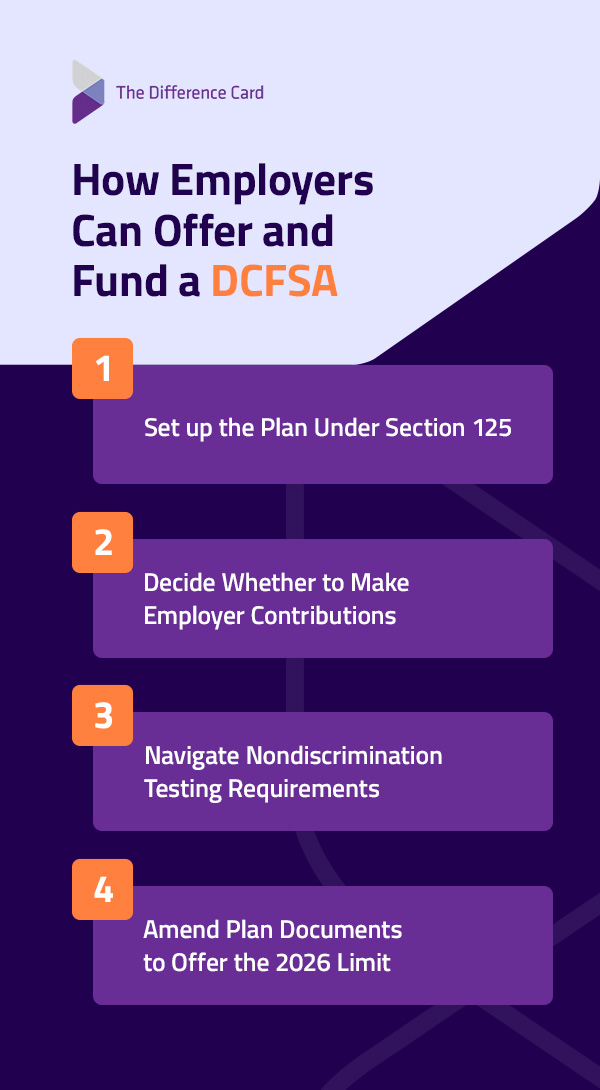
1. Set up the Plan Under Section 125
A dependent care FSA must be offered through a Section 125 cafeteria plan, the same pretax framework that governs the healthcare FSA and other elective benefits. For employers who already offer health benefits and have a Section 125 plan in place, adding a dependent care FSA often means expanding an existing structure rather than building one from scratch.
Employers without an existing Section 125 plan will need to establish one before offering a dependent care FSA. Getting there involves a few key steps:
- Draft the plan document: It must be in writing and formally adopted before it can take effect.
- Select an administrator: This partner will handle day-to-day plan operations, including claims processing and compliance testing.
- Finalize before the plan year: The plan must be in place before the start of the plan year it covers, so timing this step early helps avoid delays for employees.
With the plan document in place, employee contributions flow through payroll deductions, reducing taxable wages for both the employee and the employer. That reduction has real financial upside for employers, since the Federal Insurance Contributions Act (FICA) applies a 7.65% tax rate to employer wages, and dependent care FSA contributions are excluded from that taxable base.
2. Decide Whether to Make Employer Contributions
Employer contributions to a dependent care FSA are entirely optional. You can choose to contribute nothing, offer a flat amount, or match a portion of employees' contributions. There's no one-size-fits-all approach that works for every employer. The right approach for you will depend on your budget, your workforce demographics, and how much of a financial cushion you want to build into the benefit.
Keep in mind that any employer contribution reduces the amount employees can contribute themselves, since both count toward the same $7,500 household limit for 2026. Consequently, employees who receive an employer contribution have less room left for their own pretax election.
Employer contributions may also reduce FICA tax liability, depending on plan participation and contribution levels.
3. Navigate Nondiscrimination Testing Requirements
A dependent care FSA must pass four nondiscrimination tests under IRC Section 129 each plan year. These tests exist to confirm that the benefit doesn't disproportionately favor highly compensated employees over the rest of the workforce. The four tests are:
- Eligibility test: The plan must benefit a group of employees without discriminating in favor of highly compensated employees.
- Contributions and benefits test: Contributions and benefits under the plan cannot favor highly compensated employees over the rest of the workforce.
- More-than-5%-owners concentration test: No more than 25% of total dependent care benefits paid during the year can go to owners who hold more than a 5% stake in the company.
- Average benefits test: The average benefit provided to non-highly compensated employees must equal at least 55% of the average benefit provided to highly compensated employees.
Average benefits tests have historically been difficult to pass, but newly proposed IRS regulations, published in August 2026, could offer welcome relief if finalized. Employers should review the proposal with their plan administrator or benefits counsel to understand how it may affect dependent care FSA nondiscrimination testing.
4. Amend Plan Documents to Offer the 2026 Limit
Offering the new $7,500 limit isn't automatic. Employers must formally amend their Section 125 plan documents, including any dependent care provisions, before the plan can support the higher contribution ceiling. Payroll systems and open enrollment materials need to reflect the change as well, so employees understand what's actually available to them well before they need to make an election.
If your organization missed the amendment window, don't guess at next steps. Consult your plan administrator or benefits counsel to determine whether a midyear correction is possible or whether the higher limit will need to wait until the next plan year. Acting early gives you more options than waiting until enrollment materials and payroll configurations are finalized.
How a DCFSA Interacts With the Dependent Care Tax Credit
A household can't apply both the dependent care FSA exclusion and the Dependent Care Tax Credit to the same dollar of expenses. Any amount excluded through the dependent care FSA reduces the expenses eligible for the credit, dollar for dollar, so the two benefits apply separately and cannot be used for the same expense.
For example, a household with two or more qualifying dependents and $6,000 in eligible expenses that contributes $5,000 to a dependent care FSA has only $1,000 of expenses left to apply toward the credit, since the two benefits can't overlap on the same dollar. Households in higher federal tax brackets may see greater savings from a dependent care FSA than from the credit. The better option depends on income, filing status, payroll taxes, and total care expenses.
Because so many factors affect the right choice, employees should be encouraged to consult a tax advisor before deciding how to split their care expenses between the two benefits.
Dependent Care FSA vs. Healthcare FSA
While a dependent care FSA and a healthcare FSA share a similar pretax structure, they serve very different purposes and have distinct rules.
1. Coverage
A healthcare FSA reimburses medical, dental, and vision expenses, from copays to prescription costs and orthodontia. A dependent care FSA reimburses childcare and adult dependent care costs. The two accounts don't overlap in what they cover, so one can't substitute for the other, even temporarily.
Because they serve separate purposes, a dependent care FSA and a healthcare FSA can be offered and used simultaneously. An employee with both young children and ongoing medical expenses can maintain both accounts at once, with each account having its own election, balance, and eligible expense category.
2. Funding and Access
The two accounts also differ in how funds become available throughout the plan year. A healthcare FSA makes the full annual election available to the employee on day one of the plan year, regardless of how much has actually been contributed through payroll deductions at that point.
In contrast, a dependent care FSA only reimburses what has actually been contributed to date. As a result, an employee can't draw against funds that haven't yet been deducted from their paycheck, no matter how urgent the expense. This distinction matters most for employees planning major expenses early in the plan year, such as summer camp deposits or lump-sum payments to a new care provider.
3. Carryover, Grace Period, and Use-It-or-Lose-It Rules
Both account types are subject to a strict use-it-or-lose-it spending rule, but the flexibility employers can offer varies by account type. Here's how they differ:
- Use-it-or-lose-it: Both a healthcare FSA and a dependent care FSA require employees to forfeit any unused funds at the end of the plan year unless the employer provides additional flexibility.
- Carryover: Employers can soften the healthcare FSA rule by allowing employees to carry over a limited amount of unused funds into the next plan year, but this option doesn't extend to a dependent care FSA.
- Grace period: A dependent care FSA does not allow carryover, though employers may be able to offer a grace period of up to two and a half months if the plan permits it.
Partner With The Difference Card for DCFSA Administration

Offering a dependent care FSA can be a practical way to help employees save on eligible care expenses, but the setup and compliance details matter. The Difference Card has helped employers build cost-effective benefits packages since 2001, with the Difference Benefits Admin System supporting plan setup, nondiscrimination testing, and claims administration. With claims typically processed within two business days and a dedicated account manager for every client, this system is designed to simplify ongoing administration for your team.
Ready to offer a dependent care FSA that works for your workforce and your bottom line? Contact us today to request a proposal.