
The Impact of the One Big Beautiful Bill Act on HSA and FSA Benefits

Table of Contents
The One Big Beautiful Bill Act (OBBBA) significantly reshapes U.S. healthcare savings. It makes the most substantial update to health savings account (HSA) and flexible spending account (FSA) benefits in over a decade. The OBBBA revises eligibility, contribution limits, and plan design for employers, brokers, and benefit administrators. It also expands access and flexibility for employees amid rising healthcare and dependent care costs.
Here is The Difference Card's explanation of the OBBBA's impact on HSA and FSA benefits. Find out how this creates new opportunities for tax-advantaged savings, especially for families managing child care costs and individuals relying on telehealth or nontraditional care models.
How the OBBBA Is Impacting HSA and FSA
Signed into law in late 2025, the OBBBA broadly addresses healthcare affordability by updating multiple account-based programs. This includes expanded HSA eligibility and a permanent increase in the dependent care FSA reflecting modern child care and eldercare costs.
At a high level, the law focuses on three goals. First, it removes barriers that exclude people from using telehealth and alternative care models. Second, it recognizes lower-cost insurance options as compatible with an HSA. Third, it increases tax-advantaged savings for working families.
Legislatively, the OBBBA amends the Internal Revenue Code sections governing HSA and FSA benefits. IRS Notice 2026-5 clarifies implementation details, provides operational guidance, defines key terms, and offers transition relief. Employers should review both, as the notice addresses practical questions the statute leaves unanswered.
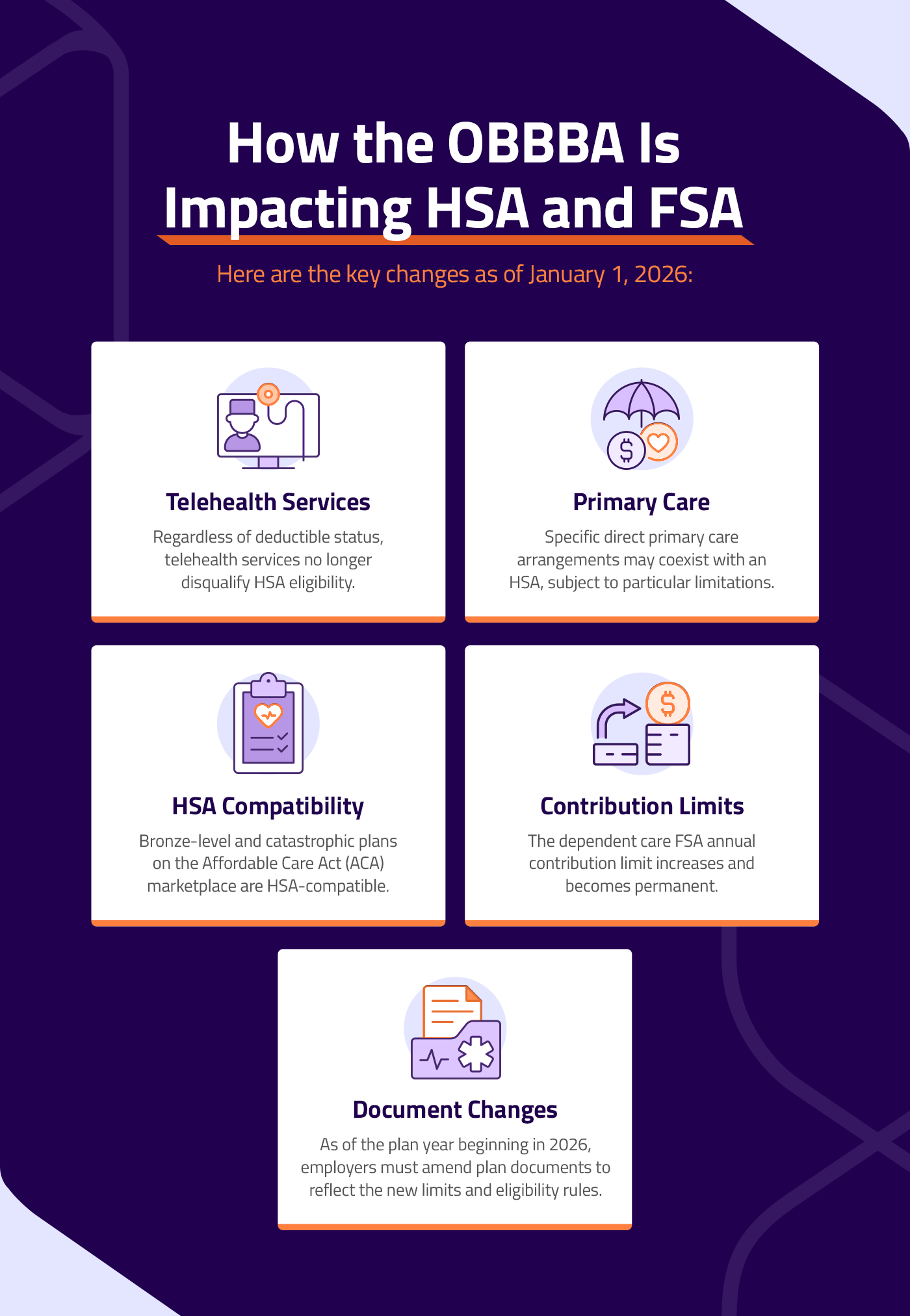
Here are the key changes as of January 1, 2026:
- Telehealth services: Regardless of deductible status, telehealth services no longer disqualify HSA eligibility.
- Primary care: Specific direct primary care arrangements may coexist with an HSA, subject to particular limitations.
- HSA compatibility: Bronze-level and catastrophic plans on the Affordable Care Act (ACA) marketplace are HSA-compatible.
- Contribution limits: The dependent care FSA annual contribution limit increases and becomes permanent.
- Document changes: As of the plan year beginning in 2026, employers must amend plan documents to reflect the new limits and eligibility rules.
This scope redefines how employers design benefit plans, how producers advise clients, and how administrators configure systems. Expanded eligibility increases participation, potentially shifting contribution patterns and testing outcomes for annual nondiscrimination FSA testing. While higher dependent care limits increase FSA value, they also elevate compliance stakes. It is crucial to ensure the plan does not disproportionately benefit highly compensated employees in terms of eligibility and participation rates.
The OBBBA encourages a shift in benefits philosophy from merely offering standard plans to designing a holistic ecosystem. This shift means prioritizing employee well-being through integrated preventive, virtual, and primary care options. It can become a significant differentiator in talent acquisition and retention.
As you move into the specific provisions, it becomes clear that the OBBBA is not a simple adjustment. It is a structural update that rewards proactive planning and penalizes inattention.
Expanded HSA Eligibility Under IRS Notice 2026-5
One of the most significant elements of the OBBBA is the expansion of HSA eligibility. In the past, strict rules limited access based on plan design and first-dollar coverage. IRS Notice 2026-5 relaxes several of those constraints while preserving the core principle that HSA benefits pair with high-deductible coverage. The notice focuses on three core areas:
- Direct primary care (DPC)
- Telehealth
- Health plan design
The notice clarifies that specific services and plan types no longer disqualify individuals from HSA contributions. This change illustrates the growth in care delivery, particularly since 2020. It also acknowledges that affordability does not always mean higher deductibles alone.
Expanded eligibility means more employees can open and fund an HSA. It also means employers must reassess who qualifies, how they communicate eligibility, and how payroll systems track these contributions.
Direct Primary Care Integration
DPC, an alternative to traditional fee-for-service models, historically raised HSA eligibility concerns due to monthly fees potentially being disqualifying coverage. Now, individuals remain HSA-eligible even if their health plan offers first-dollar coverage for telehealth services, regardless of the preventive care relationship.
The OBBBA introduces a new rule that allows limited DPC integration in HSA benefits. IRS Notice 2026-5 permits DPC arrangements that meet criteria such as a capped monthly fee or a defined scope of services. DPC cannot provide coverage beyond primary care services, and the monthly fee must remain within statutory limits. While it may cover:
- Primary care visits
- Preventive services
- Basic diagnostic services
Ancillary services, such as labs or imaging, and hospitalization are still subject to the deductible to preserve HSA eligibility. For example, a DPC arrangement capped at $150 a month may cover unlimited primary care visits, in-office labs such as strep tests, and basic health screenings. However, advanced diagnostics such as an MRI, specialist consultation, or emergency care still fall under the high-deductible health plan (HDHP) deductible.
The caveat is documentation. Employers and administrators must confirm that DPC arrangements meet IRS criteria. Without that diligence, participants risk losing their HSA eligibility.
This change opens the door for innovative plan designs. Employers can offer DPC with high-deductible plans to boost access and satisfaction. Producers should help clients carefully review vendor contracts to avoid unintended disqualification.
Telehealth Safe Harbor Permanency
Telehealth coverage was a recurring issue for HSA eligibility. Temporary relief measures allowed pre-deductible telehealth without disqualifying participants, but those measures required repeated extensions.
The OBBBA establishes telehealth as a permanent safe harbor. According to IRS Notice 2026-5, plans can offer pre-deductible telehealth services — including behavioral health and primary care consultations — without affecting HSA eligibility. This provides employees with straightforward early access to telehealth, without sacrificing HSA contributions, while giving employers long-term certainty in virtual care plan design.
Individuals remain HSA-eligible even if their health plan offers first-dollar coverage for telehealth services, regardless of whether these services relate to preventive care. This change reflects how people access care, as telehealth is often the first point of contact for:
- Mental health services
- Chronic condition management
- Non-urgent care visits
This permanency also supports cost control, as telehealth often replaces higher-cost visits, diverts from emergency care, reduces associated costs, and saves on time away from work. By pairing telehealth with HSA benefits, plans encourage early intervention while preserving tax advantages.
Bronze and Catastrophic Plan Eligibility
Another notable expansion involves insurance plan design. Previously, only certain high-deductible health plans qualified for HSA benefits. The OBBBA recognizes that some bronze and catastrophic plans function similarly from a cost-sharing perspective.
According to IRS Notice 2026-5, specific bronze and catastrophic plans qualify as HSA-compatible if they meet the revised deductible and out-of-pocket expense criteria. This change acknowledges the role of lower-premium plans in the individual and employer markets. For employees, it means more choice. You can select a lower-cost plan and still enjoy HSA contributions. For employers, it creates flexibility in offering tiered coverage without excluding HSA participation.
This expansion may increase HSA adoption among younger or generally healthier populations. Over time, broader participation can strengthen the overall value proposition of an HSA as a long-term savings vehicle.
Dependent Care FSA: The $7,500 Leap
While HSA benefits get a lot of the attention, the dependent care FSA (DCFSA) update may have the most immediate impact on working families. The OBBBA permanently increases the annual contribution limit to $7,500 per household, a significant leap from the previous cap.
This change reflects the rising costs of child care, after-school programs, and eldercare. A higher limit lets families set aside more pre-tax dollars to cover essential expenses. While the DCFSA offers immediate pre-tax savings, the dependent care tax credit may be more beneficial for lower-income families or those with significant care expenses that exceed the FSA limit. A quick calculation based on your household income and care costs during open enrollment can help you determine the optimal choice.
Unlike temporary increases, the new limit is permanent. Employers can design plans with confidence, and employees can plan contributions without worrying about future rollbacks.
Economic Impact
The $7,500 limit increase reduces taxable income, boosting take-home pay. This offers substantial savings for higher-tax-bracket families and helps moderate-income households offset rising care costs.
From a workforce perspective, access to affordable care closely ties into:
- Employee retention
- Reduced absenteeism
- Improved productivity
The FSA increase also signals employer commitment to family-friendly policies. It gives employers a tangible way to support working parents and caregivers without increasing wages.
Administrators can expect higher participation rates. As the benefit grows more valuable, more employees will enroll. Employers may need to improve communication and enrollment tools.
Consider conducting an internal audit of the existing benefits communication strategy to ensure all employee segments are reached effectively. A targeted approach, using a combination of short videos, interactive FAQs, and personalized emails, can help employees fully understand these changes and make informed decisions.
Tax Credit Interaction
The dependent care FSA increase also interacts with the dependent care tax credit. Employees must choose how to allocate expenses between the FSA and the credit, as the same costs cannot be used for both. IRS Notice 2026-5 reiterates the coordination rules and emphasizes the importance of education. Employers and producers play a key role in helping employees understand trade-offs. In many cases, maximizing the FSA yields greater immediate savings — however, individual circumstances vary.
Clear guidance reduces confusion and prevents adverse tax outcomes. Simple examples and calculators can help employees make informed decisions during open enrollment.
How the OBBBA Is Impacting HSA and FSA Administration
The OBBBA reshapes HSA and FSA administration by shifting how employers govern plans, manage risk, and communicate with participants. While IRS Notice 2026-5 offers crucial guidance, the dynamic nature of healthcare legislation means plan sponsors should remain vigilant for potential future clarifications or amendments, especially as new care models emerge or economic conditions shift, and as contribution limits change.
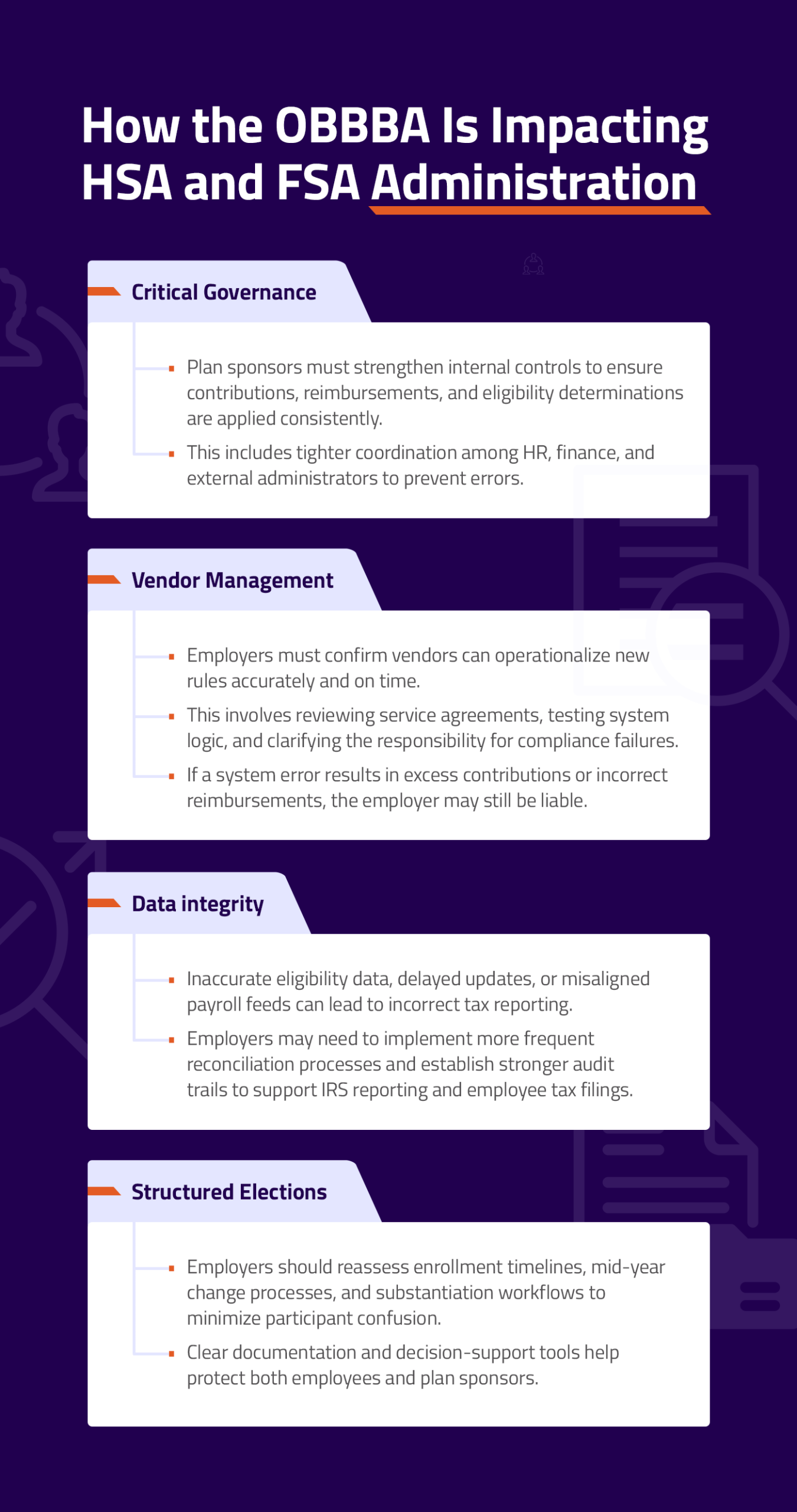
Even when eligibility rules are clear, administration becomes more complex as flexibility increases:
- Critical governance: With broader participation, employers face greater scrutiny from regulators and auditors. Plan sponsors must strengthen internal controls to ensure contributions, reimbursements, and eligibility determinations are applied consistently. This includes tighter coordination among HR, finance, and external administrators to prevent errors.
- Vendor management: The OBBBA accelerates third-party administrator reliance. Employers must confirm vendors can operationalize new rules accurately and on time. This involves reviewing service agreements, testing system logic, and clarifying the responsibility for compliance failures. If a system error results in excess contributions or incorrect reimbursements, the employer may still be liable.
- Data integrity: Higher contribution limits and more participation increase the risk of data errors. Inaccurate eligibility data, delayed updates, or misaligned payroll feeds can lead to incorrect tax reporting. Employers may need to implement more frequent reconciliation processes and establish stronger audit trails to support IRS reporting and employee tax filings.
- Structured elections: As accounts become more valuable, election errors carry higher stakes. Employers should reassess enrollment timelines, mid-year change processes, and substantiation workflows to minimize participant confusion. Clear documentation and decision-support tools help protect both employees and plan sponsors.
OBBBA-era administration requires continuous monitoring as regulatory guidance and participation trends now demand regular review to avoid compliance drift over time. In practice, the OBBBA pushes HSA and FSA administration from a transactional function into a governance discipline. Employers who invest in stronger processes, more transparent accountability, and proactive oversight are better positioned to manage risk while delivering meaningful benefits to employees.
Navigating 2026 Compliance
The OBBBA and IRS Notice 2026-5 bring both opportunity and responsibility. They expand access to HSA benefits, provide meaningful relief for dependent care costs, and modernize the rules governing benefits. At the same time, they demand careful implementation with ongoing education.
For producers, the changes reinforce the value of strategic guidance. Clients need clear expectations, realistic timelines, and hands-on support with plan design and amendments. Making small adjustments early can prevent costly corrections later and help employees feel confident in using their benefits.
The 2026 transition is a shift to align benefits with the way people live and work today. With the right professional support, the OBBBA can strengthen benefit strategies while helping families manage healthcare and care-related expenses with confidence.