

What Is the Difference Between an HSA and an HRA?

Table of Contents
Lowering healthcare costs and getting clear answers are top priorities. While both a health savings account (HSA) and a health reimbursement arrangement (HRA) offer tax advantages, they operate very differently. Selecting the right option can save you thousands annually in taxes, premiums, and out-of-pocket expenses. To find the answer, you need to understand the difference between an HSA and an HRA.
This comprehensive guide from The Difference Card explains how an HSA and an HRA impact your finances, savings, and long-term security.
Key Takeaways
In 2025, the average single deductible for employer-sponsored health plans exceeded $1,886, up just over $100 from the previous year. How you fund these costs matters, and choosing the right way to fund starts with these key takeaways:
- An HSA is an employee-owned savings account tied to a qualified HDHP.
- An HRA is an employer-funded reimbursement arrangement, controlled by the employer.
- Plan design determines whether you can maximize savings or reduce short-term risk.
- The right plan structure depends on usage, workforce demographics, and long-term financial goals.
What Is an HSA?
An HSA is a personal health savings account that works like a bank account for medical expenses. You own and control it, and the funds stay with you even when you leave your job.
To open and contribute to an HSA, you must enroll in a qualified high-deductible health plan (HDHP). The IRS sets strict eligibility and contribution rules each year. Here's how it works:
- You enroll in an HSA-qualified HDHP.
- You or your employer contributes pretax dollars into your HSA.
- You use the funds to pay for eligible medical expenses.
- Unused funds roll over year after year.
An HSA is more than a spending account. It can serve as a long-term investment vehicle. After age 65, you can withdraw funds for nonmedical expenses without a penalty. You pay ordinary income tax, similar to a 401(k), and withdrawals for qualified medical expenses are tax-free at any age.
The Triple Tax Advantage
An HSA offers three distinct tax benefits:
- Your pretax contributions reduce your taxable income.
- Your interest and investment gains are tax-free.
- Withdrawals for qualified medical expenses are tax-free.
This unique triple tax advantage can reduce federal, state, and FICA taxes for many households.
Eligibility Rules
To contribute to an HSA, you must meet these criteria:
- Not be enrolled in Medicare
- Be enrolled in an IRS-qualified HDHP on the first day of the month
- Have no other disqualifying coverage, including most general-purpose HRA setups
- Not be claimed as a dependent on someone else's tax return
The IRS defines an HDHP as a plan with a minimum deductible of $1,650 for self-only coverage and $3,300 for family coverage. Your out-of-pocket maximums can't exceed $8,300 for self-only and $16,600 for family coverage.
2026 Contribution Limits
The IRS set these HSA contribution limits for 2026 — these limits include both employer and employee contributions combined:
- $4,400 for self-only coverage
- $8,750 for family coverage
- An additional $1,000 catch-up contribution for those aged 55 and older
If you maximize contributions annually and invest consistently, an HSA can act as your 401(k) for healthcare. After age 65, you can withdraw funds for nonmedical expenses without penalty, though you will pay income tax. Fidelity reported that a 65-year-old couple retiring today may need over $345,000 for healthcare costs in retirement. An HSA can help you prepare for this.
What Is an HRA?
An HRA is an employer-funded reimbursement arrangement. It's not a bank account you own, but rather a promise from your employer to reimburse eligible medical expenses. You can't contribute your own money to a traditional HRA — only the employer funds it. This means the employer decides:
- How much to contribute.
- Which expenses qualify.
- Whether unused funds roll over.
When you have an eligible expense, you submit documentation and your employer reimburses you, tax-free.
Types of HRA
There are several forms of HRA, each serving a specific strategy:
- Integrated HRA pairs with a traditional group health plan.
- Individual coverage HRA (ICHRA) reimburses premiums for individual market coverage.
- A qualified small employer HRA (QSEHRA) is available to employers with fewer than 50 full-time employees.
- Excepted benefit HRA covers limited benefits, such as dental or vision.
- Limited-purpose HRA only covers dental and vision, and is often paired with an HSA.
- Post-deductible HRA reimburses expenses after the HDHP deductible is met.
- Retiree HRA funds health expenses in retirement.
Why Employers Choose an HRA
Employers use an HRA to control plan costs by shifting all risk to employees. The HRA allows employers to:
- Set predictable reimbursement limits.
- Offset high deductibles.
- Encourage consumer engagement.
- Reduce premium spend.
The HRA also increases plan flexibility, allowing employers to design incentives that encourage cost-conscious healthcare use. In 2025, employers continued to face medical trend rates between 6.7% and 7.7% annually. An HRA offers a structured way to manage these increases.
What Happens to the Money if I Leave?
In most cases, your HRA funds stay with your employer after you leave. The employer owns the arrangement, so unused funds typically revert back to them. Some retiree HRA programs allow continued access after separation, but this depends on the plan's design.
Ownership is the defining difference between an HSA and an HRA.
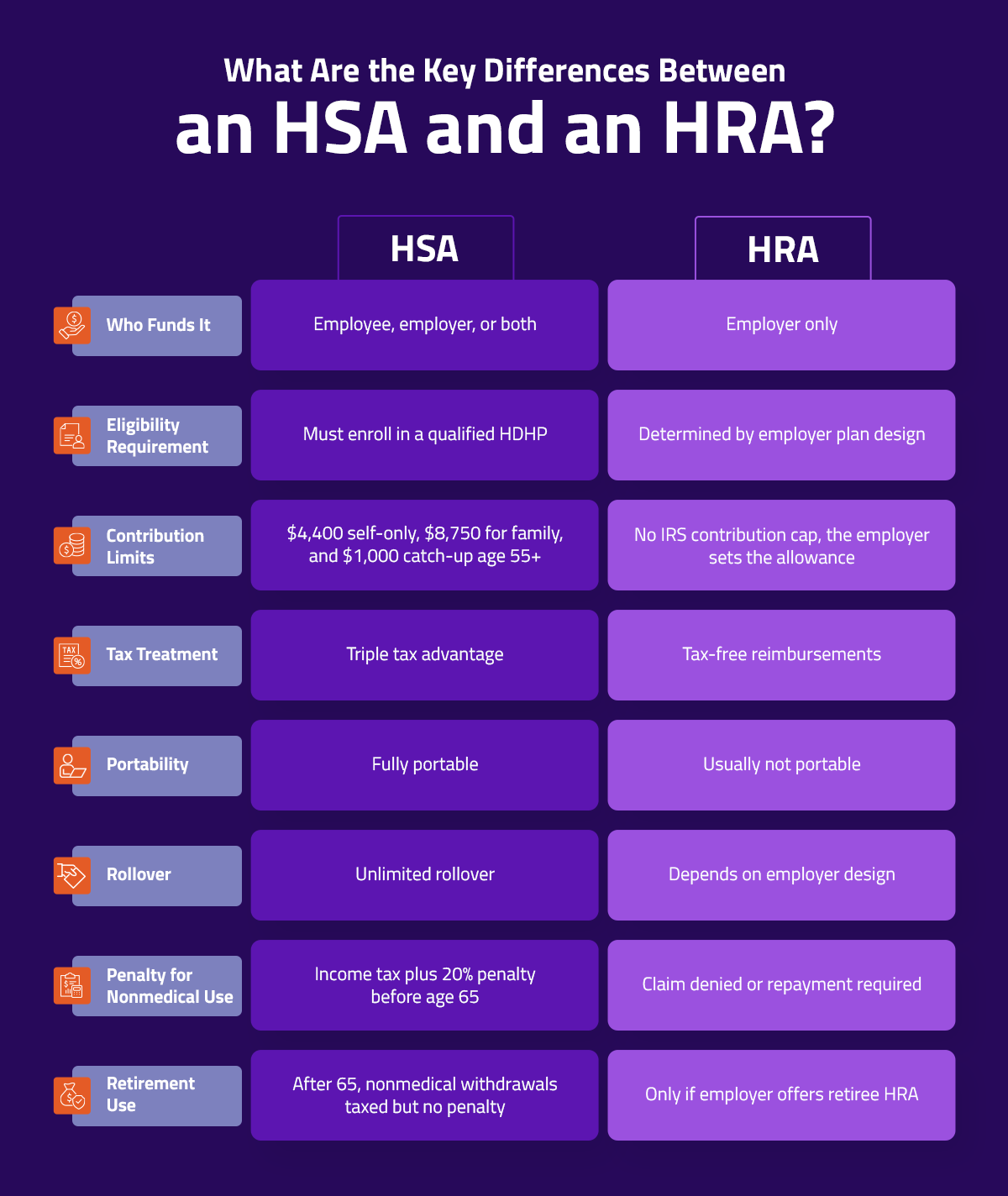
At a basic level, an HSA is employee-owned and portable. An HRA is employer-owned and reimburses expenses, but it's the details that determine whether you can contribute to, invest in, or combine these accounts.
Understanding specialized HRA designs is critical if you want to stay HSA-eligible:
- Limited-purpose HRA: A limited-purpose HRA only reimburses dental and vision expenses, preserving your HSA eligibility. This structure works well if you want to maximize HSA contribution while getting employer support for routine dental and vision care.
- Post-deductible HRA: A post-deductible HRA reimburses medical expenses, but only after you meet the IRS minimum HDHP deductible. This design protects you from catastrophic costs while encouraging responsible use of health services.
- Retiree HRA: A retiree HRA helps fund health expenses after employment ends. Employers may credit a fixed dollar amount each year of service, often reimbursing Medicare premiums, supplemental coverage, and out-of-pocket medical costs.
This table shows the clear distinction, including how an HSA supports long-term savings and an HRA focuses on short-term predictability:
| Type of Plan | HSA | HRA |
| Who Funds It | Employee, employer, or both | Employer only |
| Eligibility Requirement | Must enroll in a qualified HDHP | Determined by employer plan design |
| Contribution Limits | $4,400 self-only, $8,750 for family, and $1,000 catch-up age 55+ | No IRS contribution cap, the employer sets the allowance |
| Tax Treatment | Triple tax advantage | Tax-free reimbursements |
| Portability | Fully portable | Usually not portable |
| Rollover | Unlimited rollover | Depends on employer design |
| Penalty for Nonmedical Use | Income tax plus 20% penalty before age 65 | Claim denied or repayment required |
| Retirement Use | After 65, nonmedical withdrawals taxed but no penalty | Only if employer offers retiree HRA |
Eligible Expenses
Both HSA and HRA rely on IRS Section 213(d) to define eligible medical expenses. This section covers costs for disease diagnosis, treatment, mitigation, or prevention. Common eligible expenses include:
- Doctor visits.
- Hospital services.
- Prescription medications.
- Mental health therapy.
- Physical therapy.
- Durable medical equipment.
Many people overlook other eligible categories, which may include:
- Menstrual care products.
- Certain over-the-counter medications.
- Smoking cessation programs.
- Substance use disorder treatment.
- Hearing aids and batteries.
Cosmetic procedures generally aren't eligible unless they're medically necessary.
With an HSA, if you use funds for nonmedical costs before age 65, nonmedical withdrawals trigger income tax plus a 20% penalty. After age 65, you only pay income tax. With an HRA, nonqualified expenses aren't reimbursed, and improper reimbursements can create taxable income or compliance risks for employers.
Which Is Better for You?
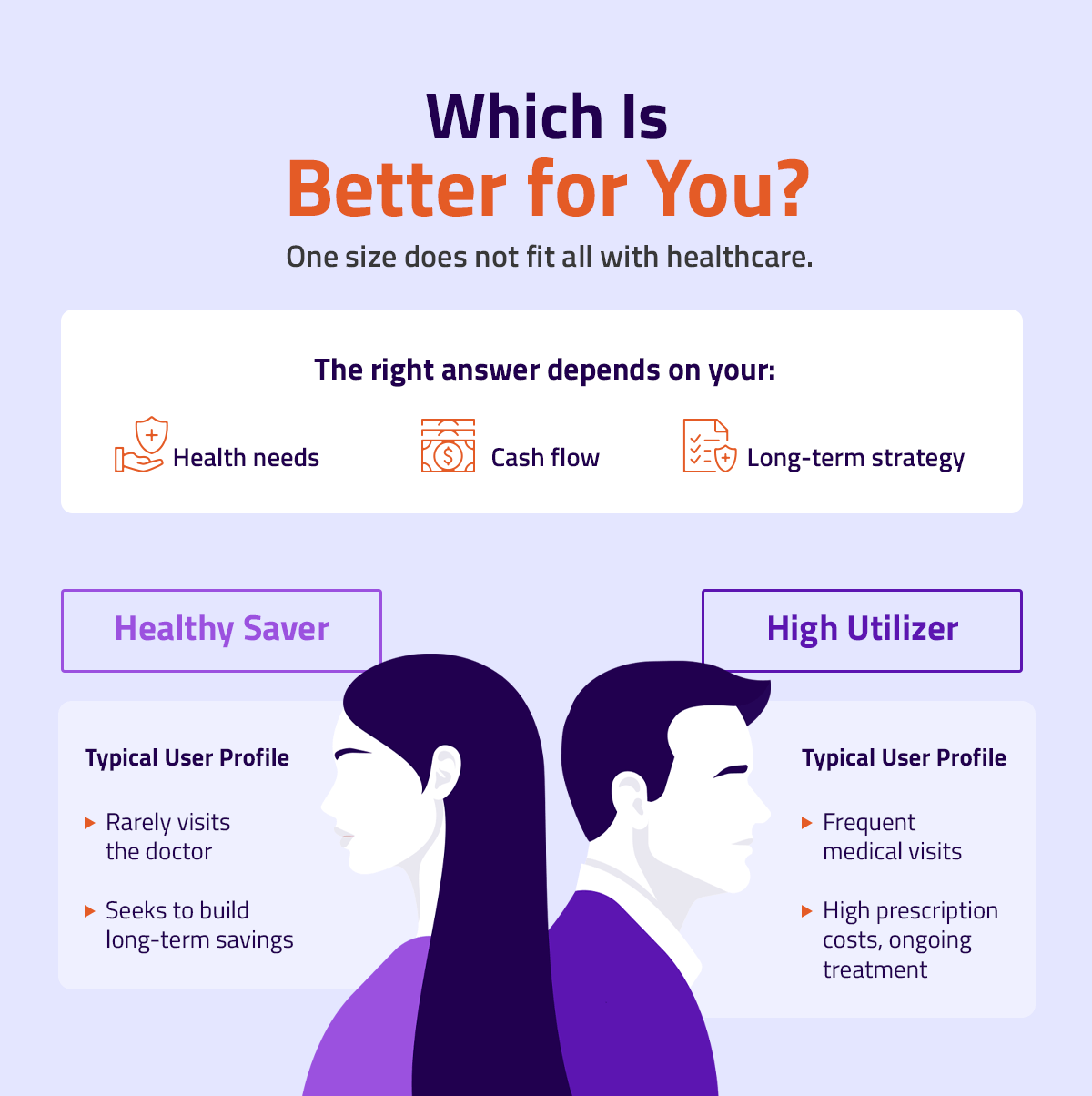
One size does not fit all with healthcare. The right answer depends on your health needs, cash flow, and long-term strategy. You should factor in the total cost of care, including deductibles. This means considering that:
- HDHP typically has lower premiums.
- Employer HRA funding can offset your higher deductibles.
- The total cost of coverage consists of your premiums plus any out-of-pocket expenses.
In simpler terms, are you focused on saving, or do you expect to use your medical savings much more?
The "Healthy Saver"
If you rarely visit the doctor and want to build long-term savings, an HSA paired with a qualified HDHP may offer the most benefit. With this strategy, you can lower taxable income, invest unused balances, and accumulate funds for retirement health costs. Over time, compounded growth can offset future premiums and Medicare expenses.
A healthy saver who contributes the maximum to the family annually and earns moderate investment returns can accumulate a sizeable amount in their HSA over a decade.
The "High Utilizer"
If you expect frequent medical visits, high prescription costs, or ongoing treatment, an HRA-funded plan can give you more predictable support. It can offset high deductibles, reduce immediate out-of-pocket exposure, and stabilize cash flow during high-cost years. For families managing chronic conditions, structured employer reimbursement often delivers stronger year-to-year value.
High utilizers often value stable copays and first-dollar coverage over a long-term tax strategy.
Can I Have Both an HSA and an HRA?
Yes, you can have both, but only if the HRA is HSA-compatible. The IRS restricts HSA contributions if you have disqualifying coverage, so you are looking at an HRA with an HDHP, which is generally structured in one of these ways:
- As a general-purpose HRA, it reimburses your qualifying medical expenses up to a set annual limit during any time of the plan year.
- As a post-deductible HRA, reimbursements are only available after your claims hit a set dollar amount.
- As a limited-purpose HRA, reimbursements are available immediately for limited-scope dental and vision expenses up to a set amount.
Each structure avoids interfering with HSA eligibility because it does not offer first-dollar medical coverage under the IRS deductible threshold. You generally can't contribute to an HSA if you are covered by a general-purpose HRA that reimburses first-dollar medical expenses. This means that coordination is essential. Misalignment can trigger IRS compliance issues.
You cannot contribute to an HSA if:
- You are covered by a general-purpose HRA that reimburses medical expenses before meeting the HDHP deductible.
- You are enrolled in Medicare.
- You have other non-HDHP coverage that pays primary medical benefits.
In these cases, even partial-month disqualification can reduce your annual HSA contribution limit.
Why Coordination Matters
Improper coordination creates compliance risk. Excess HSA contributions trigger IRS penalties until you correct them. Employers must structure an HRA carefully to avoid unintended consequences.
Strategic integration gives you the long-term tax benefits of an HSA while you use an HRA to manage specific costs. This approach supports both healthy savers and high utilizers while keeping you compliant. When designed correctly, the combination will strengthen your financial outcomes and offer your employer better cost predictability. Precision in plan design determines success.
What Is a MERP?
A medical expense reimbursement plan (MERP) is a structured employer reimbursement strategy that often resembles an HRA but can operate alongside a level-funded or self-funded health plan. A MERP reimburses specific costs, such as a corridor deductible. It creates blended funding that reduces premium equivalents while protecting you from high out-of-pocket exposure.
Ownership Is Key
Healthcare financing is complex, with rising premiums, increased deductibles, and regulatory shifts that require disciplined planning. When you understand the difference between health savings plans, you move from confusion to control.
With an HSA, you control the account and decide when to spend or invest. The balance rolls over every year, staying with you through job changes and into retirement. With an HRA or a MERP, your employer controls the structure and funding, providing short-term support but limited portability. This distinction shapes behavior, savings rates, retirement planning, and workforce satisfaction.
The right partner is critical to choosing the right plan. A service provider helps you evaluate plan performance with real data, examining corridor deductibles, aggregate exposure, stop-loss integration, and reimbursement patterns. The result is a recommendation that aligns with your needs, reduces costs, and keeps you compliant.