


How to Choose the Right Healthcare Provider: Tips and Tools
Key Takeaways A Quick Summary
Key Takeaways
- Choosing the right healthcare provider is essential for members (accessibility, affordability, timely care) and employers (lower absenteeism, improved employee well‑being, potential cost reductions).
- Healthcare providers include primary care physicians, specialists, hospitals/urgent care, telehealth/virtual providers and integrated providers that coordinate multiple services.
- Follow a four‑step selection process: (1) identify needs and priorities (cost, coverage, location, languages, out‑of‑hours, specialists), (2) build a short list (insurer directory, recommendations, reviews), (3) evaluate candidates (customer reviews, credentials, communication, cultural competence, insurance compatibility), (4) verify suitability (confirm coverage with insurer and schedule a test appointment).
- Use tools and data sources to compare providers—e.g., Difference Card’s PLUM, CMS Care Compare, state reports, patient review sites, price‑comparison tools—and check key accreditations like NCQA, The Joint Commission and URAC.
- Watch for red flags (high staff turnover, unclear billing, limited services, poor coordination, negative reviews, high infection rates) and consider integrated providers for broader services, better coordination, higher satisfaction and potential cost savings.
Choosing a healthcare provider can be challenging, as there are many factors to consider and options available to you. However, narrowing down your options is necessary to get the high-quality healthcare you need.
Fortunately, with the right knowledge and tools, you can find the ideal healthcare provider for your needs. Explore practical tips and strategies to make the right decision in this guide.
Why It's Important to Choose the Right Healthcare Provider
Selecting an appropriate healthcare provider is always important, but the reasons for this will depend on whether you're a member or an employer.
Members
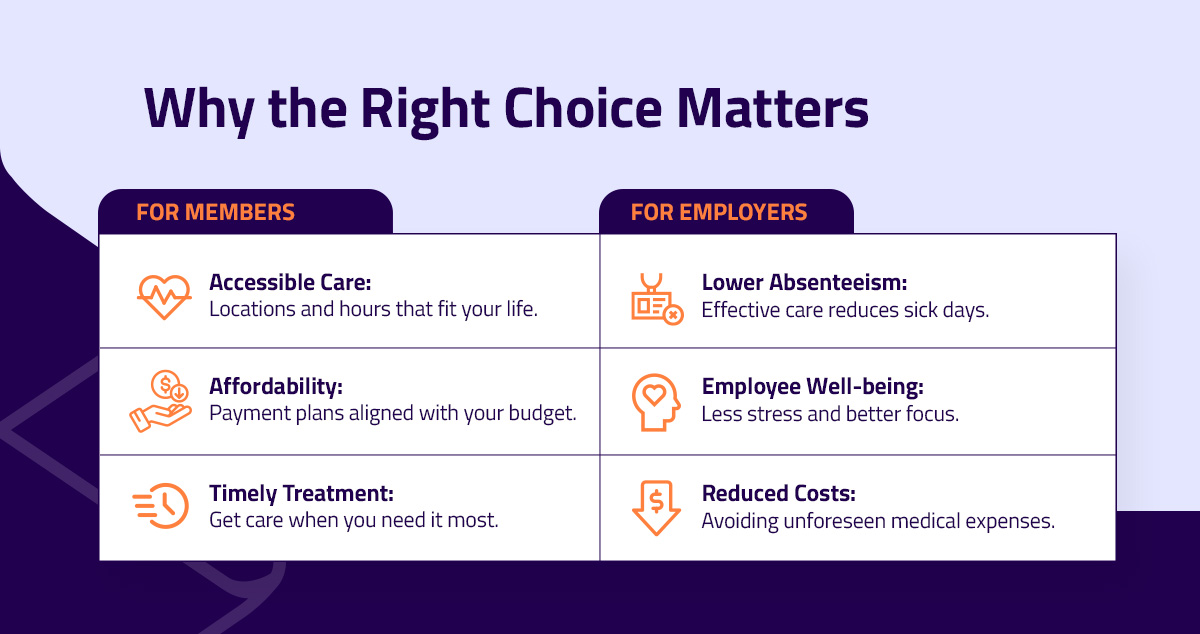
Choosing a suitable healthcare provider is essential to receiving healthcare that meets all your needs, including accessible care. Whether it's because of the location, opening hours, or other factors, you can't receive the healthcare you need if you can't access your provider.
Your healthcare also needs to be affordable. Medical care can be expensive, so it's vital to find a provider who offers services and payment plans that align with your budget and healthcare needs.
By choosing a provider who meets these criteria, you can get treatment when you need it most.
Employers
Many employers offer healthcare benefits to their employees. Since employees rely on receiving the correct healthcare, it's important for their sakes that employers choose the right provider.
The choice of healthcare provider can massively impact the employer, too. Employers who choose a good healthcare provider for their employees can:
- Lower absenteeism: When employees have access to effective healthcare, they are often less likely to take time off work for sickness.
- Improve employee well-being: Employees who don't have to worry about the cost of healthcare experience less stress and can better focus on their work.
- Reduce costs: The cheapest healthcare provider isn't always the most cost-effective choice for employers. The wrong healthcare provider can mean unforeseen costs or increased employee absenteeism.
Who Classes as a Healthcare Provider?
A healthcare provider is any organization or person who provides medical services. The type that many people are most familiar with is a primary care physician (PCP). This doctor provides nonurgent medical care, but when further treatment or investigation is needed, they may refer you to another type of healthcare provider. Choosing the right doctor is important, as it can often determine the first steps in your medical treatment, including who they refer you to.
Specialists often receive referred patients from PCPs. These medical professionals can have various titles, depending on their area of expertise. From pediatricians and dieticians to cardiologists and dermatologists, a patient could be referred to them so they can receive a higher level of care. For urgent care, a patient may have to go directly to a hospital, another type of healthcare provider.
There are less orthodox types of healthcare providers, too. Many people, particularly those with mobility issues who may struggle to travel, prefer to receive medical advice over the phone or virtually. These telehealth and virtual care providers can deliver healthcare to those who may otherwise be unable to receive it.
An integrated healthcare provider brings together various medical professionals and facilities to deliver a range of medical services.
How to Choose a Healthcare Provider in Four Steps
Following these four steps can help ensure your next healthcare provider is right for you:
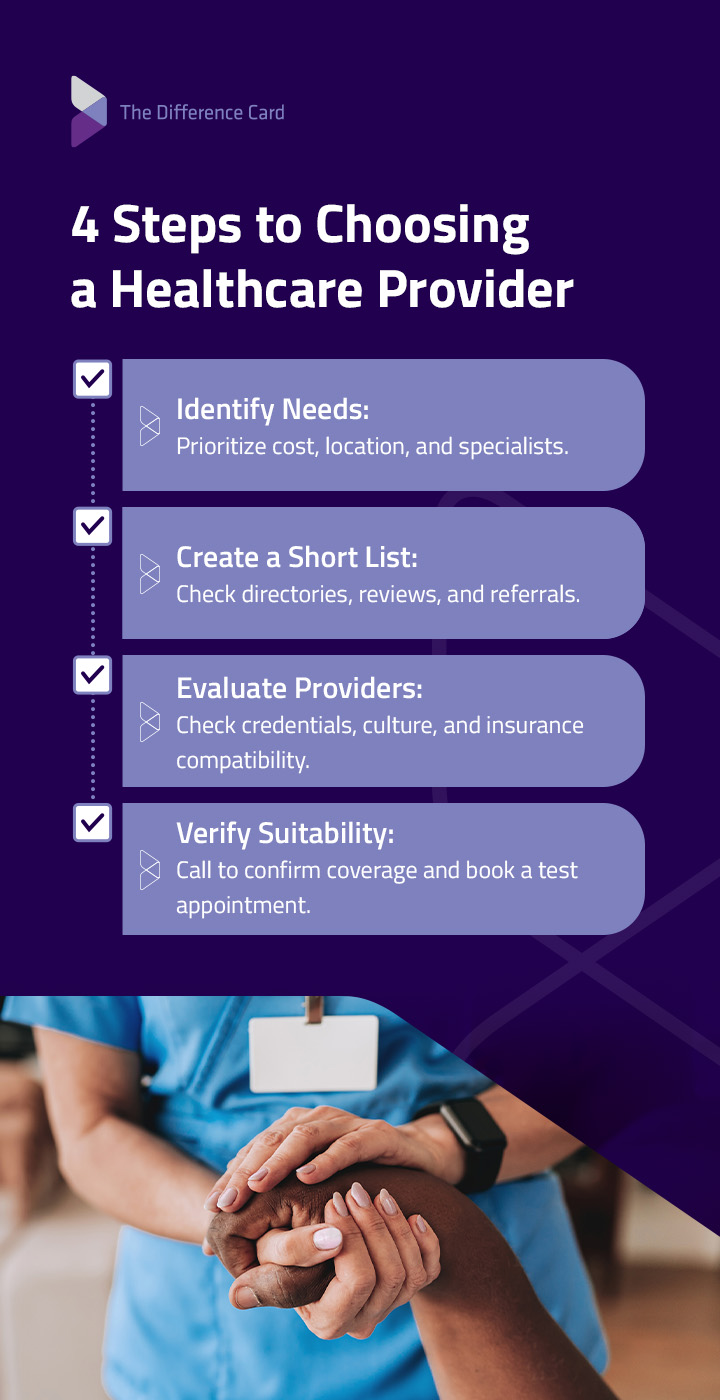
1. Identify Your Needs and Priorities
First, decide what needs your healthcare provider must meet and what your top priorities are, as these variables will affect which healthcare providers may be suitable for you. Factors that often influence the choice of healthcare provider include:
- Cost: For many people, the monthly premium and excess fees are among the main considerations.
- Coverage: Healthcare providers who offer access to a wide range of care services can be more appealing.
- Family access: If your family also needs coverage, a healthcare provider who offers family plans may be preferable.
- Specialists: If you need specialist treatment or simply want to cover all your bases, you may want a provider who offers specialized healthcare.
- Location: Most people don't want to travel far for every medical appointment, so consider where your provider operates.
- Languages: If you're not fluent in the local language, you may prefer a provider who offers services in your native language.
- Out-of-hours care: The ability to receive advice or medical attention at any time will appeal to many people.
2. Create a Healthcare Provider Short List
Next, create a list of healthcare providers who meet your criteria. First, check which healthcare providers operate in your area. You can find these by:
- Searching your insurer's directory.
- Asking friends and family for recommendations.
- Checking customer review sites.
- Searching online for healthcare providers in your area.
- Asking a PCP you trust.
- Checking your state's list of approved healthcare providers.
Keep in mind that these sources of information will simply give you the names of healthcare providers to check out. You shouldn't sign up with a healthcare provider at this stage — even if the provider was recommended to you from a trusted source, you can't yet be sure that the provider will be a good fit for you.
3. Evaluate Each Healthcare Provider
Once you've created your short list, evaluate each healthcare provider for quality, cost, access, and their claims approval rate. Your evaluation should consider:
- Customer reviews: Reading about previous customers' experiences and thoughts can help you predict what your own experience may be like with that provider.
- Provider credentials: Ensure the provider is fully licensed and has all the necessary accreditations to practice medicine in your location.
- Provider type: Find out what type of provider they are and their primary areas of specialty. Assess how this affects their ability to meet your needs and top priorities.
- Communication style: It's important that your provider's communications are clear, honest, and transparent.
- Cultural understanding: A healthcare provider's ability to understand and provide considerate healthcare to people of diverse backgrounds is vital to many people.
- Insurance compatibility: If you didn't find the provider on your insurer's directory, check whether each healthcare provider is in your insurance network.
After evaluating each healthcare provider, you should ideally have one or two prospects who stand out to you.
4. Verify Suitability
Next, verify whether your preferred healthcare providers are suitable for you. Contact your insurance provider and confirm that they cover claims from that healthcare provider. Ask whether there are any conditions that must be met, such as the location or type of treatment.
To test if a healthcare provider is truly right for you, schedule an appointment. This will give you a good idea of the provider's waiting times, communication style, and care, all before you commit to them as your long-term healthcare provider.
Employers who are considering a medical expense reimbursement plan (MERP) for their team should also research the referral process, as this will affect how their employees gain access to medical care.
When Manual Research Can Become Impractical
Considering your medical needs, researching healthcare providers, and carefully vetting your options is a highly effective way to find the right healthcare provider. However, this method is better-suited to individuals looking for their own healthcare provider. It's also a practical method for small business owners who wish to offer their small team of employees healthcare benefits.
Larger organizations may find that this method doesn't work for them due to the scale of data they have to juggle. Instead, they may need to:
- Collect information on their employees' healthcare priorities.
- Aggregate this information to decide what the team's top priorities are.
- Use automated tools to more easily find the type of provider their employees need.
Tools That Help Find the Right Healthcare Provider
Finding the right healthcare provider can involve exhaustive research, but numerous tools can help streamline the search. Comprehensive tools, such as the Difference Card's tool PLUM, are the most useful, as they can help you find relevant healthcare providers in your area and quickly give you insights into several aspects of each provider.
Alternatively, you can gather information from multiple tools to create an overall impression of each provider. This information can be gathered from:
- The Centers for Medicare and Medicaid Services (CMS), which provides a comparison tool based on various factors, from inpatient reviews to how well they treat cardiac arrests.
- State reports, which assess healthcare providers who operate in that state.
- Patient review platforms, which make it easy to see the general consensus of each provider's care.
- Price comparison and analysis tools, which help you balance quality of care and cost.
- Accreditation bodies, which provide a list of accredited organizations.
What Accreditations Should Your Healthcare Provider Have?
Three main accreditation bodies demonstrate a healthcare provider's dedication to excellent services.
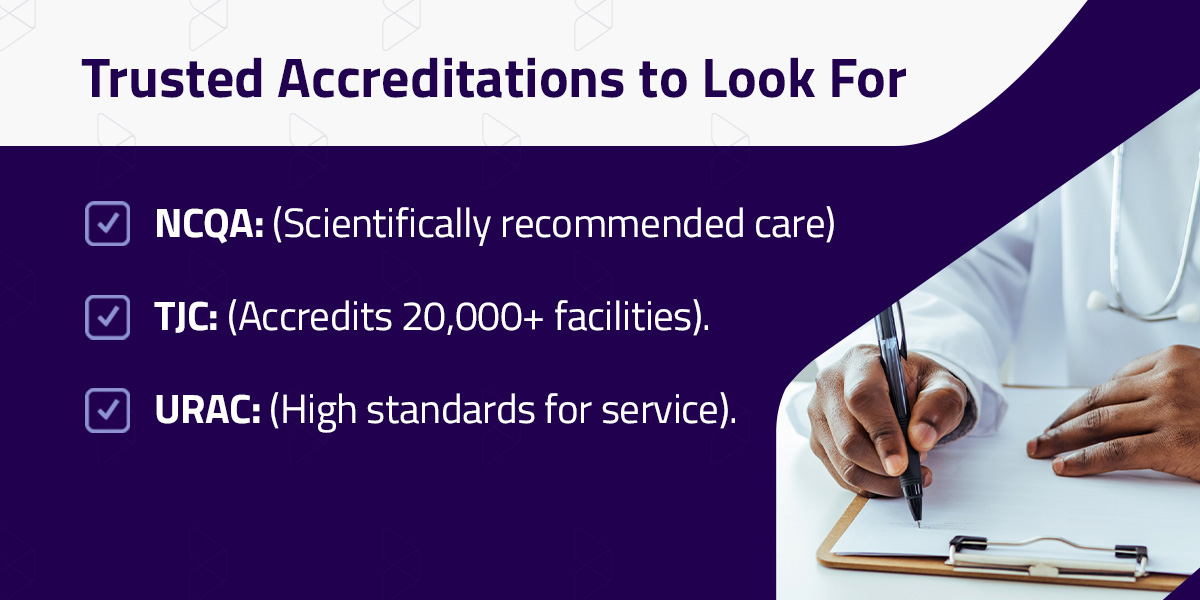
1. The National Committee for Quality Assurance
Founded in 1990, the National Committee for Quality Assurance (NCQA) accredits organizations that provide scientifically recommended care. Over 72% of the American population is enrolled in healthcare plans that provide information for the NCQA's Healthcare Effectiveness Data and Information Set (HEDIS).
This abundance of data means the NCQA has plenty of information that can be useful for those looking for a new healthcare provider. You can compare different healthcare providers and check an organization's NCQA accreditation status, too.
2. The Joint Commission
The Joint Commission (TJC) accredits almost 15,000 healthcare providers globally, and certifies or accredits over 20,000 facilities in the United States, including children's hospitals, nursing homes, and rehabilitation facilities. You can also check whether a healthcare provider is a TJC-accredited organization.
3. The Utilization Review Accreditation Commission
The Utilization Review Accreditation Commission (URAC) accredits various types of healthcare providers. Thanks to its reputation, URAC documentation is accepted in place of the required state documentation in some states. You can use the URAC directory to check whether an organization is URAC-accredited or certified.
A prospective healthcare provider may also have other types of accreditation. Research any organizations that the provider claims to be accredited by to ensure this is true, and to check how authoritative the accreditation body is.
Red Flags to Look for in a Healthcare Provider
When you evaluate healthcare providers, it will be easy to spot the good signs, such as accreditation, positive customer reviews, and short waiting times.
Signs that a healthcare provider isn't as good as others may not be as obvious. These signs may include:
- High staff turnover: If a provider is regularly losing staff and replacing them, it could signify poor working conditions, which may reflect on the level of care you receive.
- Unclear billing: Providers who aren't transparent with their costs or whose bills are confusing may be trying to muddy the waters with their costs.
- Limited services: If your provider doesn't offer many services, it could leave you without healthcare coverage for a treatment or surgery you need.
- Poor coordination: Providers who have poor interdepartmental communications can cause treatments to be delayed or missed, or even provide unnecessary medical care.
- Poor customer reviews: Regardless of the quality of care they deliver, no provider is likely to have only positive reviews. However, if a provider has a higher rate of bad reviews than most other healthcare providers, it could suggest problems with this provider's service delivery.
- High infection rates: Many providers, particularly hospitals, must report on their infection rates. If a provider's standardized infection ratio (SIR) is higher than 1, it means their infection rate is above the national average.
Benefits of Choosing an Integrated Healthcare Provider
An integrated healthcare provider offers many benefits that other types of providers can't. Thanks to their larger network, integrated providers can often deliver more services than other providers, giving patients improved access to the healthcare they need.
There's often more coordination between professionals and teams, too. This allows patients to receive a higher quality of care, with fewer delays and roadblocks to effective treatment. All of this can lead to higher patient satisfaction and potential cost savings.
Find Your Perfect Healthcare Provider With The Difference Card
To find the right healthcare provider, you need all the right information. This could require in-depth research across various sites and databases.
At The Difference Card, we want all of our members to have the information they need at their fingertips. That's why we created the Provider Lookup Manager Tool (PLUM). Using an unbiased database, members can compare the many healthcare providers in our network, allowing them to find the perfect provider for their needs.
To learn more about how The Difference Card can help your organization's team enjoy premium healthcare while you save on your health insurance costs, request a proposal today.