

How to Stack an HSA and MERP for Maximum Employer Savings
Key Takeaways A Quick Summary
Key Takeaways
- Employer health insurance premiums are rising sharply (average family premium $26,993 in 2025, up 6%), creating a trade-off between lowering premiums with HDHPs and risking employee dissatisfaction due to higher out-of-pocket costs.
- Stacking a high-deductible health plan (HDHP) with an employee-owned Health Savings Account (HSA) and an employer-funded Medical Expense Reimbursement Plan (MERP) can lower employer premiums, create payroll tax savings, and protect employees from large out-of-pocket expenses.
- IRS compliance is critical: a MERP must be structured (e.g., after-deductible activation or limited-scope coverage) so it does not provide disqualifying coverage that would eliminate employee HSA eligibility for the plan year.
- The combined design benefits employees—HSAs provide tax-advantaged, portable savings; MERPs provide employer-backed reimbursements for deductible gaps—making HDHPs more acceptable while preserving or improving benefit value.
- This strategy works best for small- to midsize employers with rising renewals and requires custom plan design and compliance expertise (The Difference Card positions itself as a specialist with documented client savings and implementation support).
Employer health insurance premiums keep climbing. In 2025, the average family premium hit $26,993, a 6% year-over-year increase. Switching to a high-deductible health plan (HDHP) seems like the logical cost-cutting move for many employers.
But there's a problem. High deductibles can feel risky, which is why employees may have concerns. Cost was the leading reason consumers delayed or avoided needed healthcare, highlighting concerns among plan participants. The choice between lowering premiums while risking employee dissatisfaction or keeping unsustainable renewal increases creates a dilemma.
Stacking a Health Savings Account (HSA)-eligible HDHP with a Medical Expense Reimbursement Plan (MERP) can help employers lower costs without leaving employees to pay high out-of-pocket expenses. Together, these tools can reduce your premiums, generate payroll tax savings, and provide your employees with stronger benefits than many traditional plans offer.
This MERP health insurance strategy works best when the HDHP, HSA, and MERP are designed to support one another from the start.
This page explains how the HSA and MERP stack works, what it can save employers, why employees may prefer it, and why expert plan design matters. If your renewal came back higher than you wanted to pay, this strategy may be worth exploring.
How the HSA and MERP Stack Works
The HSA and MERP combination works because it's deliberately designed, not just two products that happen to sit next to each other. Each part has a specific job. To make the strategy work, employers need to set up all three components correctly and comply with IRS rules.
The Three-Layer Plan Structure Employers Need to Know
Getting this strategy right starts with understanding how the three components function individually and together.
- High-deductible health plan (HDHP): This provides the foundation carrier coverage. For 2026, a health plan must have a minimum deductible of $1,700 for individual coverage or $3,400 for family coverage to qualify as a high-deductible plan. Employers usually cover the majority of premium costs, and HDHP coverage costs less than conventional PPO coverage, with 2025 averages of $8,620 for single coverage versus $9,818 for PPO plans.
- Health Savings Account (HSA): Employees control this tax-advantaged account and keep it permanently. Contributions from both employers and account holders are pretax up to annual IRS caps. The funds cover qualified medical costs without tax consequences, and the account follows workers between jobs.
- Medical Expense Reimbursement Plan (MERP): Employers fund this plan in full to reimburse employees for qualifying healthcare costs. Unlike a Health Reimbursement Arrangement (HRA), a MERP allows multiple customized benefit structures within a single carrier plan, with payments arriving tax-free to staff members.
Each layer has a clear role. The HDHP helps lower fixed premium costs. The HSA gives employees tax-advantaged savings they can keep and use for qualified expenses. The MERP helps cover the deductible gap the HDHP creates, giving employees more predictable financial support while creating tax benefits for the employer.
The IRS Compliance Rule That Keeps Both Benefits Intact
When a MERP provides immediate coverage for medical costs without requiring staff to meet their deductible first, the IRS treats this as disqualifying coverage that eliminates HSA eligibility for the entire plan year.
The key is timing. Employers can structure the MERP to activate only after employees meet the IRS-required HDHP deductible threshold. They can also limit MERP coverage to IRS-permitted categories, such as dental, vision, and preventive services.
When structured to activate after employees meet their deductible, the MERP maintains complete HSA qualification. This is what The Difference Card specializes in designing. Built correctly under IRS Section 105, it operates alongside the HSA without creating compliance conflicts, but requires expert plan design from the start.
The Employer Savings Case for Stacking an HSA and a MERP
This combination can help employers save in a few ways. An HDHP and MERP plan can lower fixed premium costs while adding protection for employees. MERP payments and HSA contributions can also create payroll tax savings. Employers can then use part of those savings to fund employee HSA contributions, giving their team more support while still reducing overall benefits costs.
The cost flow is straightforward. Employers move to a lower-premium HDHP, use part of the savings to fund HSA contributions or MERP reimbursements, and keep the remaining savings as reduced net benefits spend.
Switching to an HDHP Lowers Your Fixed Premium Costs
Moving from a traditional plan to an HDHP-qualified plan can lower fixed premium costs right away. The difference between these plan types can be significant.
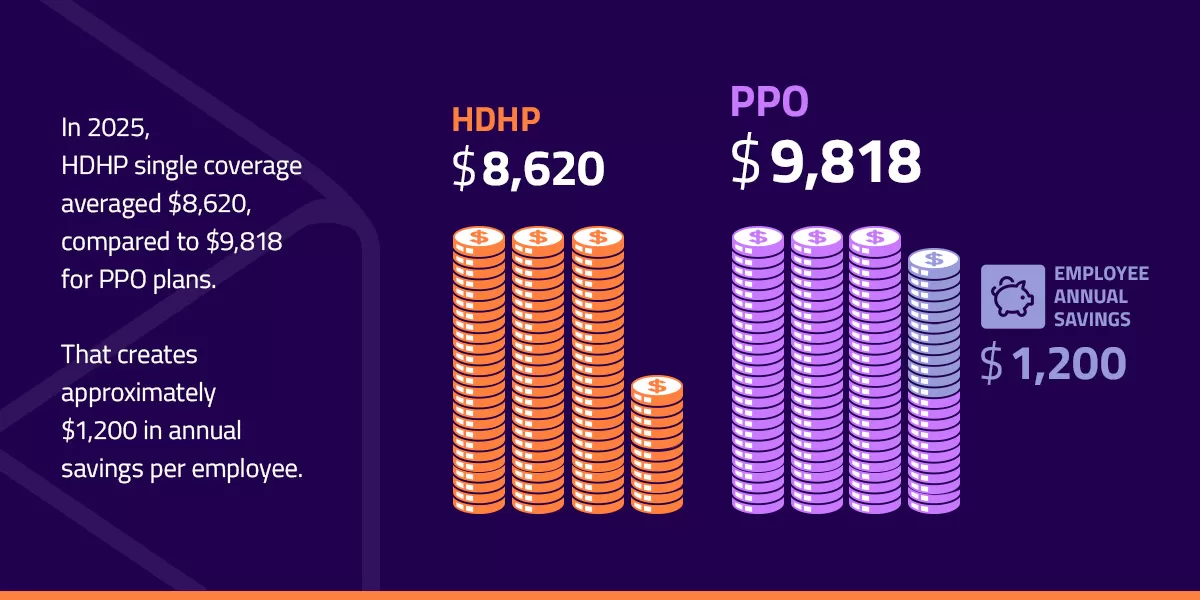
In 2025, HDHP single coverage averaged $8,620, compared to $9,818 for PPO plans. That creates approximately $1,200 in annual savings per employee. Family plans showed a similar gap, with HDHP coverage at $25,379 and PPO coverage at $28,272. That equals about $2,900 in annual savings per family.
Because employers often cover 70% to 80% of premium costs, savings can add up quickly across a workforce. For example, a 100-employee company switching to HDHP coverage could reduce total annual premium spending by about $120,000, with employer-paid savings varying based on its contribution strategy.
How MERP Reimbursements Create Payroll Tax Savings
MERP payments can create another layer of payroll tax savings. Employer-funded MERP reimbursements are exempt from FICA taxes, which can save 7.65% compared to providing the same value through wages. Federal unemployment taxes and other payroll burdens may also not apply.
Under IRS Section 105(b), employees can receive qualifying reimbursements tax-free. Section 125 cafeteria plan HSA contributions can also avoid FICA, adding to the payroll tax relief.
IRS Publication 15-B provides the framework for employer tax treatment of qualified healthcare benefits.
Redirecting Premium Savings Into Employee HSA Contributions
Many employers use the savings from an HDHP switch to fund employee HSA contributions. This approach can lower premium costs, create payroll tax savings, and give employees tax-free funds for qualified medical expenses.
In 2024, the average employer HSA contribution reached $927 per employee. For many employers, the savings from moving from a PPO to an HDHP can cover that contribution amount.
For 2026, HSA contribution limits are $4,400 for individual coverage and $8,750 for family plans. That gives employers flexibility in how much they contribute while still reducing overall benefits spending.
Why the HSA and MERP Combination Wins Over Employees
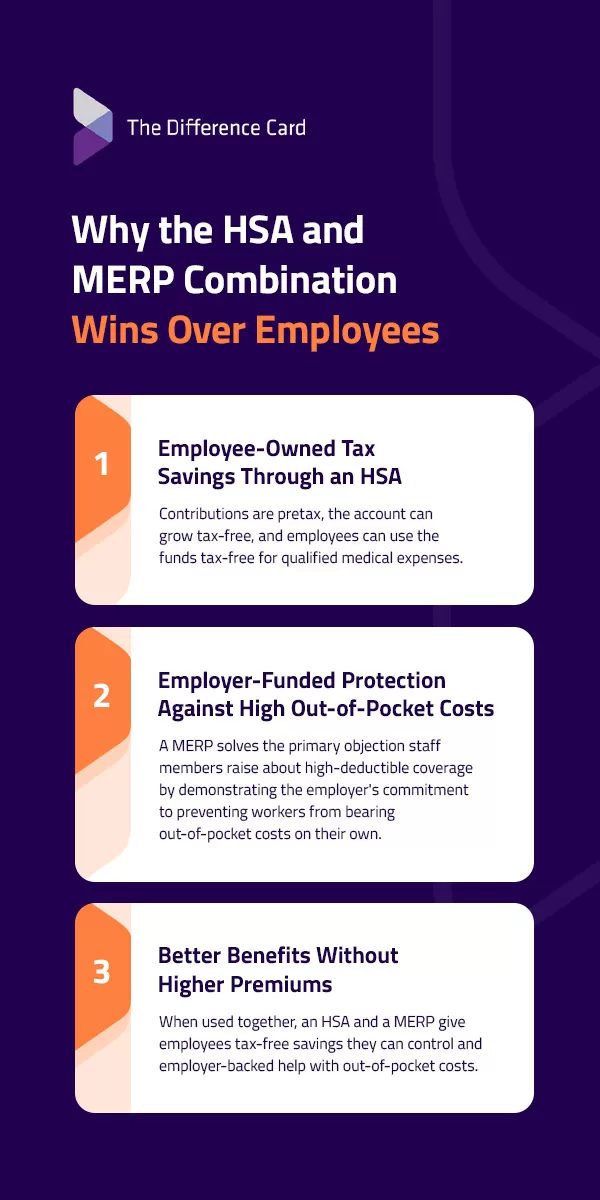
Switching to an HDHP can save employers money, but employees may worry about higher out-of-pocket costs. The HSA and MERP combination helps solve this problem. With the right design, employees can feel better protected than they would with many conventional plans.
Employee-Owned Tax Savings Through an HSA
An HSA gives employees three tax advantages. Contributions are pretax, the account can grow tax-free, and employees can use the funds tax-free for qualified medical expenses.
Employees also keep their HSA, even if they leave the company. This portability can make the benefit more valuable for recruiting and retention. Over time, employees can build savings in the account, especially when employer contributions help fund it.
An HSA is designed to provide a financial buffer, allowing employees to save tax-free funds for healthcare expenses and potentially making costs feel more manageable. This mechanism is intended to help mitigate cost-driven care avoidance.
Employer-Funded Protection Against High Out-of-Pocket Costs
A MERP solves the primary objection staff members raise about high-deductible coverage by demonstrating the employer's commitment to preventing workers from bearing out-of-pocket costs on their own. For instance, research from 2023 shows that 20% of HDHP enrollees declined all or part of a medical procedure due to its cost, and this tool directly addresses such concerns.
When the MERP is set up to activate after the deductible is met, it can cover qualifying expenses once employees meet the IRS-required threshold. The employer funds the plan, and The Difference Card administers payments through its platform.
Payments arrive tax-free under IRS Section 105(b). Staff members file claims, the plan covers costs the HDHP doesn't, and this component transforms how people perceive high-deductible coverage. The practical difference is substantial. Instead of confronting a $3,000 amount on their own, workers receive employer backing to cover much of that expense. If you have common MERP questions, The Difference Card's FAQ page provides detailed explanations of how payments function.
Better Benefits Without Higher Premiums
When used together, an HSA and a MERP give employees two forms of support. They get tax-free savings they can control and employer-backed help with out-of-pocket costs. This benefits structure can feel stronger than many traditional plans because employees receive additional financial protection without employers paying higher premium costs.
This balance depends on the right plan design. The Difference Card's MERP is built to help employers create this type of structure.
Which Employers Benefit Most From This Stack
The HSA and MERP combination works best for employers with rising renewal costs, plan design flexibility, and a workforce that needs stronger protection from out-of-pocket expenses.
The Ideal Company Size and Plan Structure
Employers that often see the strongest results are small- to midsize organizations with about 25 to 500 employees, fully insured coverage, and rising renewal costs. This strategy can also be a good fit for employers that already offer HDHP options or currently have traditional PPO plans and are considering a change.
HDHP plans paired with savings accounts are already common in employer benefits. In 2024, 27% of covered workers were enrolled in these plans. That means employers may already have part of the structure in place and could benefit from adding a MERP.
Employers with flexibility in their benefits decisions and plan design tend to see the best outcomes. For a closer look at how the MERP plan design works, The Difference Card's deductible buy-down strategy guide offers more options for brokers and employers.
Signs Your Current Plan Is Ready for a Redesign
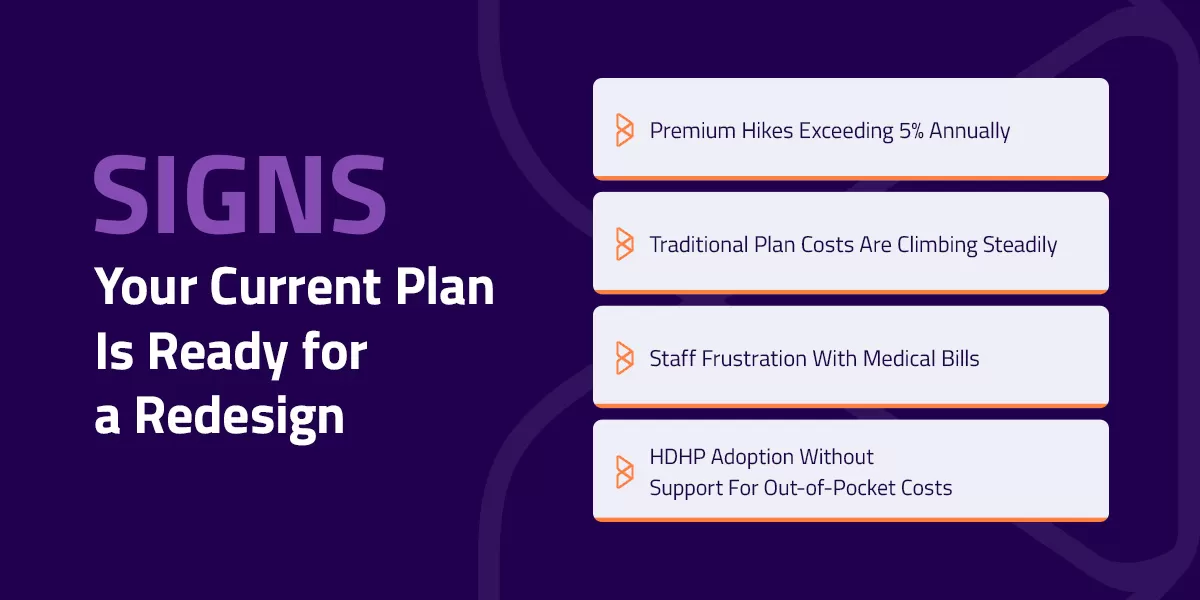
Here are signals that indicate your current plan structure is a good candidate for the HSA and MERP stack.
- Premium hikes exceeding 5% annually: Double-digit carrier quotes are becoming common, and an HDHP paired with a MERP can absorb much of that cost pressure.
- Traditional plan costs are climbing steadily: The differential between conventional coverage and HDHP options widens each year, making the transition more financially attractive.
- Staff frustration with medical bills: When your team struggles to afford copays and coinsurance under current coverage, they're ready for a structure that offers better financial protection.
- HDHP adoption without support for out-of-pocket costs: If you've already transitioned to high-deductible coverage but face worker resistance, layering in a MERP solves the satisfaction issue while maintaining cost reduction.
Success requires finding a designer who understands how to structure this combination within compliance requirements, and that's where specialized expertise becomes essential.
Why This Combination Requires a Custom Plan Designer
The HSA and MERP stack works best when it is built around the employer's goals, workforce, and compliance needs. As the HSA disqualification risk shows, this is not a strategy that generic benefits platforms can always set up correctly. It requires careful coordination between the HDHP, HSA, and MERP.
For an employer, custom health plan design turns the HSA and MERP stack into an integrated savings strategy rather than a generic benefits setup.
The HSA Disqualification Risk Hidden in Standard MERP Designs
Many standard MERP designs are not created with HSA eligibility in mind. If they cover medical expenses immediately, they can trigger IRS rules that make employees ineligible to contribute to an HSA for the plan year.
This goes beyond minor technical details because it creates employer compliance exposure and eliminates employee tax advantages. IRS Section 105 nondiscrimination requirements add another layer, requiring plan architecture to address both HSA compatibility and equitable treatment standards. Errors in either area create significant liability.
Employers should also work with a qualified benefits partner to understand how the plan fits within broader Affordable Care Act (ACA) and Employee Retirement Income Security Act (ERISA) requirements.
The risk is genuine, but the correct design approach solves it. Employers need a benefits partner who understands IRS regulations deeply and can architect the plan to maintain HSA eligibility from implementation.
The Difference Card Approach to Building an HSA-Compatible MERP
The Difference Card builds each plan to be HSA-compatible from the start. Depending on the employer's needs, we can configure the MERP as after-deductible or limited-scope coverage, helping to maintain HSA eligibility while still providing employees with meaningful protection.
Our platform manages administration, compliance verification, and claims processing. Every client also receives a dedicated account manager who understands their industry and goals. The Difference Card does not treat MERP design as a generic add-on. MERP-based custom health plan design is a core part of what we build, administer, and support for employers. Our compliance specialists also stay current on MERP requirements, so your plan remains within IRS parameters.
Real Employers Who Saved With This Strategy
Recent case studies show how this strategy can work in real employer plans.
A Texas real estate company with more than 200 employees used an HDHP, HSA, and MERP structure to secure $230,000 in guaranteed savings. The company also reduced fixed costs by more than $500,000 annually while maintaining benefit levels. See the savings documented in this case study.
A retail sports entertainment company with 240 employees also experienced a 39% renewal increase. After adopting this stacking strategy, the company reduced the increase to 24% and generated $650,000 in annual savings.
These are documented results from employers that used the HSA and MERP stack with proper plan design support.
Request a Custom HSA and MERP Proposal From The Difference Card
Employers don't have to choose between cutting costs and protecting their teams because the right plan design delivers both. Lower costs, payroll tax savings, and benefits staff members actually value are all achievable together.
The Difference Card specializes in building HSA-compatible strategies that work. Since 2001, we've delivered an average of 18% net savings to our clients while maintaining or improving employee benefits. Our approach is backed by the Difference Guarantee, insured by an A-rated division of Assurant, so you know the savings are real.
We design your plan from the ground up, handle compliance, and support your team through implementation. Our member support team answers calls in under 30 seconds on average, and claims are processed within two business days.
If you're facing a renewal increase you don't want to pay, or if your staff is struggling with out-of-pocket costs on your current HDHP, contact The Difference Card today. Request a proposal to see how an HSA-compatible MERP strategy could reduce your renewal costs while protecting your team.