

How Offering an HSA Reduces Your FICA Tax Liability

Key Takeaways A Quick Summary
Key Takeaways
- Offering HSA contributions through a properly structured Section 125 cafeteria plan makes those contributions pretax and exempt from FICA for both employer and employee (7.65% savings on payroll taxes).
- To obtain the FICA exemption employers must adopt a written Section 125 plan before the plan year, configure payroll to route pretax HSA contributions, perform annual nondiscrimination testing, and maintain/update plan documents and participant notices.
- Noncompliance risks include IRS reclassification of pretax contributions as taxable wages with retroactive FICA assessments, penalties, and interest; failures of nondiscrimination rules typically strip the tax break from highly compensated/key employees.
- Employer FICA savings scale with headcount and total pretax contributions — estimate savings as total pretax HSA contributions × 7.65% (example: 100 employees × $2,500 each = $250,000 pretax reduction → $19,125 employer FICA savings).
- Eligibility and limits matter: employees must be eligible individuals enrolled in an HDHP (2026 HDHP thresholds: self $1,700 deductible/$8,500 OOP; family $3,400/$17,000), and 2026 HSA contribution limits are $4,400 self / $8,750 family (+$1,000 catch-up); increase participation via employer seed contributions, automatic enrollment, education, and wellness incentives.
Healthcare costs generally rise faster than inflation. In 2024, the average family premium reached $25,572, up 7% from the previous year. For small and midsize employers with tight budgets, savings on benefits create breathing room without sacrificing employee coverage. One effective way to reduce costs is by offering Health Savings Account contributions through a Section 125 cafeteria plan.
A Section 125 plan is a benefits structure that allows employers to offer employees and their covered family members benefits on a pretax basis. These pretax contributions lower taxable income. The contributions are also exempt from Federal Insurance Contributions Act (FICA) taxes, which include Social Security and Medicare. That exemption saves employers and employees 7.65% each on payroll taxes.
Employers and employees can fund an HSA through a Section 125 plan to reduce FICA liability. This reduction can help improve the company's bottom line and workforce retention. Understanding how the exemption works, what compliance requirements apply, and how to maximize participation can help capture thousands of dollars in annual savings.
How HSA Contributions Affect FICA Taxes
HSA contributions are not treated as wages if made from an employer's payroll through a Section 125 cafeteria plan. Because they are not wages, neither the employer nor the employee owes FICA on those dollars. FICA taxes consist of two components:
| Social Security | 6.2% |
|---|---|
| Medicare | 1.45% |
| Combined FICA burden | 7.65% |
The total FICA burden for employers and employees is 15.3%, which, in contrast, is the combined amount they save for pretax contributions.
If an employee contributes to an HSA from personal savings, they can no longer recover FICA that was withheld from those wages. Employers and employees can maximize savings by ensuring HSA contributions flow through payroll.
The Section 125 Requirement
FICA exemption does not happen automatically. It requires a properly structured Section 125 cafeteria plan. This plan is an IRS-governed arrangement that allows employees to elect pretax benefits, including HSA contributions, to reduce their taxable compensation.
The IRS treats wages as having been received by employees, even if employees choose to have them directed into an HSA, due to the concept of constructive receipt. The money would be treated as a taxable wage. However, with a Section 125 plan, the law treats the funds as not having been received.
Employers must follow specific rules to establish and maintain a compliant plan:
- Adopt a written plan document before the plan year begins: The written document must be in place before employees make decisions and must designate the HSA as a qualified benefit.
- Configure payroll to route contributions pretax: This configuration reduces taxable wages at each pay period, creating the FICA exemption.
- Conduct annual IRS nondiscrimination testing: Testing confirms the plan does not disproportionately favor highly compensated employees. Plans must meet nondiscrimination requirements.
- Maintain current plan documents and update them when rules change: Plan participants must receive a summary of material changes within 210 days after the close of the plan year if there are any changes to eligibility rules, contribution limits, or plan terms.
Section 125 Nondiscrimination Requirements
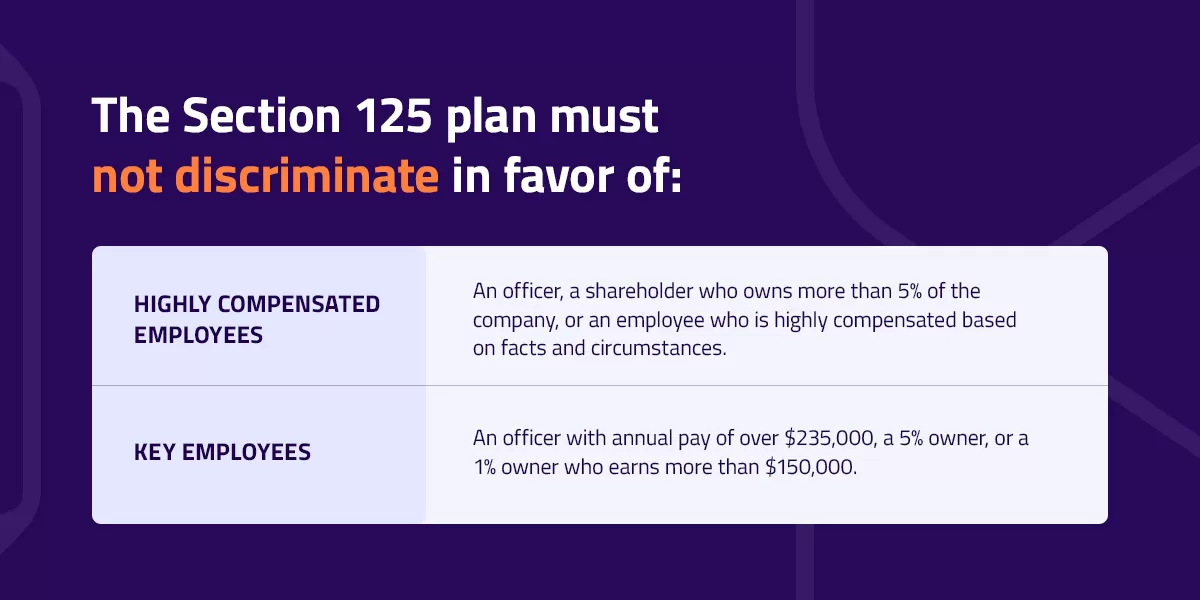
HSA contributions that flow through the Section 125 cafeteria plan must follow nondiscrimination rules, separate from the rules that affect employers contributing to an HSA directly, outside the plan. The Section 125 plan must not discriminate in favor of:
- Highly compensated employees: A highly compensated employee can be an officer, a shareholder who owns more than 5% of the company, or an employee who is highly compensated based on facts and circumstances. Spouses and dependents are included.
- Key employees: A key employee can be an officer with annual pay of over $235,000, a 5% owner, or a 1% owner who earns more than $150,000.
Favor is based on eligibility to participate, contributions, and benefits. The consequence is targeted, meaning it is the highly compensated employees who will lose their tax break, not all plan participants.
Noncompliance Risks
The IRS can reclassify pretax contributions as taxable wages if employers improperly administer a Section 125 plan. This reclassification triggers retroactive FICA assessments, penalties, and interest on the amounts that should have been withheld. An improper administration looks like not having a properly written plan or not following through with it. While breaking nondiscrimination requirements only affects highly compensated or favored employees, plan administration issues affect the entire plan arrangement.
Compliance and plan administration services that handle Section 125 plan documents, nondiscrimination testing, and ongoing compliance management streamline the process and mitigate risks.
How Much Can Employers Save From FICA by Offering an HSA?
You can get an estimate of the annual employer FICA savings by multiplying the total pretax contributions by 7.65%. A chief financial officer managing 100 employees would have different calculations than a company with five employees. The FICA rate of 7.65% applies across company sizes, but savings scale with headcount and contribution levels. Note that HSA employer contributions are also deductible as a business expense, adding to the savings.
Sample Calculations by Company Size
Headcount multiplied by average annual pretax contribution equals the total reduced pretax dollars. Here are some examples:
| Company Size | Average Contribution per Employee | Total Pretax Reduction | Employer FICA Savings (7.65%) |
|---|---|---|---|
| 50 employees | $2,000 | $100,000 | $7,650 |
| 100 employees | $2,500 | $250,000 | $19,125 |
| 250 employees | $3,000 | $750,000 | $57,375 |
Actual savings depend on participation rates, the HSA program's design, and individual contribution amounts. Employers can use these calculations as a starting point to model their own potential savings based on workforce size and expected participation. For small businesses, tax savings can represent a significant portion of benefits spending. For a 50-employee company saving $7,650 annually, that amount can fund other strategic initiatives or offset rising healthcare costs.
How Benefits Translate to Employees
Employees save 7.65% in FICA on their pretax payroll contributions, increasing their take-home pay. An employee contributing $2,500 per year through payroll saves $191.25 in FICA taxes. On top of these savings, employees can enjoy an HSA's triple tax advantage:
- Tax-deductible contributions: If an employee adds funds to their HSA using their after-tax money, they can claim a tax deduction for it, lowering their federal income tax.
- Tax-free growth: HSA funds grow tax-free within the account. There is no annual tax on interest, dividends, or investment gains.
- Tax-free withdrawals: Employees can withdraw funds tax-free, provided they use them for qualified medical expenses.
These benefits make HSA participation attractive. Employers who help employees understand the plan's value can encourage more participation, driving greater FICA savings. Additionally, the HSA is portable. It stays with employees even if they leave the company.
Which Business Owners Can Participate
Section 125 plans are only available to employees. That means business owners and self-employed individuals generally can't make pretax elections under a cafeteria plan. Employers must maintain the plan for the benefit of their employees.
Business owners who can participate include:
- C-corporation owner-employees and shareholders: These owners who work for their company are considered common-law employees.
- S-corporation shareholders who own up to 2% of the company: These shareholders, who are also employees, can participate, as they fall below the threshold that triggers partner treatment.
Sole proprietors, partners, and S-corporation shareholders who own more than 2% of the company cannot make pretax Section 125 elections. These exclusions don't mean that owners can't open an HSA, just that they can't take advantage of the FICA tax break.
Other Plan Requirements
Before FICA savings can occur, employees must be considered eligible individuals and enrolled in a qualifying plan structure. Contribution limits also apply, which affect potential savings.
Eligibility Requirements
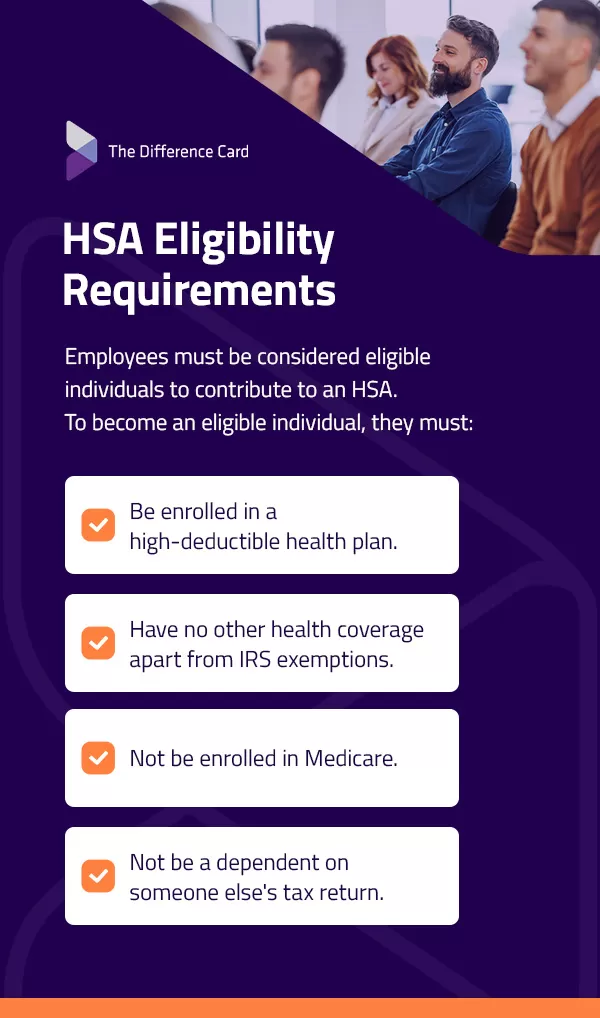
Employees must be considered eligible individuals to contribute to an HSA. To become an eligible individual, they must:
- Be enrolled in a high-deductible health plan.
- Have no other health coverage apart from IRS exemptions.
- Not be enrolled in Medicare.
- Not be a dependent on someone else's tax return.
Employees can often be considered eligible individuals for the entire year if they qualify on the first day of the last month of their tax year, which is December 1 for most taxpayers.
High-Deductible Health Plan Requirements
The IRS sets specific thresholds annually to qualify a plan as an HDHP. For 2026, the plan must have the following requirements:
| Coverage | Minimum Deductible | Maximum Out-of-Pocket |
|---|---|---|
| Self-only | $1,700 | $8,500 |
| Family | $3,400 | $17,000 |
An HDHP typically has a lower premium than a traditional plan. Employers can realize premium savings in addition to FICA savings.
HSA Contribution Limits
The combined employer and employee contribution cannot exceed the annual limit. For 2026, contribution limits include:
| Coverage Type | Annual Contribution Limit | Catch-Up Contribution (Age 55+) |
|---|---|---|
| Self-only | $4,400 | +$1,000 |
| Family | $8,750 | +$1,000 |
Maximizing contributions maximizes the employer's FICA savings. The higher the total pretax dollars contributed, the greater the 7.65% return.
How to Increase Employee Participation and Improve Employer Savings
Participation rate is the multiplier on the entire savings equation. If 40% of eligible employees enroll, the employer captures 40% of potential savings.
Four practical strategies drive enrollment:
- Employer seed contributions: When the employer contributes directly to employee HSA accounts, it incentivizes participation. The employer's own contribution is itself FICA-exempt and deductible.
- Automatic enrollment: Automatically enroll employees in the HSA when they select an HDHP at open enrollment. Employees can opt out if they choose, but default enrollment increases participation significantly.
- Employee education: Employees who understand the triple tax advantage may enroll and contribute more. Employers need to communicate how the account works and how to access funds to encourage employee participation.
- Wellness incentives: Pairing HSA enrollment with wellness program rewards encourages adoption.
Reliable third-party plan administrators can help encourage employees to participate in your Section 125 plan. The best services offer dedicated account management, member education resources, and wellness programs that cater to employees' needs. They also simplify HSA enrollment and ongoing management.
Frequently Asked Questions About HSA and FICA
Employers commonly ask the following questions when evaluating an HSA program.
What is the HSA loophole?
The so-called HSA loophole for FICA tax savings is not a loophole at all. It is a designed feature of the Internal Revenue Code meant to incentivize employer-sponsored healthcare savings. HSA accounts were established in 2003 as part of the Medicare Prescription Drug, Improvement, and Modernization Act. Both HSA and FICA exemptions are enacted statutory law, not regulatory interpretations.
How does the One Big Beautiful Bill Act affect an HSA?
The One Big Beautiful Bill Act, signed July 4, 2025, expanded HSA eligibility. The act allows individuals with telehealth and other remote care coverage on top of their HDHP to remain eligible to contribute to an HSA. Previously, such additional coverage could disqualify a person.
The law also allows an HDHP to provide telehealth benefits without a deductible. This provision applies to plan years beginning after 2024. More employees may now qualify to contribute, which could expand the employer's FICA savings pool.
At what age is HSA withdrawal tax-free?
HSA withdrawals for qualified medical expenses are tax-free at any age. After age 65, account holders can withdraw funds for any purpose and pay only ordinary income tax, with no penalty. Before age 65, nonmedical withdrawals incur income tax plus a 20% penalty. This structure mirrors the treatment of a traditional IRA.
Examples of qualified medical expenses include:
- Payments for annual physical examinations.
- Medical expenses for ambulance services.
- Inpatient care expenses.
- Special medical equipment purchases.
- Eyeglasses and contact lens purchases.
How can I stop paying FICA taxes?
You cannot completely stop paying FICA taxes, but you can legally reduce your FICA tax liability through a Section 125 cafeteria plan. An HSA is among the highest-limit pretax vehicles available. Other pretax benefits can further reduce the FICA-taxable wage base when structured under the same Section 125 umbrella. A flexible spending account and a dependent care account also reduce taxable wages when properly administered.
Structure Compliant Plans Easily With The Difference Card
Understanding the FICA savings potential is the first step. Capturing it requires proper Section 125 plan design, compliant administration, and employee participation that makes the savings real. That is exactly what The Difference Card delivers.
The Difference Card handles Section 125 plan documents, nondiscrimination testing, and compliance processes, mitigating audit risks. We simplify HSA administration with automated contribution management, employee roster tools, and one-click reporting so HR teams can focus on strategy, not paperwork.
Every client works with a dedicated account manager. We also offer members educational resources and engagement programs to help encourage employee plan participation. We customize employee benefits according to each company's needs.
We save companies an average of 18% on healthcare spending. These savings amount to $2.13 billion since we started in 2001. We also process 99% of claims within two business days. If you're ready to use HSA contributions to lower FICA costs, contact The Difference Card today.