
How Transparency in Healthcare Pricing Can Affect Patient Choices
Key Takeaways A Quick Summary
Key Takeaways
- Healthcare pricing has long been opaque, leaving patients unable to know or plan for costs until after care; recent increases in pre-visit pricing access can empower employees to make informed choices.
- The Hospital Price Transparency Rule requires hospitals to publish prices, but compliance is incomplete (over 75% not fully compliant) and published data often appears in inconsistent, non-actionable formats.
- Published chargemaster prices frequently differ from insurers' negotiated rates and actual plan costs, so list prices can mislead employers and employees unless reconciled with plan-specific claims data.
- Effective cost-containment relies on using your plan's claims data and a three-part strategy: flexible funding (MERP), claims-based provider lookup tools (real cost visibility), and plan design that steers employees toward high-value care.
- Combining MERP funding, a claims-driven provider lookup tool, and employee education enables proactive healthcare spending management; The Difference Card offers such solutions, claiming average 18% savings and $2.13B total saved.
Healthcare pricing has long been a source of frustration for employees and their families. For decades, the true cost of medical services remained hidden behind layers of negotiation, complex billing systems, and opaque insurance processes. Patients often received care without knowing what they would owe until bills arrived weeks or months later. This lack of clarity made it nearly impossible to plan financially or compare options.
Now employees have more access to pricing information before scheduling appointments or undergoing procedures. This shift can empower them to make informed decisions about where to seek care and how to allocate their healthcare dollars.
When they understand costs up front, they can identify high-value providers, avoid unnecessary expenses, and feel more confident navigating their benefits.
Healthcare Price Transparency Rules
The federal Hospital Price Transparency Rule requires hospitals to publish prices. The idea is simple. If hospitals publish their prices, patients can compare costs. In theory, this competition drives down prices and gives consumers more control over their healthcare spending.
This data is typically provided for regulatory compliance and patient-facing purposes. However, compliance is still developing, and over 75% of hospitals have yet to fully implement the transparency rule. When hospitals do publish pricing information, the data often appears in varied formats that require time and effort to compare meaningfully. This inconsistency creates added complexity for employers and insurers working to control costs.
Hospitals may technically comply by posting extensive pricing files, but translating that information into actionable insight for benefit design is an ongoing challenge. Thought leaders like the National Committee for Quality Assurance continue to call for improvements, yet most transparency tools lack the context or customization employers need. For cost containment to be practical, employers need access to data that's relevant, reliable, and rooted in actual claims — bridging the divide between compliance and real-world decision-making.
How Transparency Impacts Employers
For insurance producers and employer groups, healthcare pricing transparency should deliver clear benefits:
- Better budgeting and predictability: Knowing costs up front helps you plan more effectively and forecast healthcare spending with greater accuracy, reducing surprise expenses that disrupt annual budgets.
- Improved employee engagement and satisfaction: Transparency helps build trust in your benefits program and demonstrates your commitment to helping employees make informed healthcare decisions.
- Easier talent attraction and retention: Competitive benefits packages that include transparent pricing tools can help employers attract top candidates and keep valuable employees from seeking opportunities elsewhere.
- Reduced administrative burden: Clear pricing data streamlines benefits management and reduces the time your HR team spends fielding employee questions about coverage and costs.
Published hospital prices typically show chargemaster list prices rather than the actual cost to your plan. Chargemaster rates, negotiated rates, and cash prices vary across institutions, making strategic cost-containment planning more complex using public data alone. This gap means employees may research list prices while their actual costs depend on plan-specific rates and cost-conscious decisions.

An employee who selects what appears to be a lower-cost provider based on published chargemaster rates might end up at a facility where your plan's negotiated rate is higher.
For producers, this gap affects your ability to provide precise guidance to employer clients. When clients ask which hospitals offer the best value for common procedures, health plan price transparency through plan-specific cost data provides the answer.
The Challenge With Hospital Chargemaster Data
Hospital chargemaster data — the list of standard charges for services and procedures — aims to provide transparency. In practice, it requires additional analysis. Chargemaster data presentations vary substantially across institutions, making manual comparison time-intensive. Service names differ, descriptions vary, and data formats span a wide range.
One hospital may list "MRI brain without contrast" while another uses "cranial MRI non-contrast" for the identical procedure. This variation means employers who want to compare costs need to manually review files from multiple hospitals — a task requiring significant time and resources.
The format challenges extend beyond naming conventions. Some hospitals publish data in spreadsheets with hundreds of columns. Others use a PDF format and use specialized software to analyze. Still others provide data in formats that meet technical requirements while allowing additional processing for comparison.
The Difference Between Published Prices and Real Costs
Even with perfectly standardized chargemaster data, your plan's negotiated rates tell the complete story. A gap exists between a hospital's sticker price and the negotiated rates your insurer secures. Prices for common procedures can vary by 50% or more.
For employers designing health plans, knowing the real costs — rather than published rates — means designing tiered networks or value-based incentives that actually align with today's claims.
Consider a common knee replacement. One hospital might publish a chargemaster price of $45,000, while another lists $60,000. At first glance, the first hospital appears more affordable. But after applying your plan's negotiated rates, the first hospital might cost your plan $38,000 while the second costs only $28,000. The published prices point in a different direction than the actual contracted rates.
These negotiated rates often vary substantially even within the same insurance network, depending on when contracts were signed, the hospital's market position, and the specific services covered. With access to your plan's actual cost data, healthcare cost-containment strategies can target specific high-cost areas, enabling targeted, specific approaches.
Moving From Public Data to Actionable Claims Insights
The strategic approach is straightforward — use your plan's own claims data as your primary resource. Your claims history shows what procedures your employees need, which providers they use, and what those services cost your plan. This information forms the foundation of effective cost control.
Claims data also reveals utilization trends that help you forecast future costs more accurately. If you notice increasing utilization of high-cost imaging services, you can proactively address it through employee education, prior authorization requirements, or network design changes. You can identify opportunities for preventive care that might reduce emergency department visits or hospitalizations.
Securing this data and turning it into insights is the pathway toward actionable cost-containment solutions for producers and employers.
How to Build Healthcare Cost Containment Strategies
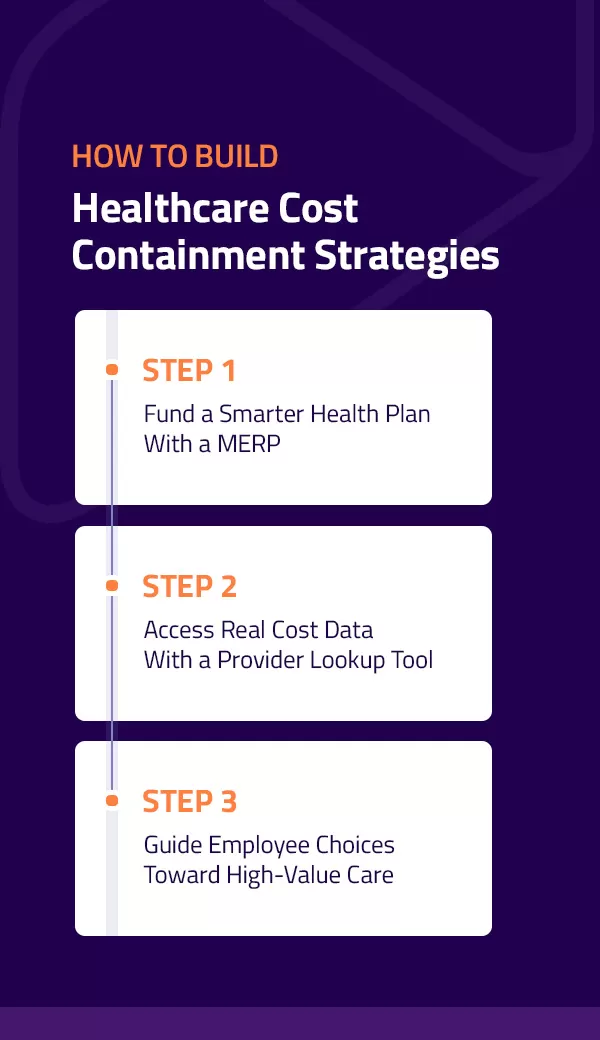
Once you have access to real claims data, you can build a three-part strategy that turns transparency into savings. The approach combines flexible plan funding, real-time cost visibility, and plan design. Each component works together to create a system that preserves employee benefits and satisfaction.
This strategy shifts the focus from reacting to healthcare costs to proactively managing them. Rather than discovering cost increases at annual renewal, you gain ongoing visibility into spending patterns and the ability to intervene early.
Step 1: Fund a Smarter Health Plan With a MERP
A Medical Expense Reimbursement Plan (MERP) gives you the flexibility to fund employee benefits differently and capture savings that traditional plans often leave untapped. Unlike a carrier-integrated health reimbursement arrangement, a MERP allows you to build multiple plan designs from a single underlying carrier plan — and you share the full cost with your employees through premium equivalent rates.
Here's how it works: Instead of offering a single plan design to all employees, you can create tiered options that give employees choices while controlling your costs. You might offer a high-deductible health plan as the base, then use a MERP to reimburse employees for qualifying expenses up to a certain threshold. This approach gives you greater control over benefit-dollar allocation.
If you want to cover certain preventive services at 100% while maintaining higher cost-sharing for other services, a MERP makes that possible. If you want to incentivize employees to use certain high-value providers by covering more of their out-of-pocket costs when they do, a MERP can accommodate that design.
This structure delivers three key advantages:
- Cost containment through flexible funding.
- Tax advantages for everyone.
- Compliance flexibility.
For brokers and employers focused on long-term cost control, a MERP is the foundation that enables the rest of the strategy. It creates the financial structure needed to reward smart healthcare choices and connects directly to your claims data, enabling you to refine incentives based on actual employee behavior.
Step 2: Access Real Cost Data With a Provider Lookup Tool
The second piece is a provider lookup tool that uses real, historical claims data to show cost and quality metrics. This data empowers informed decisions by showing employees what a procedure will cost under your plan before they schedule it.
Unlike network-tied tools, PLUM leverages claims-based data from multiple carriers to provide an unfiltered view of real costs and outcomes. You can identify which employees are high utilizers, which procedures drive the most spending, which providers deliver quality care at competitive costs, and where opportunities for savings exist. This information lets you design targeted interventions — guiding you toward high-value providers, negotiating better rates with frequently used facilities, or restructuring plan designs to incentivize cost-effective choices.
While federal transparency rules have moved the industry forward, most published data is formatted for compliance rather than for employers seeking actionable insight into cost management. PLUM bridges this critical gap, translating compliance-driven data into meaningful, claims-based intelligence.
These tools analyze your plan's actual claims history to calculate the cost of specific procedures at specific facilities under your negotiated rates. When an employee needs a knee replacement, they can search the tool and see that Hospital A will cost them $2,500 out-of-pocket while Hospital B will cost $6,000 — based on your plan's actual contracted rates rather than list chargemaster prices. The tool might also show quality metrics, patient satisfaction scores, and outcomes data to help employees choose providers that deliver both value and quality.
Beyond procedure pricing, sophisticated provider lookup tools help employees understand their full financial picture:
- Data may show how much of their deductible they have met.
- Data can estimate their total out-of-pocket costs for a course of treatment.
- Data can highlight which providers accept payment plans.
Some tools even integrate with telemedicine options or urgent care centers as convenient alternatives to emergency department visits for nonemergencies.
Cost comparison tools reduce financial surprises for employees and encourage them to be more cost-conscious consumers of healthcare. When patients, clinicians, physicians, and nurses all have access to the same data, the entire system becomes more efficient and competitive.

By giving employees accurate, personalized cost information when they're making healthcare decisions, you can empower them to be active partners in cost containment.
Step 3: Guide Employee Choices Toward High-Value Care
High-value care decisions require healthcare cost-containment strategies that incentivize employees to choose high-value providers — those who deliver quality outcomes at lower costs. High-value care means finding the right balance between cost and quality while respecting patient preferences and values.
Identifying high-value providers requires analyzing both cost and quality data together. A provider might offer low prices while delivering outcomes that affect long-term costs through complications, readmissions, and additional treatment needs. Conversely, a higher-priced provider might deliver exceptional outcomes, thereby preventing complications.
Plan design strategies might include:
- Tiered networks where employees pay less when they use higher-value providers.
- Reference-based pricing, where the plan pays a set amount for a procedure.
- Employee responsibility for any difference if they choose a more expensive provider.
Some employers create focused networks that include high-value providers. Others use steerage programs that provide decision support and incentives to guide employees toward better choices while maintaining broad network access.
Education and communication are critical here. Employees need to understand why one provider offers better value than another — seeing the numbers and understanding the quality and outcome differences behind them. This education goes beyond simply providing data — it includes helping employees interpret that data and understand what it means for their specific situation.
Communication strategies might include personalized outreach when employees are scheduled for high-cost procedures, decision-support tools to help them evaluate their options, or success stories from colleagues who saved money by choosing high-value providers.
Take Control of Healthcare Spend With The Difference Card
Transparency in healthcare pricing empowers patients and employers to make more informed decisions, but public data alone often falls short due to inconsistent formats and a lack of actionable insights. Employers benefit most from using their own claims data to build cost-containment strategies, such as a MERP, provider lookup tools, and educational initiatives that guide employees toward high-value care. This approach shifts organizations from reactive to proactive healthcare spending management.
The Difference Card has been delivering this solution since 2001, saving clients an average of 18% on annual health insurance costs. We combine a MERP with real-time claims data through our proprietary lookup tool. The Difference Card has helped clients save over $2.13 billion in 25 years, with a 90% client retention rate. Our Difference Guarantee is backed by an A-rated Assurant division, which puts those savings on the line for you.
Ready to see the difference? Request a proposal, or explore solutions for insurance producers.