


What Is Reference-Based Pricing in Healthcare?

Key Takeaways A Quick Summary
Key Takeaways
- Reference-based pricing (RBP) is a self-funded plan strategy where the plan pays a fixed percentage of Medicare rates (rather than prenegotiated carrier discounts), using Medicare as a public benchmark to set payments and compare costs.
- Typical RBP payments run roughly 110%–200% of Medicare versus commercial PPOs that often pay 254%–279% (hospital/outpatient averages), creating substantial savings potential on facility-based services.
- Claims are repriced by a TPA to the plan's reference rate and providers bill the remainder, creating balance-billing risk for members; the No Surprises Act protects some emergency and specific out-of-network situations but gaps and negotiation needs remain.
- Successful implementation requires upfront employee education, provider-search tools, a clear escalation process, and robust member advocacy; RBP is available only to self-funded (ERISA) plans and fits best with stable workforces and markets where PPO rates are far above Medicare.
- Brokers and vendors play a key role—providing repricing services, advocacy, and plan design expertise—and early adopters report measurable savings and greater cost transparency, though employers must evaluate local provider dynamics and risk tolerance.
Reference-based pricing is a healthcare payment strategy in which self-funded plans pay providers a predetermined amount for services, often calculated as a multiple of what Medicare would pay, rather than accepting the rates that a traditional insurance carrier negotiates.
For employers, reference-based pricing in healthcare creates a more straightforward way to set plan payments and compare costs against a consistent benchmark. As healthcare premiums continue their steep climb, this model is attracting interest from employers and brokers seeking alternatives to traditional network discounts that deliver diminishing returns.
The average annual family premium rose to $26,993 in 2025, a 6% increase from the previous year. This guide explains how the model operates, the savings employers can expect, and the implementation challenges to plan for up front.
How Reference-Based Pricing Works
This approach replaces the traditional carrier network model with a fixed payment formula. In an RBP health insurance model, the employer's health plan pays a defined percentage of what Medicare would pay for the same service at the same facility, based on plan design rather than prenegotiated discounts that vary by provider.
Medicare Rates as the Benchmark
Medicare gives employers consistent standards for healthcare payments. The Centers for Medicare & Medicaid Services publishes updated Medicare payment rates annually, with adjustments for factors like location and care setting.
Employers can use that public reference point to compare plan payments against a specific yardstick rather than relying on provider-by-provider discounts, which can be difficult to evaluate.
The gap between Medicare rates and commercial insurance rates can be significant. Research found that employers paid an average of 254% of Medicare for hospital services in 2022. Outpatient services reached 279% of Medicare.
Most reference-based pricing plans pay providers between 110% and 200% of Medicare rates, depending on plan design and local market conditions. That difference can create savings opportunities compared to traditional PPO plans while giving employers a more transparent view of what they pay for care.
The TPA's Responsibility in an RBP Plan
Claims processing is different under reference-based pricing. When an employee receives care, the provider bills at the full charge. The third-party administrator then reprices the claim at the plan's reference rate, such as 150% of Medicare, and the plan pays that amount. The provider can either accept the payment to close the claim, or the difference between the reference-based pricing payment and the provider's full charge becomes a potential balance bill to the employee.
Traditional PPO insurance handles this differently. Carriers maintain prenegotiated contracts with in-network providers, and the contracted rate applies automatically when they process the claim. With reference-based pricing, the benchmark applies at the time of the claim through the established formula.
Many vendors include repricing services and member advocacy support to answer billing questions. These services ensure the model runs smoothly for those who are unfamiliar with how it works.
RBP vs. Traditional PPO Networks
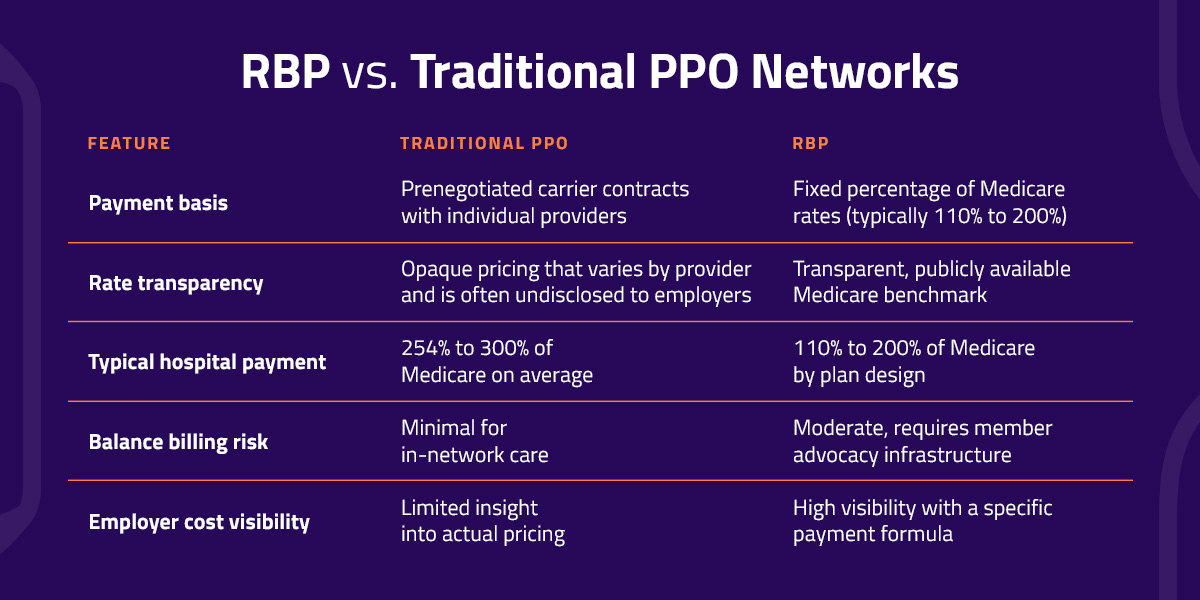
Employers evaluating RBP should understand how it differs from a traditional network-based plan in pricing, transparency, and employee support. Here’s how the two approaches compare.
| Feature | Traditional PPO | RBP |
|---|---|---|
| Payment basis | Prenegotiated carrier contracts with individual providers | Fixed percentage of Medicare rates (typically 110% to 200%) |
| Rate transparency | Opaque pricing that varies by provider and is often undisclosed to employers | Transparent, publicly available Medicare benchmark |
| Typical hospital payment | 254% to 300% of Medicare on average | 110% to 200% of Medicare by plan design |
| Balance billing risk | Minimal for in-network care | Moderate, requires member advocacy infrastructure |
| Employer cost visibility | Limited insight into actual pricing | High visibility with a specific payment formula |
Many PPO plans promote discounts from hospital chargemaster rates. However, those starting rates are often much higher than the actual cost of care, so even after the discount, employers may pay several times as much as Medicare would for the same service.
The RAND data shows the difference. For example, if Medicare pays $8,000 for a procedure, a traditional PPO plan may pay $20,000. A reference-based pricing plan that pays 150% of Medicare would pay $12,000 for the same procedure.
State-level analysis shows similar savings potential. In Vermont, hospital payments averaged 289% of Medicare rates. A government-commissioned analysis found that adjusting payments to 200% of Medicare could have saved the Vermont state health plan about $79 million in 2022.
One critical limitation applies. Reference-based pricing is only available to self-funded health plans operating under ERISA. Fully insured plans cannot use this strategy as a comprehensive payment approach because they do not directly control claims payments.
Benefits for Employers
This model offers two primary advantages for employers evaluating alternatives to traditional network-based plans. The first is direct cost savings on facility claims. The second is transparent, predictable healthcare spending.
Potential Employer Savings
Published employer case studies and actuarial analyses document meaningful RBP claims savings on facility services compared to in-network PPO arrangements. The actual savings depend on the local market, how current PPO rates compare to Medicare, how aggressive the benchmark is, and the mix of services employees use.
Facility-based services account for a significant share of employer health plan spending and can offer noticeable savings opportunities.
- Outpatient hospital services: These averaged 279% of Medicare in 2022, offering substantial room for savings. Procedures such as diagnostic imaging, infusion therapy, and same-day surgeries often see dramatic cost reductions under this model.
- Ambulatory surgery centers: These facilities averaged 171% of Medicare rates, and while the markup is lower than hospitals, the volume of procedures performed at surgery centers means savings add up quickly across a plan year.
- Inpatient hospital care: Inpatient stays averaged 254% of Medicare, with high-cost events like joint replacements, cardiac procedures, and complex surgeries delivering the largest dollar savings per claim.
Since employer adoption remains relatively low, brokers who understand how to evaluate and implement these models have access to an untapped cost-containment approach that can differentiate their value proposition. Early adopters often report satisfaction with the financial performance and increased visibility into healthcare spending patterns.
Predictable Costs and Greater Transparency
Traditional PPO plans operate as a black box from the employer's perspective, with carrier repricing happening behind closed doors and limited insight into how costs compare to a set benchmark. Reference-based pricing changes this by giving employers a user-friendly formula that breaks down what they pay and why.
Medicare rates are publicly available from CMS, allowing any employer to benchmark their payments against a consistent external standard. The Transparency in Coverage Rule requires insurers to post negotiated rates, making comparison analysis even more feasible for those who want to understand where they stand.
Transparency and the ability to quantify and explain cost drivers strengthens brokers' position in a market built on carrier relationships and renewal negotiations. Those who can bring data-informed plan design conversations to employers and show how reference-based pricing would compare with current PPO spending can build long-term trust and deliver measurable value beyond annual renewals.
Challenges to Plan For
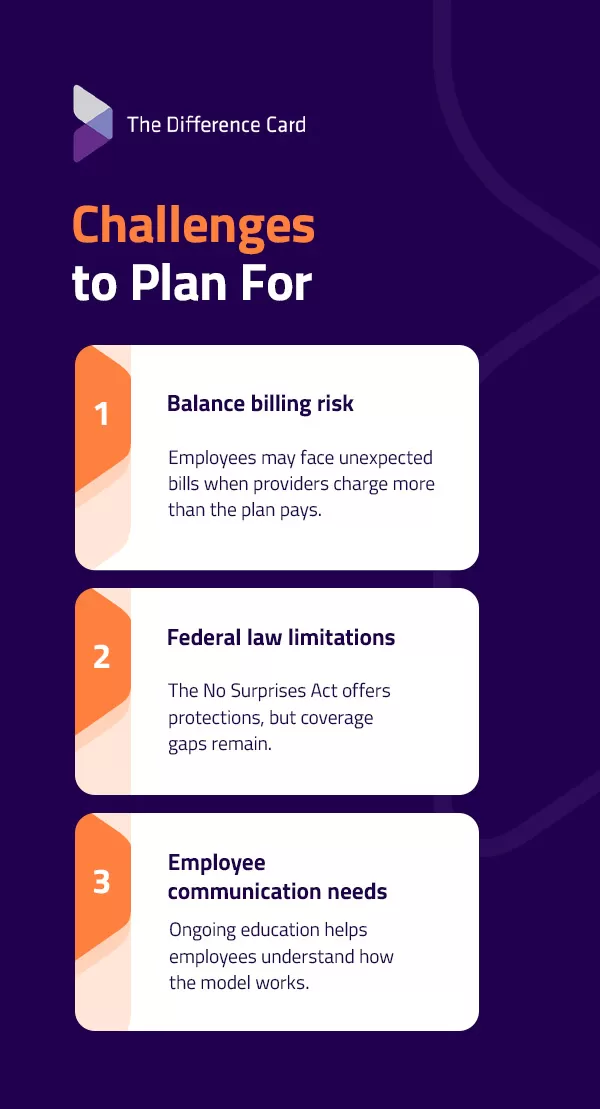
Employers should consider the potential savings and the support employees may need during implementation when weighing RBP pros and cons. The model is cost-effective, but it also introduces challenges that traditional PPO plans avoid.
Prepare for these three primary obstacles.
- Balance billing risk: Employees may receive bills for the difference between what the plan pays and what providers charge, which creates balance-billing disputes. Resolving these situations requires a robust member advocacy infrastructure to negotiate and empower team members through the process.
- Federal law limitations: The No Surprises Act offers some protections, though coverage gaps remain for reference-based pricing plans, requiring plan-level solutions.
- Employee communication needs: Success depends heavily on up-front education and ongoing information to teach employees how the model works.
What Is Balance Billing?
When a provider's full charge exceeds the amount the reference-based pricing plan pays, they'll bill the employee for the difference. This phenomenon, known as balance billing, is a typical concern that brokers and employers raise when evaluating reference-based pricing healthcare models.
Balance billing does not apply to every claim, but it can occur in situations involving surgery, hospitalization, and emergency care. Patients may have questions when they receive care from multiple specialists during a single hospital visit, especially if those providers bill separately.
Emergency physicians, radiologists, anesthesiologists, and hospital-based specialists generate balance bills most frequently because they often operate independently of the facility and bill separately. Strong plans include member advocacy services and support for balance bill negotiation to protect employees when these situations arise.
Recent federal data on surprise billing disputes shows how the No Surprises Act has begun to address some billing concerns. Federal protections under the No Surprises Act also prohibit many surprise balance bills, though gaps and billing issues can still occur.
How the No Surprises Act Affects RBP
The No Surprises Act, which took effect Jan. 1, 2022, prohibits balance billing in specific situations. The law covers emergency care at any facility, specific nonemergency care provided by out-of-network providers at in-network facilities, and air ambulance services.
Applying the law can be more complex for reference-based pricing plans. Since most of these plans have no traditional provider network, they treat all emergency services as out-of-network, so federal surprise billing protections under the No Surprises Act apply to emergency care.
The protections for nonemergency services are more limited because there's no in-network facility standard to reference. For those situations, the plan's advocacy team typically works directly with providers to negotiate a resolution. Employers considering RBP self-funded plan models should understand how federal surprise billing guidance applies to their specific plan design. You can manage these complexities by working with experienced vendors who stay current on regulatory developments.
Communicating RBP to Your Employees
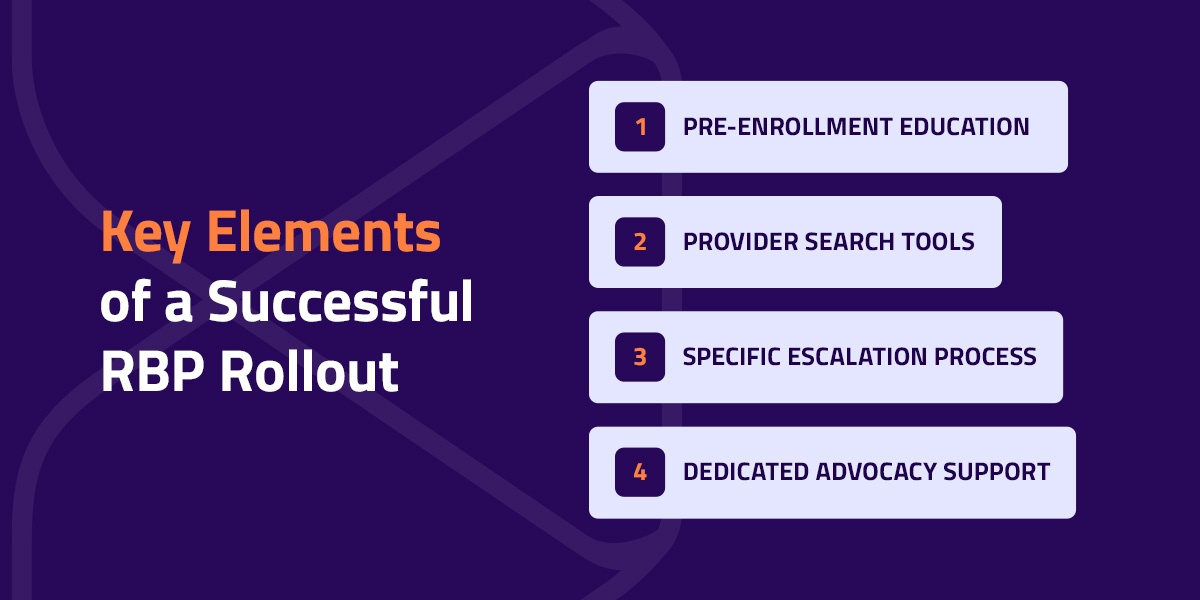
Communication and preparation before the plan goes live determine how smoothly employees experience the transition. Employees who understand reference-based pricing up front experience fewer problems and higher satisfaction than those who encounter it for the first time after filing a claim.
Successful rollouts typically include these four elements.
- Pre-enrollment education: Explain the model in plain language before open enrollment to eliminate surprises. Use simple analogies and real-world examples to illustrate how reference-based pricing works and what it means for their out-of-pocket costs.
- Provider search tools: Provide resources to help employees find providers who accept reference-based pricing rates. Many vendors offer online directories or concierge services to assist with provider selection before scheduled procedures.
- Specific escalation process: Document a process for employees who receive unexpected charges. Employees should know who to contact and how to respond if they receive a balance bill.
- Dedicated advocacy support: Offer a member advocacy contact or hotline so employees know where to find answers to their questions. Quick response times and knowledgeable staff make the difference between frustrated employees and confident plan users.
A broker's responsibility in plan design extends beyond selecting the model. Those who help employers develop a communication strategy become more valuable partners and see better client retention. Employee education materials, frequently asked questions, and pre-enrollment webinars all contribute to smoother implementation.
Is RBP Right for Your Self-Funded Plan?
The model works best in specific situations and requires careful evaluation of your workforce, market, and risk tolerance. Consider these factors when assessing fit.
- Best candidates for reference-based pricing: Self-funded employers with a stable workforce, predictable claims volume, and operations in markets where commercial PPO rates run significantly above Medicare. Employers with sophisticated HR teams and employees who are comfortable making healthcare decisions tend to see smoother implementations.
- Potential challenges to consider: Markets with aggressive provider systems that refuse to accept reference-based pricing rates, employees concentrated near facilities with limited negotiation flexibility, or workforces with lower healthcare literacy may face greater friction. Geography and local provider dynamics can affect how smoothly the model works.
In 2025, 67% of covered workers participated in self-funded plans, showing how mainstream self-funding has become and how many employers considering reference-based pricing may already have the funding structure needed to evaluate this model.
Choosing this model starts with a close look at your workforce, market, and risk tolerance. Ask questions like:
- Do you have the infrastructure to support member advocacy?
- Are your employees in a region where providers are more likely to negotiate?
- How do your current PPO rates compare to Medicare benchmarks in your market?
- How prepared are you to handle balance billing situations when they arise?
Reference-based pricing is one tool in a broader cost-containment strategy. The right plan design depends on your specific risk profile, goals, and workforce characteristics. Brokers who can guide employers through this assessment and tailor recommendations to each situation deliver more strategic value.
Explore Cost-Containment Strategies With The Difference Card
Reference-based pricing is one approach to managing healthcare costs within an overarching strategic framework. The Difference Card helps employers and brokers build the most cost-effective health plans available, including alternative funding strategies that reduce spending without reducing benefits.
Since 2001, clients have achieved an average net savings of 18%, totaling nearly $1 billion to date. An A-rated division of Assurant backs The Difference Guarantee, providing employers with financial security and flexibility. Contact The Difference Card to find the appropriate cost-containment strategy for your plan goals.