

What Are Your Benefits Really Worth?

Key Takeaways A Quick Summary
Key Takeaways
- Benefits are a substantial part of total compensation (about 30.1%), so you should evaluate the whole compensation package—not just salary—when interviewing, negotiating, or staying with an employer.
- Key components of a benefits package include health insurance, retirement savings (e.g., 401(k) with employer match), paid time off (PTO), disability and life insurance, dental/vision, and ancillary lifestyle perks (wellness programs, hybrid work, stipends).
- Health benefits specifics: employers typically cover roughly 84% of single premiums and ~74% of family premiums (employees pay ~16% and ~26%, respectively); health coverage represents about 6.9% of annual compensation and average single deductibles are around $1,886.
- You can calculate the dollar value of benefits by assigning monetary values to each component (e.g., employer health contribution as a percentage of salary, retirement match % of salary, PTO value = hourly rate × PTO hours, Social Security/Medicare at 7.65%). Example: on a $60,000 salary the example calculation produced about $15,972 of annual benefits value.
- To assess competitiveness, benchmark your package (aim for ~80–84% single health coverage, ~6% retirement match, at least 15 days PTO, dental/vision, disability), perform a benefits audit, discuss gaps with HR, and consider partners like The Difference Card to optimize healthcare value.
Knowing what your benefits are really worth is an important advantage when you are interviewing for a new position, starting a new job, or even if you have been loyal to your company for a long time. Many employers offer comprehensive benefits to stand out in a competitive landscape and attract the top talent.
When you fully understand what your benefits package is worth, you can use it as a tool to progress in your career. From choosing between potential employers to negotiating new packages at the same company, these insights allow you to look beyond the salary to the whole invisible paycheck.
Benefits account for 30.1% of total compensation for private industry workers, so when focusing on salary alone, you can easily overlook the substantial dollar value sitting in your benefits package. Use this guide to navigate your own compensation package and understand what a strong benefits offering entails.
Understanding Employee Compensation and Benefits
While your total compensation includes both your wages and benefits, these are two distinct offers that provide value in their own ways. Wages typically include your standard pay rate, salary, or commission, as well as stock options and any overtime pay.
Conversely, you receive your benefits as nonmonetary additions to your compensation. Benefit packages cover lifestyle compensation, such as pension plans, health insurance, and vacation time. Some employers also offer additional perks, such as access to wellness programs, workplace gym memberships, stipends, or discounts on workplace services like the in-house coffee shop or cafeteria.
Many employees underestimate their total compensation because wages are easy to see on a pay stub, whereas benefits are harder to quantify. However, when benefits make up nearly a third of the average person's paycheck, knowing what your full compensation entails is essential.
What Makes a Good Benefits Package?
To decide whether your offer is worth taking, it's important to consider what a good benefits package looks like. Certain benefits are legally required of employers, such as Social Security, Medicare, unemployment insurance, and workers' compensation, while others are optional but increasingly expected. HR departments report that healthcare is very or extremely important to 88% of HR leaders, with 96% of employers offering health coverage.
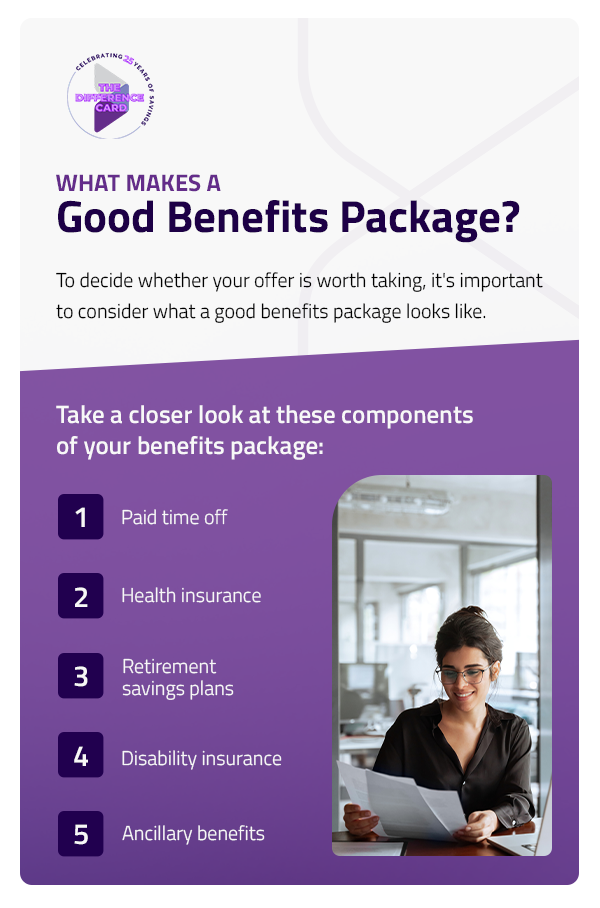
Take a closer look at these components of your benefits package:
- Paid time off: Time off from work forms part of most benefit packages, with the number of days determined by time at the company and role level. To calculate the dollar value of your leave, divide your annual salary by your working hours for the year and multiply this rate by your PTO hours.
- Health insurance: Employers typically cover an average of 84% of single health insurance premiums and around 74% of family premiums. Look into your employer's contribution as part of your benefits package.
- Retirement savings plans: Eighty-two percent of employers say retirement savings and planning benefits are very or extremely important. Many offer a traditional 401(k) or similar defined contribution plan with an employer contribution match.
- Disability insurance: Most policies cover up to 60% of your income if you cannot work due to illness or injury, serving as income protection.
- Ancillary benefits: Additional benefits you may find in your offer include life insurance, dental coverage, and lifestyle benefits such as therapy, wellness programs, and hybrid work models.
How Much Are Employee Benefits Worth?
Even though you do not receive the value of your benefits in cash, their worth is measurable. Health insurance or retirement contributions have an explicit monetary value, while flexible hours or a hybrid model have more implicit worth.
When you evaluate your benefits package, consider the cost and the value these benefits add on a personal or professional level. While benefits don't show up as a direct deposit, they can represent thousands of dollars in annual value.
Health Insurance Costs
Since health insurance is one of the most important parts of your benefits package and the highest-value benefit by dollar amount for most workers, it is essential to understand its worth and coverage parameters.
How much your healthcare benefits are worth will largely depend on which coverage plan your employer has opted for. Coverage can range from the bare minimum to fully comprehensive. According to a 2025 KFF study, employees typically contribute 16% of the premium for single coverage and 26% for family coverage. Health insurance coverage accounts for roughly 6.9% of an employee's annual compensation.

Be sure to consider your copayments when evaluating the total value of your health insurance. The average general annual deductible is $1,886 for single coverage. The Difference Card provides custom-tailored benefit accounts funded entirely by your employer to help reduce your out-of-pocket health insurance costs and get the best value out of your coverage.
Retirement Plans
Retirement savings plans are another essential benefit to consider. How much your retirement package is worth depends on the plan your workplace offers and the employer contribution match. Most employers offer a 401(k) with an employer match. If your employer offers a match and you contribute to the plan, they will match your contribution up to a predefined percentage of your salary toward your retirement savings. The employer match rate is often 6% of your salary.
Leave Benefits and Paid Time Off
Most workplaces will offer some form of leave benefits, which may include paid time off (PTO), sick leave, family leave, and parental leave. If you know your hourly rate and number of PTO days, multiply them to calculate a concrete dollar value for your paid leave.
Depending on your contract and employer, you may receive sick leave, family leave, and parental leave either in addition to your PTO offer or as part of your total number of days off. Paid leave costs employers $2.24 per hour at the median for private industry workers, so unused PTO is effectively money left on the table for both you and your employer.
Disability, Life, Dental, and Vision Insurance
Many employers also offer ancillary benefits to make their offers more attractive and competitive. These can include disability coverage, life insurance, and dental plans.
Disability insurance covers a portion of your income if an employee cannot work due to illness or injury, essentially protecting your income if you cannot work. Employer-sponsored group life typically provides coverage of one to two times your annual salary, often at no cost to you.
Additionally, most employers also offer dental and vision insurance, which offer concrete out-of-pocket savings.
Lifestyle Benefits
While lifestyle benefits often have no monetary value, they can significantly contribute to your job satisfaction, productivity, motivation, and career longevity. Lifestyle benefits promote a healthy work-life balance — don't disregard these vital benefits when considering a position or an offer.
Lifestyle benefits can include perks like flexible hours, work-from-home or hybrid options, and access to facilities like a workplace gym.
While it can be challenging to quantify the exact worth of these benefits across the board, consider the following ways in which they add monetary value:
- Fuel savings: Work-from-home or hybrid work models can significantly reduce your commuting costs.
- Time savings: Hybrid and flexible work models also offer time savings, since travel time to and from the office during peak traffic is reduced.
- Out-of-pocket savings: Access to free or discounted memberships, such as gym memberships, or to therapeutic, legal, or financial counseling, removes or reduces those expenses from your budget.
Why Competitive Benefits Matter
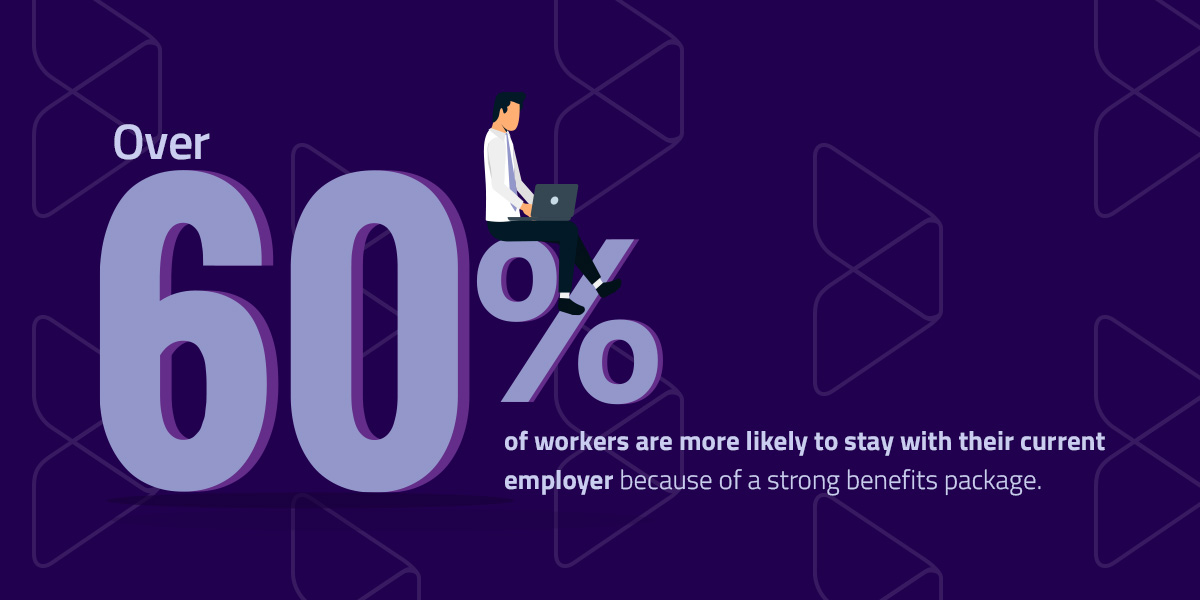
Benefits are one of the most powerful tools for attracting and retaining talent. According to a LIMRA press release, over 60% of workers are more likely to stay with their current employer because of a strong benefits package.
In a competitive labor market, a strong benefits package can be worth more to a candidate than a salary increase. Since rising healthcare costs are the top issue influencing employers' benefits strategy, The Difference Card helps them deliver maximum value efficiently.
How to Assess the Value of Your Benefits Package
Now that you know what each benefit type is worth, here is how to put a specific dollar figure on your package and benchmark it against what the market offers.
Calculating the Dollar Value of Your Benefits
For this calculation, consider an annual salary of $60,000. A step-by-step benefit calculation would entail:
- Health insurance: Considering an employer's annual contribution of 6.9% of your salary, that would equate to $4,140 in value on top of your compensation.
- Retirement match: With the average retirement match of 6% of your salary, in this case, you would receive up to $3,600 in retirement benefit value.
- PTO: On an annual salary of $60,000, if you work an average of 2,080 hours and receive 15 days of paid time off per year, your hourly earnings of $28.85 would equate to $3,462 in additional compensation.
- Social Security and Medicare contributions: At a combined rate of 7.65% for both Social Security and Medicare contributions, on a $60,000 salary, that would equate to $4,590 of additional value through your benefit package.
Using this salary example, the total annual value of the benefits package would be $15,972 in addition to the salary.
How to Compare Your Package to Industry Benchmarks
Now that you know your benefit package's dollar value, how do you know if it is competitive? Evaluate your benefits package against the latest benchmarks. If your employer covers less than 84% of your single health premium, less than 74% of your family healthcare premium, or offers no 401(k) or similar retirement contribution match, your package may be below market.
A formal benefits audit can surface both gaps and savings opportunities for employers and enable them to strengthen their benefits packages. The Difference Card is a partner that helps organizations build cost-effective packages that clear the competitive bar.
Frequently Asked Questions
Learn more about the importance and value of your employee benefits by exploring these frequently asked questions:
How much are benefits worth in salary?
On average, benefits are worth about 30.1% of your total compensation, and are separate from salary — they don't appear as cash but represent real dollar value. For your current employment, you can easily see how much your benefits are worth.
Your paycheck should reflect some of your benefits and will often include a monetary value. The monetary value will never be in the form of cash, but it shows what your employer contributes on your behalf to give you access to or increase your privileges with these benefits.
What is a good benefits package?
A good benefits package remains competitive even when compared against current benchmarks. Today, a comprehensive benefits package will include:
- Health coverage, with the employer paying at least 80%–84% of single premiums
- A 401(k) with an employer match of around 6%
- At least 15 days of PTO with included or separate sick leave
- Dental and vision coverage for employees and sometimes their families
- Disability insurance and other ancillary plans
Why is it important to have good benefits?
A good benefits package is much more than "perks." Benefits are the foundation of the relationship between an employer and an employee, especially since they can account for a significant portion of your total compensation. Comprehensive benefits packages can also improve your job satisfaction and inspire you to remain loyal to a single employer for years.
Benefits offer financial protection, retirement security, and quality-of-life tools. For employees, a strong package significantly increases total compensation and provides security against major life events, such as illness, disability, or retirement. For employers, good benefits reduce turnover and attract top talent.
What steps can I take to assess my benefits?
Determining the value of your employee benefits package can be easier than you realize! While the assessment will only be a relative estimate, since some benefits, like flexible hours or exceptional facilities, do not have an exact dollar value for you, it is still possible to get a clear overview of your benefit package's value.
For a basic assessment of your benefits, follow these steps:
- List all current benefits
- Assign dollar values using the calculation framework in this post
- Compare to market benchmarks
- Identify any gaps
- Contact your HR team to discuss options
Employee compensation calculators can also help you tally the value, or you can explore your providers for additional insights. For example, with The Difference Card, our member resources and tools help you understand your benefits.
Maximize Employee Benefits With The Difference Card
Since 2001, The Difference Card has delivered clients an average net savings of over 18% on annual healthcare costs — nearly $1 billion and counting — while maintaining the highest level of employee benefits.
Contact The Difference Card to learn more about delivering maximum benefit value — especially on healthcare — without overspending.