

How To Present an HSA To Your Employer Clients
Key Takeaways A Quick Summary
Key Takeaways
- Rising health costs are driving employers to seek solutions — total health benefit cost is on pace to exceed $18,500 per employee in 2026 — so lead client conversations by focusing on the cost problem before proposing products.
- An HSA paired with an HDHP offers a clear, market-ready option: HDHPs have lower monthly premiums (example: $109 vs $191) and HSAs provide tax-advantaged funds to cover qualified expenses; 2026 HDHP minimum deductibles are $1,700 (self) and $3,400 (family).
- Use concrete 2026 numbers in presentations: HSA contribution limits are $4,400 (self) and $8,750 (family) with a $1,000 catch-up for 55+, and HDHP out-of-pocket maximums are $8,500 (self) and $17,000 (family); also emphasize the HSA’s triple tax advantage and account portability.
- Anticipate and answer employer objections: mitigate deductible concerns by recommending employer contributions (average employer HSA contribution in 2026 is $1,060 individual/$1,769 family), use seed or deductible-gap funding (front-loading often preferred), provide simple employee education, and use partners to handle administration and Section 125 requirements.
- Leverage recent policy and market changes and partner support: The OBBBA expanded HSA eligibility (marketplace bronze/catastrophic plans, direct primary care limits, permanent pre-deductible telehealth), and working with a plan-design partner (or MERP strategies) can deliver tax/FICA savings and higher employee adoption.
Your employer clients are bringing up health savings accounts more than they used to. That's not a mere coincidence. Renewal costs keep climbing, and you're often the one who has to turn that pressure into a plan that employers feel good about. Total health benefit cost is on pace to exceed $18,500 per employee in 2026, a 6.7% increase.
When a number like that lands in front of an employer, they usually turn to you looking for a real option. A health savings account (HSA) paired with a high-deductible health plan (HDHP) gives you a clear option to bring to the table. It also gives you a practical way to address concerns about cost, deductibles, and employee education.
Knowing where the broader insurance market is headed only strengthens that pitch further, and keeping an eye on 2026 insurance trends can help you walk into these conversations with more to offer.
A Broker's Guide for Presenting an HSA
Whether you're refining how to sell an HSA plan or presenting this pairing for the first time, this three-step approach gives you a repeatable structure for the employer meeting, regardless of company size or plan history.
1. Lead With the Cost Problem
Before mentioning an HSA, start with the employer’s own numbers. Renewal quotes are climbing, and employers are feeling the strain. Average family premiums reached $26,993 in 2025, up 6% year over year, and these costs are pushing employers toward action. Meanwhile, 59% of employers planned cost-cutting changes to their health plans in 2026, up from 48% the year before.
An HSA-paired plan gives employers a direct answer to a problem they're already trying to solve. Starting with the problem they already feel, rather than a product pitch, sets up the rest of the sales conversation.
2. Introduce the HDHP and HSA Pairing
An HDHP usually has a lower monthly premium and a higher deductible. The HSA gives employees a tax-advantaged way to pay for qualified costs before they meet that deductible.
Among large employers, employees enrolled in an HDHP paid an average of $109 per month, compared with $191 per month for a preferred provider organization plan. That’s a savings of $82 per employee, per month. To qualify, a plan must meet the 2026 HDHP minimum deductible of $1,700 for self-only coverage and $3,400 for family coverage.
That trade-off can still feel intimidating at first. The HSA helps balance the concern by giving employees funds they can use when they need care.
Keep the explanation simple in the employer meeting. The employer doesn't need a breakdown of every rule right away. Start with why the lower premium matters. Then show how the HSA can help employees manage qualified expenses. From there, explain the support available to employees if they have questions after enrollment.
3. Put Numbers To the Value
When presenting the plan, show what the HDHP and HSA pairing means in real numbers. For employees, the 2026 HSA contribution limits are $4,400 for self-only coverage and $8,750 for family coverage. Anyone 55 or older can add an additional $1,000 catch-up contribution, and every dollar an employee contributes lowers their taxable income for the year.
Employers can also see tax savings when contributions are made through a Section 125 cafeteria plan. Because those dollars move pre-tax, they can reduce the employer’s FICA tax exposure. Some employers haven't fully taken advantage of this yet, which gives you room to differentiate your recommendation with a stronger contribution strategy. Walking an employer through FICA tax savings and the tax benefits of offering an HSA tends to land well once the concept is on the table.
Benefits To Discuss in Your Presentation
These are the specific employee health plan benefits worth highlighting for employees and the employer's bottom line.
The Triple Tax Advantage
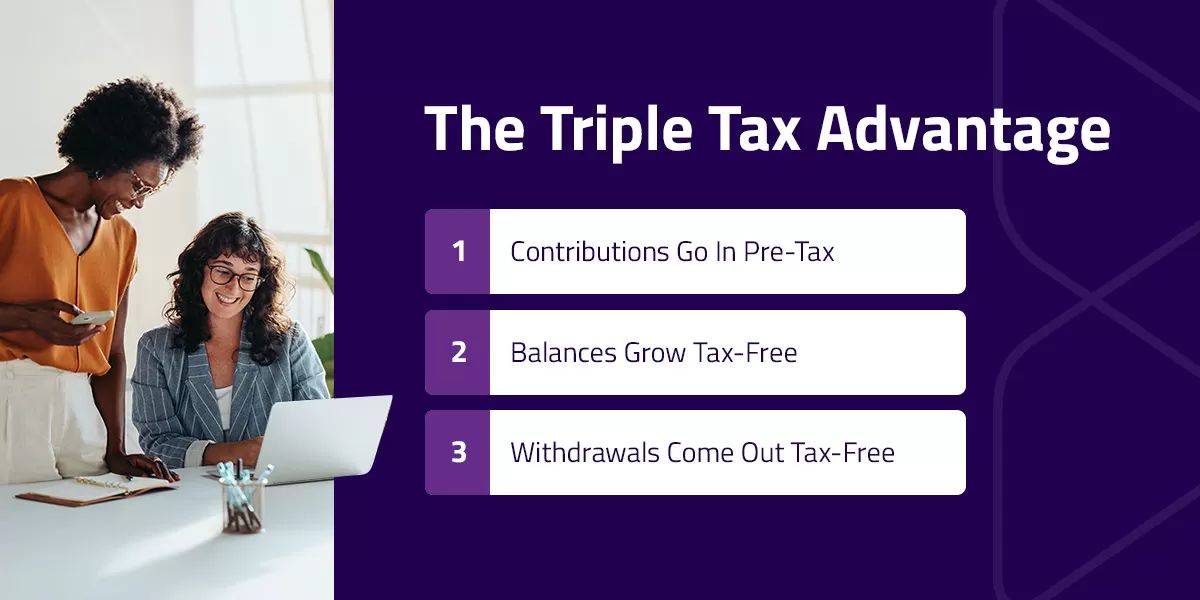
An HSA offers what's often called a triple tax advantage, and breaking it into its three stages makes the concept easy for an employer to follow:
- Contributions go in pre-tax: When employees contribute through payroll, those dollars are excluded from federal income tax and FICA tax. In most states, they are also excluded from state income tax.
- Balances grow tax-free: Funds sitting in the account accumulate without triggering any additional tax liability.
- Withdrawals come out tax-free: Money used for qualified medical expenses is never taxed at any point in the process.
For an employee, that means every dollar contributed stretches further than a dollar spent straight from a paycheck. Many employees don't fully grasp this on their own, so explaining it clearly is part of what makes a broker's presentation valuable. Unlike a flexible spending account (FSA), which comes with a use-it-or-lose-it deadline, funds in an HSA roll over indefinitely. Walking employers through how an HSA compares to an FSA or HRA can help frame this distinction clearly.
Premium and FICA Savings for Employers
Employers may see two types of savings from this approach. Moving to an HDHP can lower monthly premiums, while contributions through a Section 125 cafeteria plan can create FICA savings. Together, these savings can help employers lower plan costs throughout the year, not just at renewal.
Advisors who help employers structure and communicate these tax efficiencies clearly can turn a routine renewal into a broader strategic discussion.
Leading with FICA tax savings gives employers a clear reason to keep listening.
Portability Employees Own and Keep
Portability is one of the clearest advantages of an HSA. If they leave the company, they keep the money in their HSA. For employers, this ownership can make the benefit package more valuable in a competitive labor market.
That's a detail worth stating plainly, since it directly answers a concern many employers raise without being asked. Framing how an HSA compares to an HRA or FSA around ownership can reinforce why this benefit matters to employees long term.
Respond to Common HDHP Employer Objections
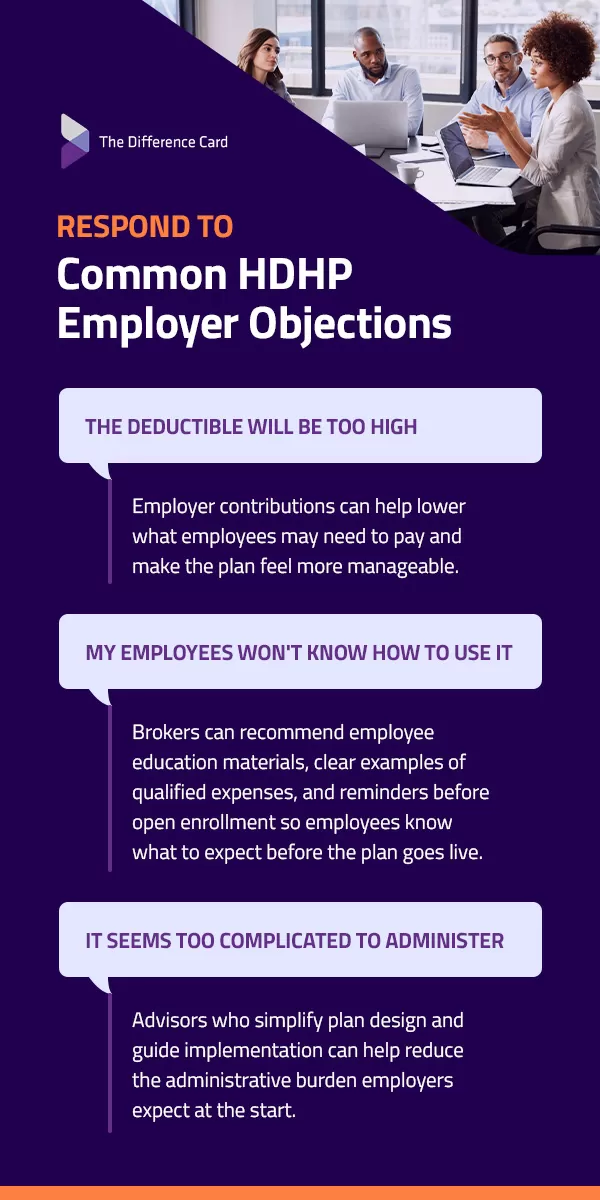
Employers may have questions about an HSA-paired plan, especially around deductibles, employee education, and administration. Your role during the sales conversation is to answer these questions clearly and show how the plan can work for their team.
The Deductible Will Be Too High
Start by acknowledging the concern. A higher deductible can feel risky to employers and employees. Employer contributions can help lower what employees may need to pay and make the plan feel more manageable.
The average maximum employer HSA contribution is $1,060 for individual coverage and $1,769 for family coverage in 2026. If an employer applies that $1,060 contribution to the $1,700 HDHP minimum deductible, the employee has about $640 left before the deductible is covered.
Most plans do not close that gap. Only 3% of workers in an HSA-qualified HDHP receive employer contributions equal to or greater than their deductible.
A well-funded contribution strategy built around annual contribution limits immediately sets a broker's recommendation apart from a plan employers may have already dismissed elsewhere.
My Employees Won't Know How To Use It
Employee education is one of the most common reasons an HSA underperforms after launch, but it's also a solvable problem rather than a flaw in the plan itself. Employees generally need to understand how the HSA debit card works, which expenses may qualify under IRS Publication 502, and how contributions get set up.
A simple rollout plan can make a big difference here. Brokers can recommend short employee education materials, clear examples of qualified expenses, and reminders before open enrollment so employees know what to expect before the plan goes live.
Complexity and unclear employee communication are often the real barriers to adoption. As a broker, you can help simplify that communication. Working alongside a plan design partner can also give employers the education resources and ongoing support they need to make the benefit easier to use.
It Seems Too Complicated To Administer
An HSA-paired plan does have a few extra administrative steps. Employers may need Section 125 plan documentation, contribution tracking, and nondiscrimination testing under Section 125 requirements.
These pieces are manageable with the right partner in place, and often far less demanding than employers initially expect. Advisors who simplify plan design and guide implementation can help reduce the administrative burden employers expect at the start. The message worth reinforcing throughout is simple. No employer has to handle this alone.
HSA Employer Contribution Strategies To Strengthen Your Pitch
A clear contribution strategy helps employers see how an HSA-paired plan can work for their team. It also shows employers that you can help them think through the bigger-picture benefits.
That extra guidance can be especially helpful when employers are comparing multiple plan options and trying to balance savings with employee satisfaction.
Employer Contributions Are the Top HSA Adoption Driver
Employer funding is one of the strongest reasons employees open and use an HSA. About 54% of current HSA holders opened their accounts primarily to receive employer contributions.
The HSA product itself is already mainstream, with roughly 63% of employers currently offering one. Recommending a clear contribution strategy helps you bring more value to the employer conversation.
Employers who seed their HSA product see an 11% higher adoption rate than those who don’t, which can support stronger ROI and retention.
How To Recommend a Contribution Approach
We recommend one of these two practical approaches when you present the plan in an employer meeting:
- Seed contributions: A lump sum deposited at the start of the plan year gives employees immediate access to funds and immediate confidence in the benefit.
- Deductible-gap funding: The employer uses HSA contributions to cover part of the deductible, making the higher deductible feel more manageable for employees. Using the $1,700 deductible and $1,060 average contribution figures, this approach can reduce the employee’s remaining responsibility to a few hundred dollars.
Many brokers recommend front-loading contributions at the start of the plan year instead of spreading them across pay periods. This gives employees access to the full contribution amount if unexpected costs arise early in the year.
One rule worth flagging is that contributions made outside a Section 125 cafeteria plan are subject to IRS comparability requirements under Internal Revenue Code Section 4980G. These contributions must be equal in amount or percentage of the deductible for all eligible employees in the same coverage class.
Key 2026 HSA Numbers Every Broker Should Know
These are the numbers you should have ready before walking into any employer meeting this year.
Contribution Limits and HDHP Thresholds
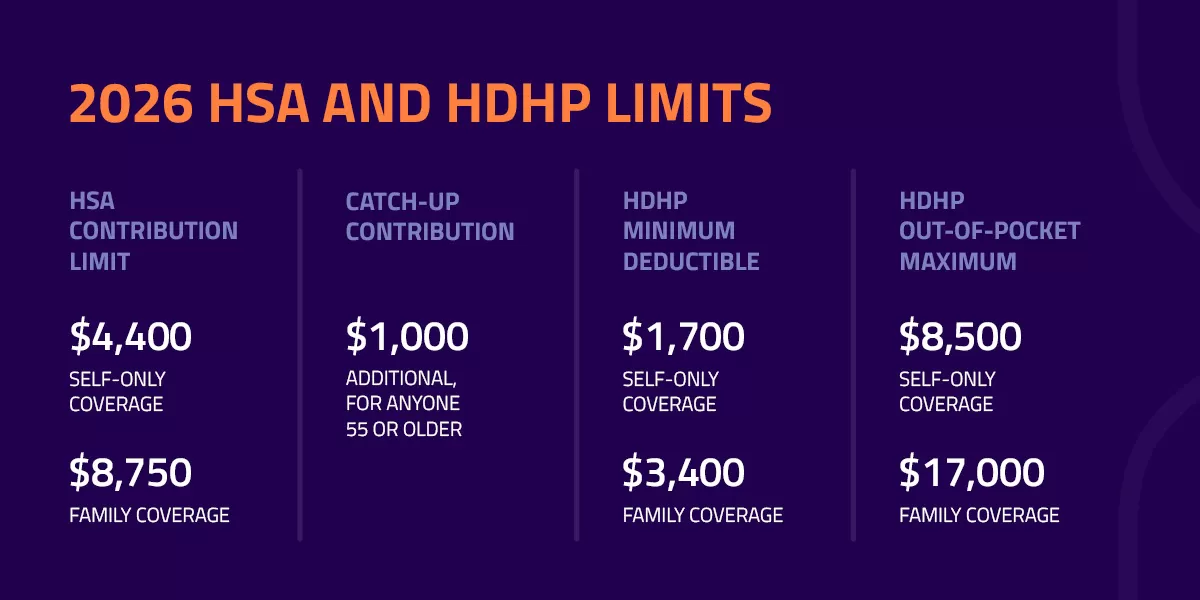
Here are the key 2026 HSA and HDHP limits brokers should have ready:
- HSA contribution limit: $4,400 for self-only coverage and $8,750 for family coverage.
- Catch-up contribution: An additional $1,000 for anyone 55 or older.
- HDHP minimum deductible: $1,700 for self-only coverage and $3,400 for family coverage.
- HDHP out-of-pocket maximum: $8,500 for self-only coverage and $17,000 for family coverage.
These figures serve as the authoritative reference for every number cited earlier in this guide, including the annual HSA contribution limits covered above.
What the OBBBA Means for HSA Conversations
The One Big Beautiful Bill Act (OBBBA) made several updates that affect HSA eligibility. Key provisions take effect across 2025 and 2026. These changes give brokers a few timely talking points:
- Marketplace plans: Bronze and catastrophic Affordable Care Act marketplace plans now qualify as HSA-eligible HDHP coverage. This change is estimated to extend eligibility to 7.3 million more Americans.
- Direct primary care: Membership fees no longer disqualify someone from HSA eligibility, provided the arrangement stays within the IRS-defined monthly limit.
- Telehealth coverage: Pre-deductible telehealth access is now permanent for plan years beginning on or after Jan. 1, 2025, so employers can offer it without jeopardizing HSA eligibility.
Some employer clients may have employees who are newly eligible under these changes. That can make HSA eligibility a natural topic to raise at the next renewal. The One Big Beautiful Bill Act HSA changes cover these updates in more depth for anyone who wants to go further.
Partner With The Difference Card To Present HSA Plans With Confidence
The right plan design partner can make HSA planning easier. We support brokers with HSA plan designs and other strategies, including MERP-based designs as needed. A MERP, or medical expense reimbursement plan, uses a single underlying carrier plan, giving brokers more flexibility when building options for employer clients. Understanding how a MERP differs from an HSA can help you guide employers toward the option that best fits their needs.
We've delivered over $2.13 billion in healthcare savings to clients so far, with an average net savings of over 18% and a dedicated account manager for every relationship. Pulling from strategies for broker clients can help you sharpen your pitch even more for your own book of business.
If you’re already having these conversations with employer clients, you do not have to navigate them alone. Contact The Difference Card to learn more and bring in a plan design partner who can support your recommendation with real numbers and reliable support.