
Comparing Tax-Advantaged Accounts: HSA, FSA, and HRA

Key Takeaways A Quick Summary
Key Takeaways
- Healthcare costs are rising, putting pressure on employers to offer meaningful benefits without stretching budgets while employees seek more support for everyday and future medical expenses.
- HSA, FSA, and HRA all offer tax advantages but differ materially: HSA is employee-owned, fundable by employee and/or employer, requires a qualifying HDHP, rolls over indefinitely and is portable; FSA is employer-owned, primarily funded by employee payroll deductions, works with most plans, provides immediate access to the annual election but is subject to use‑it‑or‑lose‑it rules and is generally not portable; HRA is employer-owned and -funded, reimburses eligible expenses per employer rules and is usually not portable.
- HSA offers a triple tax advantage—pretax contributions, tax‑free investment growth, and tax‑free withdrawals for qualified medical expenses—making it strong for long‑term healthcare savings and retirement planning; HSA eligibility requires enrollment in a qualifying HDHP and other IRS criteria, and 2026 contribution limits are $4,400 (self), $8,750 (family) with a $1,000 catch‑up for age 55+.
- FSA provides pretax dollars for predictable annual healthcare costs, gives access to the full annual election at the plan year's start, has a 2026 contribution limit of $3,400, and is subject to the IRS 'use it or lose it' rule unless the employer permits up to a $680 carryover or a 2.5‑month grace period.
- HRA is an employer‑funded reimbursement arrangement (no employee contributions) with flexible designs—traditional HRA, Individual Coverage HRA (ICHRA), Qualified Small Employer HRA (QSEHRA), and Excepted Benefit HRA (EBHRA)—that reimburse eligible expenses tax‑free, with employers controlling funding, qualified expenses and portability.
Healthcare costs continue to rise, with the average annual premiums for employer-sponsored family health coverage up by 6% in 2025 compared to 2024. As a result, employers face growing pressure to offer meaningful benefits without stretching already tight budgets. Employees also want more support as they manage everyday medical expenses and prepare for future healthcare needs.
A health savings account (HSA), flexible spending account (FSA), and health reimbursement arrangement (HRA) each help reduce healthcare costs through tax advantages. Yet these similarities can make the decision more confusing. Each account follows different rules, ownership varies, funding works differently, and long-term value depends on how employees use their benefits.
That creates an important question. Which account offers better tax benefits?
Here is a guide from The Difference Card explaining how each account works, how to qualify, and which option may best support your workforce.
HSA, FSA, and HRA: How They Compare at a Glance
For brokers, benefits consultants, and employers, understanding how these accounts compare matters. The right account can improve affordability, strengthen a benefits package, and help employees make more informed healthcare decisions.

Although all these options provide tax advantages for qualified medical expenses, they operate in very different ways. Before comparing the finer details, it helps to understand each account's structure:
| Feature | HSA | FSA | HRA |
| Ownership | Employee | Employer | Employer |
| Who funds it? | Employee, employer, or both | Primarily employee through salary reduction, with optional employer contributions | Employer only |
| Required health plan | Qualified high-deductible health plan (HDHP) | Compatible with most employer-sponsored health plans | Depends on HRA design |
| Rollover rules | Full balance rolls over indefinitely | Generally subject to use-it-or-lose-it, with limited employer-approved exceptions | Determined by the employer |
| Portable when employment ends? | Yes | No | Usually no |
The popularity of these accounts varies. While all three reduce healthcare costs, their value depends on your workforce, benefit strategy, and long-term objectives.
The HSA Triple Tax Advantage
An HSA offers one of the strongest tax benefits available through an employer-sponsored health plan. It's a personal savings account available to employees enrolled in a qualifying HDHP. Employees can contribute pretax dollars, invest their savings over time, and withdraw funds tax-free for eligible healthcare expenses.
This combination creates what many financial professionals call the triple tax advantage:
- Employees get tax savings when they contribute money.
- Investment earnings grow without federal income tax.
- Qualified medical withdrawals are tax-free.
The HSA belongs to the employee. The account stays with them when they change jobs or retire, creating a long-term healthcare savings vehicle instead of a short-term spending account.
Who Is Eligible for an HSA?
HSA eligibility follows strict Internal Revenue Service (IRS) requirements. Employees must meet all requirements before contributing. To qualify, an employee must:
- Be enrolled in a qualifying HDHP on the first day of the month.
- Have no other disqualifying healthcare coverage.
- Not be enrolled in Medicare.
- Not be claimed as a dependent on another person's federal tax return.
Another important consideration involves an FSA. A general-purpose FSA typically makes an employee ineligible to contribute to an HSA. However, employees may remain eligible if their employer offers a limited-purpose FSA for qualified dental and vision expenses only.
Eligibility also depends on the health plan itself. For 2026, an HDHP must meet minimum deductible requirements and remain within the annual out-of-pocket maximum limits established by the IRS.
HSA Contribution Limits and Rollover Rules
The IRS establishes annual contribution limits for the HSA. For 2026, employees may contribute $4,400 for self-only coverage, $8,750 for family coverage, and, for employees age 55 and older, an additional $1,000 as a catch-up contribution. HSA funds also never expire.
Every unused dollar rolls into the following year automatically. Employees continue building savings throughout their careers without worrying about forfeiting unused balances.
Another advantage involves funding flexibility. Employees can contribute through payroll deductions. Employers may also contribute. Family members and other individuals may make contributions as long as total annual deposits remain within IRS contribution limits. This flexibility allows employers to encourage participation while giving employees greater control over how much they save.
The Long-Term Value of an HSA
Many employees first view an HSA as a way to cover deductibles or unexpected medical bills. Over time, however, the account becomes much more valuable.
Employees who consistently contribute and invest their balances can build significant healthcare savings for retirement. Because medical expenses often increase with age, tax-free healthcare savings can help offset future financial pressure. Many HSA administrators also allow employees to invest balances after reaching a minimum cash threshold. Investment options often include mutual funds, similar to those in retirement accounts.
Over several decades, tax-free investment growth may substantially increase the account's value. Retirement adds another layer of flexibility.
After age 65, employees may withdraw HSA funds for nonmedical expenses without paying the usual nonmedical withdrawal penalty. However, ordinary income taxes apply to those withdrawals, much like a traditional retirement account.
Qualified medical expenses remain completely tax-free. That distinction makes the HSA unique among healthcare benefit accounts. It supports both current medical needs and long-term financial planning.
Healthcare expenses during retirement also continue climbing. Today's retirees may need hundreds of thousands of dollars in after-tax savings to cover healthcare costs throughout retirement. An HSA helps employees prepare for those expenses while maximizing tax efficiency.
For employers, encouraging HSA participation can also strengthen employee financial wellness. Workers who understand the long-term value of healthcare savings often become more engaged in managing both healthcare spending and retirement planning. An HSA works especially well for employees who:
- Expect relatively low annual healthcare expenses.
- Want to build long-term savings.
- Prefer keeping their healthcare account when changing employers.
- Value investment opportunities alongside healthcare benefits.
- Plan to prepare early for healthcare costs in retirement.
The FSA's Flexibility With a Deadline
An FSA helps employees pay for eligible healthcare expenses using pretax dollars during the plan year. However, the FSA belongs to the employer, rather than the employee.
Employees contribute through payroll deductions, reducing their taxable income while setting aside money for anticipated medical expenses. Funds can be used for qualified costs, such as:
- Deductibles
- Copayments
- Prescriptions
- Dental care
- Vision services
- Selected over-the-counter products
An FSA works well for employees who expect regular healthcare expenses throughout the year. It also gives employees another way to strengthen their benefits package without requiring a high-deductible health plan.
Who Is Eligible for an FSA?
FSA eligibility depends on the employer benefits program rather than a specific type of health insurance. Employees generally qualify if they:
- Work for an employer that offers an FSA.
- Elect coverage during the employer's open enrollment period or after a qualifying life event.
- Reenroll each year if the employer requires annual elections.
Employees do not need to enroll in an HDHP. An FSA works alongside most employer-sponsored health plans, including preferred provider organization (PPO), health maintenance organization (HMO), and other traditional medical plans.
Although the FSA option is widely available, adoption has gradually declined while employers have introduced HSA-qualified health plans.
FSA Contribution Limits and the Use-It-or-Lose-It Rule
The IRS sets an annual contribution limit on a healthcare FSA. In 2026, employees can contribute up to $3,400 to a healthcare FSA through payroll deductions.
One feature that may surprise new participants is that employees gain access to their entire annual election on the first day of the plan year. Even though payroll deductions occur throughout the year, immediate access can help someone cover an unexpected medical bill early in the year without waiting for contributions to accumulate.
An FSA also follows the IRS "use it or lose it" rule. Employees generally forfeit unused funds at the end of the plan year unless the employer chooses one of two optional exceptions:
- A maximum unused funds carryover of up to $680 into the following plan year.
- A grace period of up to 2.5 months after the plan year ends.
Employers can offer one option or neither, but not both. Reviewing these rules before enrollment helps employees estimate contributions more accurately and avoid leaving money behind.
Because contribution elections cannot usually change midyear, employees benefit from estimating predictable healthcare expenses. Planned dental work, ongoing prescriptions, and recurring therapy appointments often provide a reasonable starting point.
The HRA Employer-Funded Reimbursement
An HRA works differently from both an HSA and an FSA. Instead of employees contributing money to an account, the employer sets aside funds and reimburses employees for eligible healthcare expenses.
Employees cannot contribute their own money to an HRA. The employer determines how much funding to provide, which expenses qualify, and how reimbursements work within IRS rules. This structure gives employers significant flexibility while helping employees reduce out-of-pocket healthcare costs.
How an HRA Works
An HRA operates as a reimbursement benefit rather than a savings account. Employees first incur an eligible medical expense. They then submit documentation to the employer or plan administrator. Once the expense is approved, the employer reimburses the employee using available HRA funds.
A traditional HRA does not have an IRS-set annual contribution limit. Employers decide how much funding best supports their workforce and benefits strategy. HRA reimbursements are generally excluded from employees' taxable wages, giving both employers and employees valuable tax advantages.
Another important distinction involves ownership. The HRA belongs entirely to the employer. If an employee leaves the organization, unused funds generally stay with the employer unless the plan specifies otherwise. For employers, this flexibility creates opportunities to design benefits around workforce needs while maintaining greater control over healthcare spending.
Types of HRA Plans
Several HRA designs serve different types of employers and employees:
- Traditional integrated HRA: A traditional HRA works alongside a group health plan, and employers reimburse eligible medical expenses that the underlying insurance does not fully cover.
- Individual Coverage HRA (ICHRA): An ICHRA allows employers to reimburse employees for the cost of their own individual health insurance. Instead of sponsoring a group plan, employers offer tax-free reimbursements for premiums and other eligible expenses.
- Qualified small employer HRA (QSEHRA): A QSEHRA is available to small employers without a group health plan. This plan is subject to IRS rules that allow employers to reimburse employees for self-only or family coverage.
- Excepted benefit HRA (EBHRA): An EBHRA supplements a traditional group health plan by reimbursing certain excepted benefits and qualified medical expenses.
What Is the Difference Between an HRA and an HSA?
Although both accounts help reduce healthcare costs, they serve different purposes:
- Ownership: An HSA belongs to the employee, and the account follows them throughout their career. An HRA belongs to the employer, and employees generally lose access after leaving the company.
- Funding: Employees, employers, and even family members can contribute to the HSA, as long as contributions stay within IRS limits. Only employers can fund an HRA.
- Health plan requirements: An HSA requires enrollment in a qualified HDHP. An HRA offers more flexibility because employers determine how the arrangement integrates with their healthcare strategy.
In practice, an HRA often reduces employees' immediate out-of-pocket costs by reimbursing expenses as they occur. An HSA focuses more heavily on long-term healthcare savings while giving employees greater ownership and investment opportunities.
Which Account Offers Better Tax Benefits?
Each account offers distinct tax advantages, but the value depends on your goals.
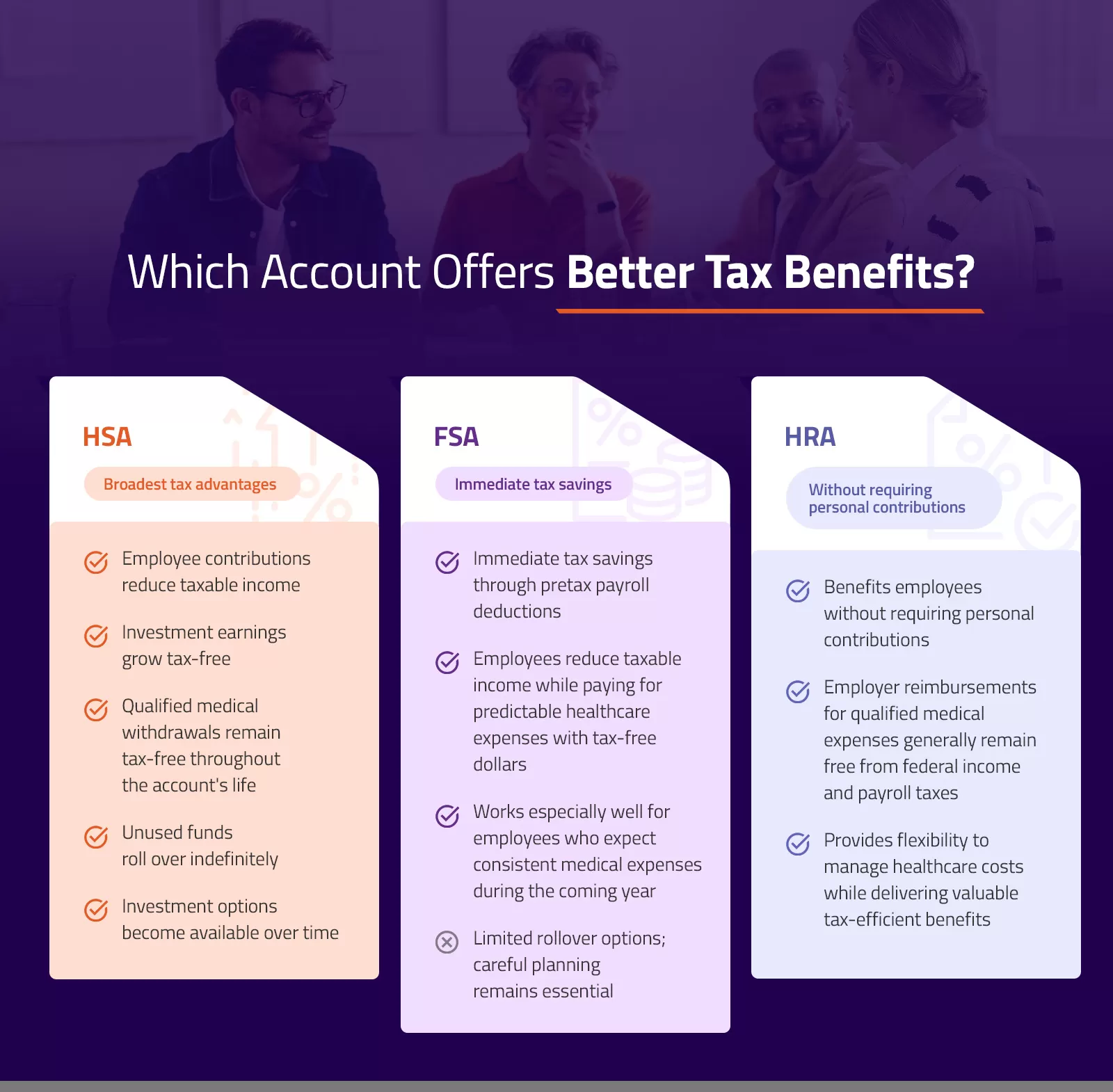
An HSA has the broadest tax advantages, as employee contributions reduce taxable income. Investment earnings grow tax-free, and qualified medical withdrawals remain tax-free throughout the account's life. Because unused funds roll over indefinitely and investment options become available over time, many financial professionals see an HSA as both a healthcare account and a supplemental retirement savings vehicle.
An FSA delivers immediate tax savings through pretax payroll deductions. Employees reduce taxable income while paying for predictable healthcare expenses with tax-free dollars. The account works especially well for employees who expect consistent medical expenses during the coming year. However, limited rollover options mean careful planning remains essential.
An HRA benefits employees without requiring personal contributions. Employer reimbursements for qualified medical expenses generally remain free from federal income and payroll taxes. From an employer's perspective, an HRA provides flexibility to manage healthcare costs while delivering valuable tax-efficient benefits.
Choosing the Right Account for Your Situation
Choosing among an HSA, FSA, or HRA for healthcare expenses starts with understanding your workforce, not by comparing account features online. Consider these questions before making a decision:
- What type of health plan do your employees currently use?
- Do employees expect to cover routine healthcare expenses, or do they want to build long-term savings?
- How much administrative flexibility does your organization need?
- Should employees own their healthcare funds, or should the employer maintain greater control?
- Does your organization want to encourage long-term financial wellness alongside healthcare affordability?
As healthcare costs continue to rise, selecting the right tax-advantaged account can strengthen your overall benefits strategy while helping employees make informed financial decisions. Finding the right service provider ensures you find a plan that aligns with employee needs and reduces overhead.