

Why You Should Leverage a MERP for Your Clients
Key Takeaways A Quick Summary
Key Takeaways
- MERP (Medical Expense Reimbursement Plan) is an employer-funded health reimbursement arrangement treated as an HRA under IRC Section 105; employers fund accounts, set monthly allowances and eligible expenses (within IRS rules), and the plan cannot be a Section 125 pretax employee contribution plan.
- How it works: employer creates a written plan with eligibility and reimbursement rules; employees pay for qualified medical expenses, submit documentation (date, description, cost); employer/administrator verifies the expense and reimburses up to the allocated amount; plan must cover IRS-qualified expenses and comply with ACA rules when standalone.
- Typical eligible expenses include individual premiums, deductibles, coinsurance, copays, doctor visits, prescriptions and OTC meds, ER/urgent care, hospitalization and surgery, vision (glasses/contacts), physical therapy/acupuncture, menstrual products, and transportation for care (subject to plan design).
- Key advantages: tax benefits if structured under Section 105, flexibility for employers of any size (including those that can’t afford group plans), potential cost savings and predictable budgeting, improved employee choice and satisfaction, and unused employer funds can remain with the employer/roll over per plan.
- Third‑party MERP administrators simplify federal compliance (ERISA, COBRA, HIPAA), streamline documentation and claims review, offer enrollment automation and education, and can support fast implementation and quick claim processing with dedicated account management.
Rising healthcare costs are a concern for both employers and employees. As brokers, your offerings impact whether a company can optimize its budget and whether an employee can opt for affordable care. A medical expense reimbursement plan (MERP) is a flexible solution that can enable both scenarios. You only need to explain how MERP works and its advantages effectively.
Managing a MERP doesn’t have to be complicated — third-party administrators make federal compliance easier. A MERP also benefits businesses of all sizes, whether or not they can afford group health plans. Companies don’t even need to switch insurance carriers to adopt this plan structure. Here’s a breakdown on why you should leverage a MERP for your clients.
What Is a MERP?
A MERP is an employer-funded health plan that reimburses qualified medical expenses to eligible employees and dependents. The Internal Revenue Service (IRS) doesn’t use this industry term and considers a MERP a type of health reimbursement arrangement (HRA). It often follows section 105 of the Internal Revenue Code (IRC), leading to tax advantages if managed properly. The MERP can’t be structured as a section 125 plan, where employees contribute pretax dollars.
As required by the IRC section 105, employers contribute funds to the account. They also determine the monthly allowance for each employee, provided they follow nondiscrimination rules regarding highly compensated employees. Employers also determine the eligible medical expenses, as long as these expenses fall under the IRS’s qualified expenses. A MERP is often offered with a high-deductible health plan (HDHP), as it can cover out-of-pocket expenses before insurance coverage kicks in.
How a MERP Works
A MERP needs to follow the conditions under section 105 to enable tax benefits. These conditions require employers to create a written plan document specifying eligibility requirements and reimbursement rules. Employers must only cover IRS-qualified medical expenses, which can include individual health insurance premiums. Employees must have proof of healthcare expenses, which could be through receipts.
A MERP can comply with the Affordable Care Act (ACA) if it’s structured as an individual coverage HRA or is integrated with a group health plan. Employers cannot set an annual dollar limit on the essential health benefits if the plan will stand alone.
MERP Eligible Expenses
Qualified medical expenses can include premiums, deductibles, coinsurance, and copays, depending on the plan structure. Payments are typically for treatments that alleviate or prevent mental or physical pain or illness. Depending on the MERP, employers may reimburse:
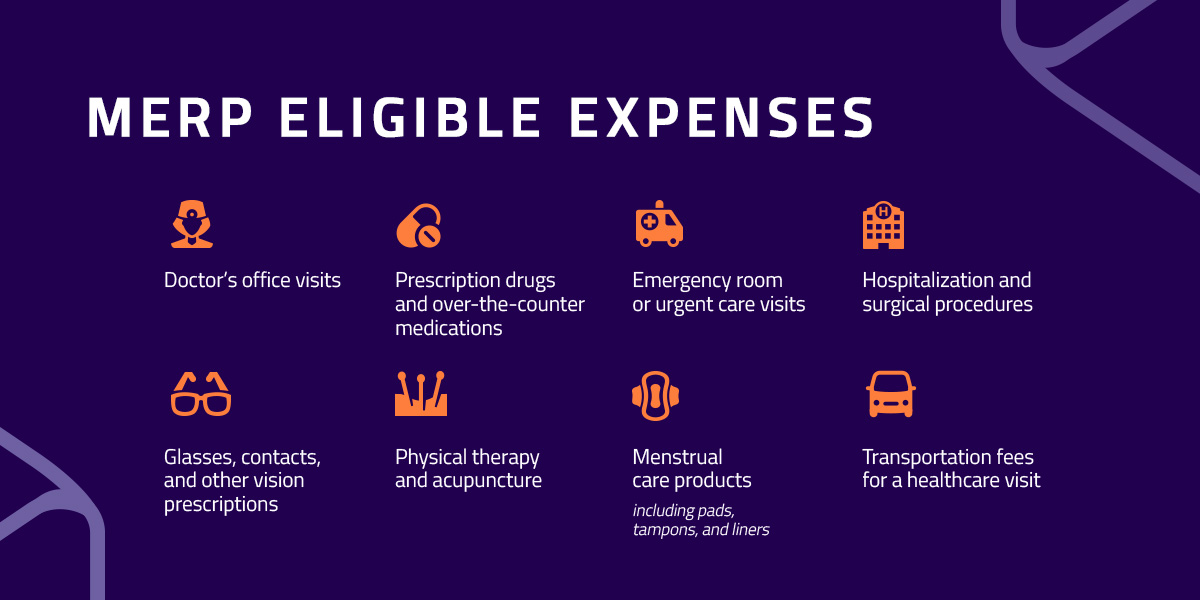
- Doctor’s office visits
- Prescription drugs and over-the-counter medications
- Emergency room or urgent care visits
- Hospitalization and surgical procedures
- Glasses, contacts, and other vision prescriptions
- Physical therapy and acupuncture
- Menstrual care products, including pads, tampons, and liners
- Transportation fees for a healthcare visit
Reimbursement Process
Here’s how the process works:
- The employer establishes the MERP rules: The employer sets the eligible expenses, contribution limits, and reimbursement process. The amount limit applies to each employee, which caps the reimbursement funds. Nondiscrimination requirements prevent employers from setting rules that benefit only highly compensated employees, such as executives.
- An employee purchases a healthcare item or service: Employees must purchase healthcare services using their own funds. Reimbursements cannot be a flat dollar estimate and should actually reflect the employee’s expense.
- The employee submits the proof of expense through documentation: To be eligible for tax advantages, the employer must collect the proof of expense from employees. This documentation must include the date of the incurred expense, healthcare product or service description, and item or service cost.
- The employer reviews the submitted documentation: The employer must review the proof of expense to ensure that the expense qualifies for reimbursement and contains the necessary information. The employer can ask the employee for additional information if necessary.
- The employee receives the reimbursement: Once all requirements are fulfilled, employers reimburse employees for their healthcare expenses up to the allocated amount.
Working with a third-party administrator makes the entire reimbursement process easier. The administrator can review the proof of expense, ensuring it qualifies based on the employer’s rules, while also maintaining adherence to federal regulations.
When to Recommend a MERP to Your Clients
A MERP can be worth it for any employer, especially for small companies looking to optimize their healthcare spending. It enables companies to offer competitive benefits, as they let employees choose individual coverage that fits their needs. Employers also benefit from the tax advantages that impact their long-term savings. Explaining the plan structure clearly can help companies understand a MERP’s advantages compared to other health plan structures.
How to Explain a MERP Program to Clients
To effectively explain MERP to your clients, you need to:
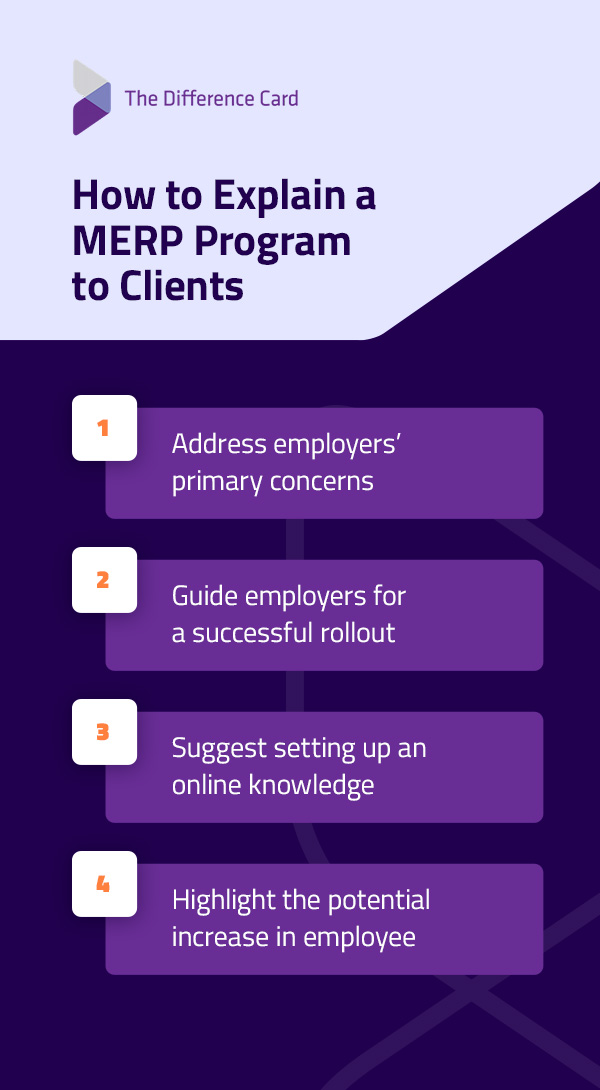
- Address employers’ primary concerns: Some employers are concerned about the MERP’s impact on their employees. Employees who understand they can get the same benefit levels, carrier, and network at a lower cost are more likely to accept and value the solution.
- Guide employers for a successful rollout: Employees need a concise explanation of benefits, and they need to understand how the reimbursement process works. If the employer works with a plan administrator, employees need to know when and how to contact them. Guide employers through the entire process for a successful implementation.
- Suggest setting up an online knowledge database: Employees may need comprehensive instructions regarding future enrollment periods and guidance on selecting the correct plan. While there is no substitute for an educational conversation, an online knowledge database helps employees use their benefits effectively.
- Highlight the potential increase in employee awareness: A MERP can enhance an employee’s awareness of healthcare costs through reimbursements without affecting their finances. This understanding can lead to a gradual behavioral change that benefits both their health and the company in the long term.
Common MERP Client Objections
Apart from explaining how a MERP works, it helps to understand how to handle common client objections. Handling objections well enables you to build trust and create long-term client relationships. Objections are also often better than a flat “no,” as they allow you to address concerns. Validating objections and empathizing with the client should help.
Here are some common objections and how you can address them:
- Limited company resources: Companies may reject a MERP proposal, saying that they don’t have sufficient budget for new plans. However, you can clarify that a MERP can save them money, not cost them more. In 2025, the annual premiums for employer-sponsored family health coverage reached $26,993, which was a 6% increase compared to 2024. A MERP’s tax advantages and budget flexibility can help companies navigate such increases.
- Insufficient leadership buy-in: Companies may reject a MERP transition due to a lack of leadership support. You can address their concerns by discussing how a MERP can increase a company’s competitive advantage, especially when it comes to hiring top talent. In February 2026, there were 6.9 million job openings — that’s a lot of competition in the job market. With 61% of Americans worrying about healthcare access, a MERP positions your client as a company that cares about an employee’s specific healthcare needs, given its flexibility.
- Existing healthcare plans: Offering a MERP doesn’t necessarily require companies to switch insurance carriers. MERP administrators can work with their existing health insurance plan providers. However, with the increasing premiums, a MERP’s tax advantages can bring companies relief. Employers also reduce out-of-pocket costs, which can improve employee satisfaction.
- Competitor broker solutions: As a broker, you may be competing with other brokers offering different healthcare solutions. However, you can position yourself ahead of the competition by leading with insights, not just quotes. By understanding how to tailor MERP to each business, you can become a trusted advisor to these companies. A customized recommendation partnered with superior customer service can increase your client satisfaction.
Providing MERP cost savings examples can help skeptical clients understand the plan’s benefits in practice. For instance, a municipal village in Illinois faced a 31% increase from Blue Cross Blue Shield in March 2026, which would have forced public sector employers to increase employee contributions, shift costs to municipal staff and first responders, or perform major budget reallocations at the municipal level.
However, adopting a MERP enabled them to reduce this increase to 17%, with $370,000 in guaranteed savings. This strategy enabled the village to manage predictable budgets and improve its employees’ healthcare experience.
Benefits of Working With MERP Administrators
Understanding the benefits of working with MERP administrators can help you explain why companies should use a MERP instead of group insurance, if they choose not to incorporate both. Administrators make the entire process efficient while ensuring the plan keeps its tax-advantaged status.
1. Ensures Companies Maintain Financial Savings
MERP administrators ensure companies create plans that adhere to the IRS rules, especially section 105. With the help of an administrator, employers can also identify which healthcare services employees use the most and their costs, making it easier to adjust plans annually. Any unused funds remain with the employer and can be rolled over to the following year. This rollover contrasts with a traditional group health plan, where the insurer retains the funds.
2. Helps Companies Navigate Complex Healthcare Regulations
Healthcare regulations can get overwhelming, especially for small business owners who have a lot on their plates. Working with an administrator removes the need for leadership to learn everything on their own at the risk of creating noncompliant plans. MERP, in particular, must comply with multiple regulations, such as:
- Employee Retirement Income Security Act (ERISA): ERISA sets minimum standards for voluntary retirement and health plans in the private industry. A MERP is often considered an employee welfare benefit plan under ERISA, which means employers must comply with the reporting, disclosure, claims procedure, and fiduciary requirements.
- Consolidated Omnibus Budget Reconciliation Act (COBRA): COBRA applies to MERP products integrated with group health plans. The act entitles employees to receive temporary coverage after a qualifying event, such as employment termination.
- Health Insurance Portability and Accountability Act (HIPAA): HIPAA requires MERP providers to protect the confidentiality of employees’ protected health information (PHI) through technical, administrative, and physical security. PHI includes an employee’s diagnoses, treatment information, medical history, and Social Security number.
A MERP must also comply with the ACA, which sets the minimum essential coverage standards for group health plans. A MERP can meet all ACA requirements by itself or integrate with a group health plan that fills any gaps.
3. Effectively Structures Plans Based on Client Needs
Unlike traditional group health plans, a MERP doesn’t offer a one-size-fits-all solution. Administrators help employers structure plans that satisfy both company and employee needs. A MERP especially benefits small business clients who can’t afford group health plans. Employers won’t need to spend on insurance premiums that don’t serve their workforce.
If employees opt for an HDHP with their MERP, employers benefit from lower premium reimbursements. Employers can also switch insurance carriers and adjust plans as needed, without losing MERP benefits. Different MERP types cater to various business needs:
- Stand-alone MERP: A stand-alone MERP is the most basic type — it lets employers set benefit levels and provide funding without additional health insurance plans. This type is ideal for those transitioning away from group health plans. Because it’s a stand-alone, the plan must comply with the ACA. Since the ACA prohibits capping funding, a stand-alone MERP may not be the best type for employers looking to control healthcare spending.
- Individual coverage MERP: Individual coverage MERP covers individual coverage premiums for all or specific employee classes. Employers typically offer this MERP for employees excluded from a group plan, such as part-time or seasonal employees. The MERP also serves as an alternative to group health insurance, especially for larger businesses.
- Qualified small employer HRA (QSEHRA): QSEHRA is a MERP that small businesses — businesses with fewer than 50 full-time employees — can offer. The annual caps employers set should be within the annual caps set by the IRS.
- Group coverage MERP: This MERP is also known as a deductible MERP, group coverage HRA, integrated HRA, or traditional HRA. The MERP supplements a group health insurance plan, covering expenses not fully reimbursed by insurance, such as copayments or high deductibles. This MERP is suited for employers who want to maintain comprehensive coverage while managing rising insurance costs, allowing employers to pay for low premiums, while employees enjoy lower out-of-pocket costs.
- MERP for vision and dental services: Since a MERP enables employers to limit the covered medical expenses, employers can design a plan solely for dental and vision services.
MERP Implementation Timeline

Administrators make MERP implementation easy, while reducing paperwork and easing compliance anxiety. Depending on the administrator, the implementation can begin with a kick-off call about 30 days before the benefit plan’s effective date.
When choosing an administrator, recommend one with a dedicated team and an account manager responsible for a smooth implementation. Implementation specialists who handle everything from start to finish make it easier for your clients to transition, impacting their satisfaction.
A good administrator also offers enrollment automation, education meetings, and member communications to simplify a company’s workload. Regardless of company size, your client should receive the attention they need to implement MERP benefits successfully.
Improve Healthcare Spending With The Difference Card

Many insurance brokers offer varying health plans to their clients. But with The Difference Card, you can place yourself ahead of the competition by offering flexible options that benefit both employers and employees.
Offering a MERP positions your services competitively against those who only offer traditional health insurance benefits. Companies don’t need to choose between affordable and good coverage — a MERP can help provide what they need.
The Difference Card has helped organizations achieve an average net savings of over 18%, translating to over $2.13 billion in savings and counting. Each company gets a dedicated account manager and experiences exceptional customer service, where they can speak to a U.S.-based representative in under a minute on average. Filed claims also get processed within two business days. Request a proposal today to get started.