
A Broker’s Guide to Helping Clients Understand Provider Search Tools
Key Takeaways A Quick Summary
Key Takeaways
- Standard carrier directories often contain inaccurate, outdated or fabricated listings (“ghost networks”), producing surprise out-of-network bills, wasted time, increased HR workload and loss of trust in the benefits program.
- Network access (in‑network status) is different from provider quality: directories show contractual relationships but usually don’t measure clinical performance or outcomes.
- Provider quality drives measurable business outcomes and ROI—better providers reduce absenteeism, readmissions and complications, raise productivity, and can materially improve patient mortality risk.
- Price is not a reliable proxy for quality: significant local and payer-driven price variation exists, so employers benefit from steering employees to high-quality, cost‑effective providers and demanding price transparency.
- Use data-driven tools (like PLUM) that evaluate providers via joinable claims, observed vs expected outcomes, episode length and risk‑adjusted metrics to identify top performers, support broker strategy, empower employees, and answer tough client questions with verifiable evidence.
You're sitting across from a CFO in the final renewal meeting. You've done the legwork, presented competitive rates, and answered the standard questions. Then they ask, “The network looks fine on paper, but how do we know these are good doctors?”
It's a fair question, and one that more clients are asking. You can answer it with confidence when you understand the difference between network access and provider quality, and when you have the right tools to back up your recommendations.
This guide gives you a framework for turning a basic find-a-doctor tool into a strategic asset for client retention and sales. You'll learn how to explain the credibility gap in standard carrier directories, connect provider quality to measurable business outcomes, and answer tough questions with data-driven insights.
Uncover the Credibility Gap in Standard Carrier Directories
Before you can show clients the value of a quality-based provider lookup tool, you need to help them understand the limitations of what they're using now. Standard carrier directories — the tools most employers rely on to find in-network providers — often contain inaccurate data and fail to reflect provider quality. The result is unexpected costs, frustrated employees, and a loss of trust in the benefits program.
The High Cost of Inaccurate Data and “Ghost Networks”
Ghost networks refer to healthcare provider listings in a health plan's directory that are inaccurate or outdated. These inaccuracies create real problems for employees trying to access care.
Common inaccuracies include:
- Outdated information: An employee calls the number in the directory only to find the office has moved or closed.
- Nonparticipating providers: The listing shows them as in-network, but they've terminated their contract with the insurer.
- Nonexistent providers: In some cases, the listing is completely fabricated or represents a provider who retired years ago.
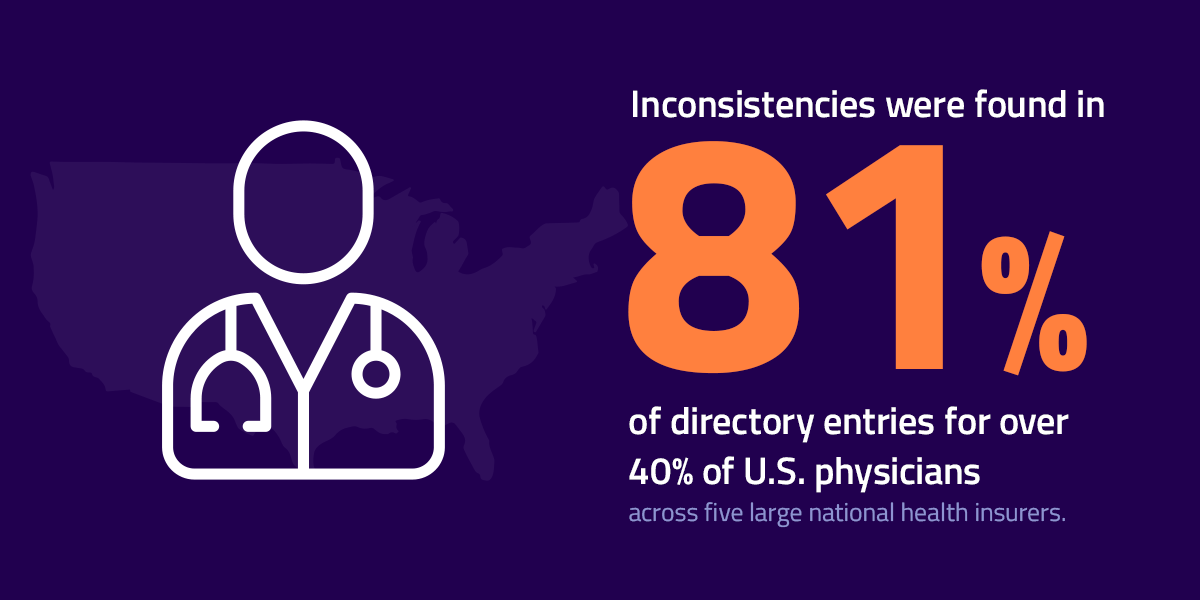
When employees rely on a health plan provider directory with ghost network issues, they face surprise out-of-network bills and wasted time. Provider address consistency in major health plan directories can be as low as 16.5%. According to one study, inconsistencies were found in 81% of directory entries for over 40% of U.S. physicians across five large national health insurers.
These issues reduce confidence in the benefits program and create avoidable costs for employers — leading to more HR inquiries, higher out-of-network claims, and greater uncertainty for employees seeking care. For HR teams already stretched thin, ghost network issues add unnecessary workload, requiring them to resolve billing disputes and field complaints about unexpected costs.
Understanding the Critical Difference Between Network Access and Provider Quality
Traditional carrier directories answer one question: “Is this doctor in my network?” They don't answer a more important question: “Is this doctor any good?” For employers who rely solely on carrier tools, that's a fundamental blind spot.
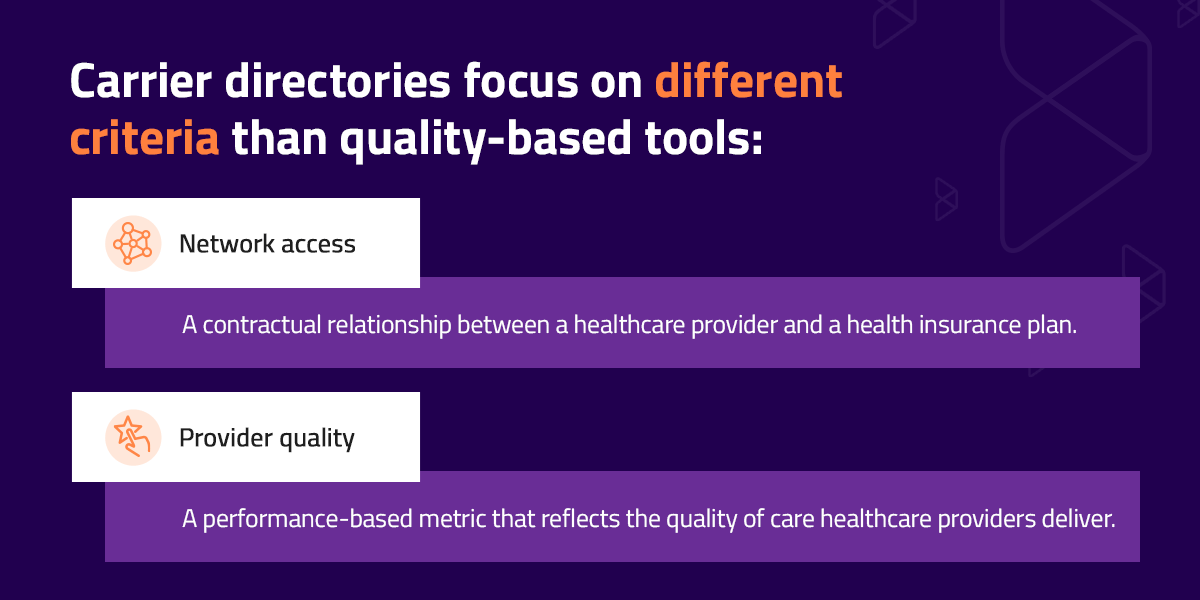
Carrier directories focus on different criteria than quality-based tools:
- Network access: A contractual relationship between a healthcare provider and a health insurance plan. A provider is in-network if they have an agreement with the insurance plan to provide services at a negotiated rate.
- Provider quality: A performance-based metric that reflects the quality of care healthcare providers deliver. It focuses on measurable outcomes such as patient mortality risk and resource utilization.
Most directories focus on network access while largely ignoring provider quality. As a result, employers miss the opportunity to steer employees toward higher-quality healthcare providers who can improve health outcomes and reduce overall healthcare spending. By helping clients shift from basic in-network provider search to quality-based provider search, you're implementing a winning health insurance strategy.
The gap between these two concepts is where you add value as a broker. Any HR administrator can distribute a carrier directory link. Explaining why quality matters alongside network access — and offering tools to measure both — positions you as a strategic partner who understands the full picture of healthcare cost management.
Shift the Conversation From an Administrative Task to a Strategic Advantage
Now that you understand these directory limitations, you can pivot the conversation with your clients. Using provider data to drive better health outcomes and lower costs directly impacts your client's bottom line.
Frame the Connection
High-quality providers deliver better patient outcomes, which leads to lower long-term business costs. As you explain this connection to clients, emphasize these measurable impacts:
- Reduced absenteeism: Employees who receive high-quality care miss fewer workdays due to complications or prolonged recovery.
- Lower readmission rates: Top-performing providers have fewer patients who need to return to the hospital after treatment.
- Fewer costly complications: Quality care for chronic conditions like diabetes prevents expensive emergency room visits and hospitalizations.
- Higher productivity: Healthier employees perform better and require less time off.
A one-standard-deviation increase in doctor quality correlates with a 12.2% decline in a patient's two-year mortality risk. This statistic shows an opportunity to improve patient outcomes, from better management of chronic conditions to reduced complications.

There's significant variation in patient outcomes, even among hospitals that have the same government star rating. Quality can differ from one provider to another, even when they appear equivalent on paper. Your clients need tools that reveal these differences, not tools that treat all in-network providers as interchangeable.
To make this concrete for clients, consider the impact on their workforce. An employee with a chronic condition like diabetes who receives high-quality care has fewer complications and can stay healthy and productive, saving their employer thousands in direct and indirect costs. When you multiply that across a workforce of 500 or 1,000 employees, the financial impact becomes substantial.
Explain Price Variation
One of the toughest questions you'll hear is: “Why does this doctor cost more?” The answer that surprises most people is that in healthcare, price is often not correlated with quality. A higher price tag doesn't mean better outcomes.
In 2022, private health plans paid hospitals, on average, 254% of what Medicare would have paid for the same services. Also, prices for the same procedure vary across the same city. An employer could be paying twice as much for a knee replacement at one hospital compared to another, with no difference in quality.
Market power, negotiating leverage, and historical pricing structures drive price variation. Quality differences have other causes. A hospital in a wealthy suburb may charge significantly more than a safety-net hospital for the same procedure performed by equally qualified surgeons with similar outcomes. That's why price transparency is essential.
As you explain price variation to clients, you're helping them see that steering employees toward high-quality, cost-effective providers helps them make decisions that protect their health and wallets. The point becomes especially important as more employers adopt high-deductible health plans, where employees bear a larger share of the cost.
Your Playbook for Talking to Clients About Their Provider Network
These are the scripts, analogies, and objection-handling techniques you can use in your very next client meeting to demonstrate your expertise and shift the conversation toward strategic value.
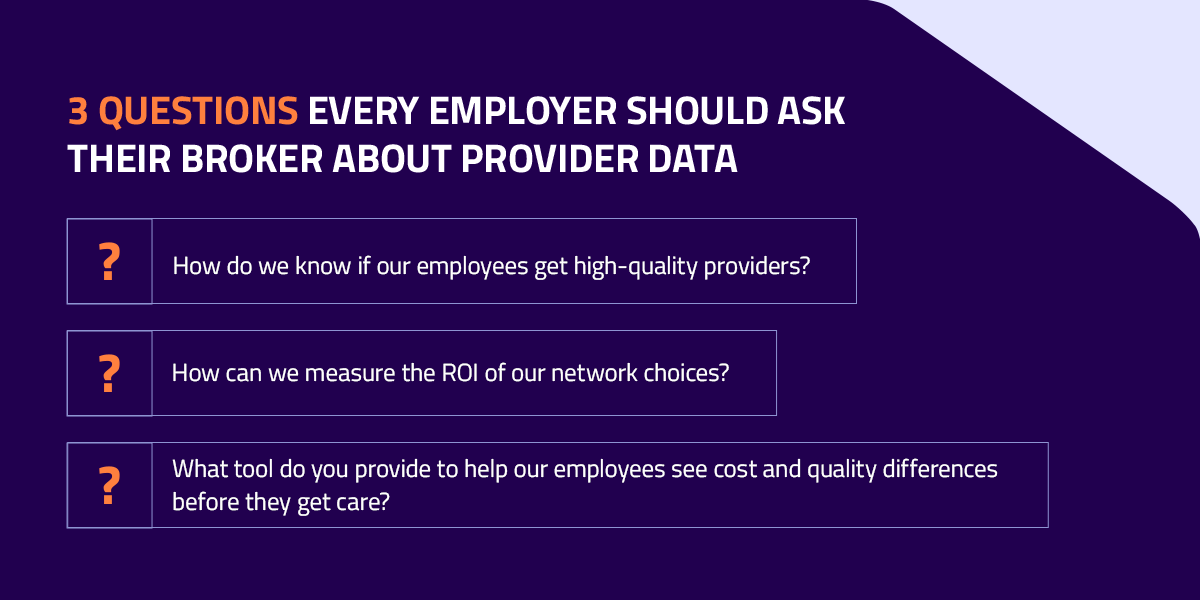
3 Questions Every Employer Should Ask Their Broker About Provider Data
When you meet with clients to discuss their provider network, thoughtful HR leaders and CFOs should ask these questions:
- How do we know if our employees get high-quality providers?
- How can we measure the ROI of our network choices?
- What tool do you provide to help our employees see cost and quality differences before they get care?
If they don't ask them, you can introduce them yourself to show that you're thinking ahead.
The first question gets at the heart of the trade-off between provider quality and network access. Explain that standard directories don't measure quality, and that you have access to tools that use outcomes data to identify top-performing providers. Describe how those tools work and what data sources they use.
The second question signals that the client understands healthcare as a business investment. A good answer ties provider quality to measurable outcomes such as lower readmission rates, fewer complications, and reduced absenteeism, all of which have clear financial value. Be prepared to share case studies or data that demonstrate these connections.
The third question shows the client is thinking about employee experience and cost transparency. Describe a quality-based provider lookup tool that displays both cost and performance data in a user-friendly format. Emphasize that the tool empowers employees to make informed choices without requiring them to become healthcare experts.
By raising these questions proactively, you demonstrate strategic thinking about plan performance and employee outcomes.
A Simple Analogy to Explain Quality-Based Search to a CFO
Choosing a doctor from a standard directory is like buying a car based only on a list of dealerships in your area. You know which dealerships exist, but you have no idea which cars are reliable, which ones have safety recalls, or which ones will cost you the least to maintain over time.
A quality-based provider search tool is like having access to safety ratings, reliability reports, and cost-of-ownership data for every car on every lot. You still have full freedom to choose, but now you're making an informed decision based on performance and not only availability. The tool helps you pick a better car, one that delivers reliable performance and value over time.
The analogy works because it's grounded in a decision most CFOs have made. They already understand the value of data-driven purchasing decisions in other contexts. You can help them see that healthcare decisions deserve the same level of rigor.
How to Address Common Client Questions and Objections
Even when clients understand the value of quality-based provider search, they may have implementation concerns. Here's how to handle the two most common objections.
“Will this limit my employees' choices?” It expands their information, not their restrictions. Employees can still see any in-network doctor, but now they also see which doctors have a track record of better outcomes. It's about informed choice. You can emphasize that this approach respects employee autonomy while providing them with the information they need to make informed decisions.
“It sounds complicated. We want something simple.” The tool itself is simple for employees to use, but it is powered by sophisticated data. This approach simplifies the employee's decision by clearly highlighting the top-performing, most cost-effective providers for their specific needs. Walk them through a real search scenario to show how intuitive the interface is.
When you can answer these objections with confidence and data, you shift from an order taker to a strategic advisor. That's the position where you protect your book of business and grow it.
Answer the Hard Questions With Verifiable Data From the PLUM Tool
Now that you've established the problem and shown clients why provider quality matters, let's focus on a solution. The Difference Card's PLUM tool is designed specifically to answer the hard questions you've been raising with verifiable data.
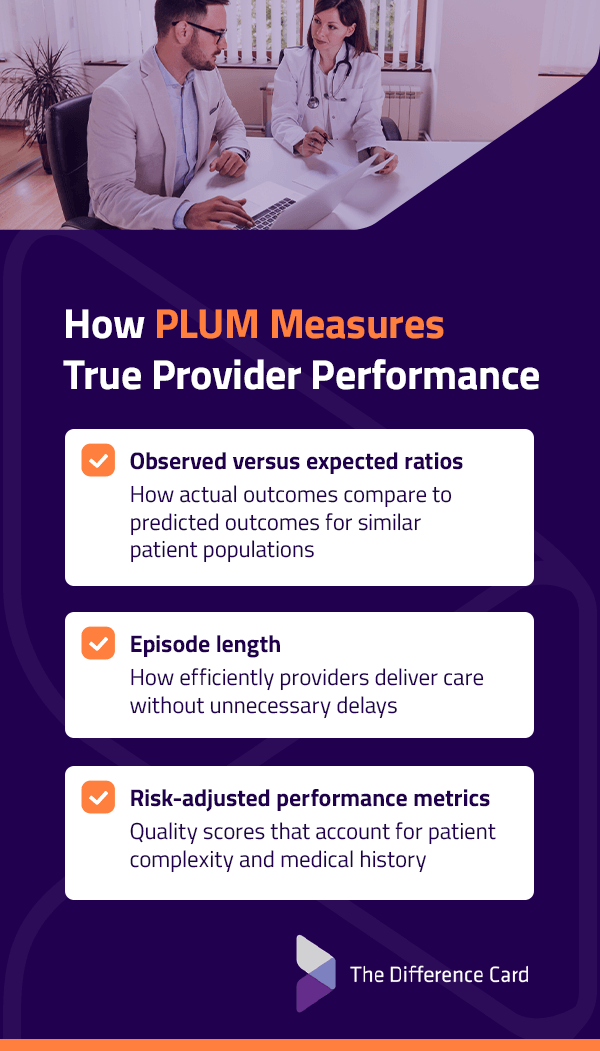
How PLUM Measures True Provider Performance
PLUM uses a fully joinable claims database to evaluate providers across three key dimensions:
- Observed versus expected ratios: How actual outcomes compare to predicted outcomes for similar patient populations
- Episode length: How efficiently providers deliver care without unnecessary delays
- Risk-adjusted performance metrics: Quality scores that account for patient complexity and medical history
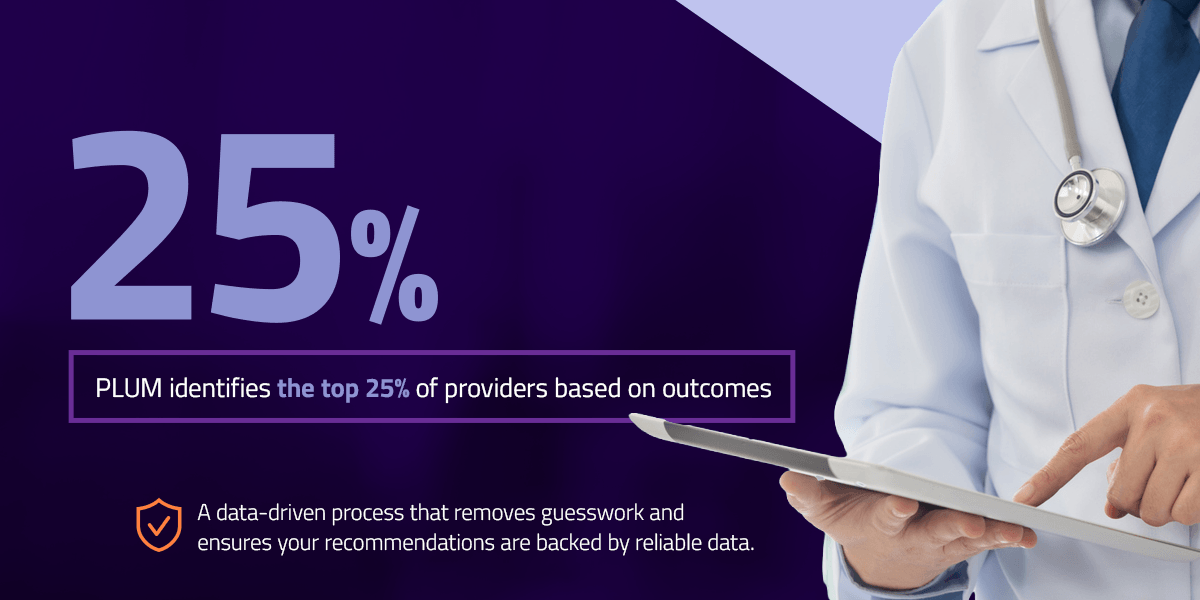
PLUM identifies the top 25% of providers based on outcomes — a data-driven process that removes guesswork and ensures your recommendations are backed by reliable data.
The risk adjustment is particularly important. Rather than penalizing providers who treat more complex patients, PLUM compares each outcome to what would be expected given the patient population they serve. A cardiologist who specializes in high-risk cases can still rank in the top quartile if their outcomes exceed expectations for that patient mix, which means the rankings reflect true quality, not patient selection.
That level of precision matters because it shifts the conversation from subjective opinions ("I've heard good things about this doctor") to objective evidence ("This provider ranks in the top quartile for outcomes in their specialty"). This level of precision builds trust with clients and gives employees the confidence to make better healthcare decisions.
A Powerful Broker Tool That Doubles as a Client-Facing Resource
PLUM serves dual purposes. It's an internal analysis tool and a resource you can share directly with HR teams and employees. It's uniquely valuable for benefits broker provider tools — brokers who want to demonstrate ongoing strategic value beyond the initial recommendation.
Here's how PLUM delivers dual value:
- For brokers: Conduct plan design analysis, identify high-performing networks, and spot cost-saving opportunities across specialties and regions.
- For HR teams: Reduce time spent answering questions and give employees a self-service tool they can trust.
- For employees: Search for quality providers independently with clear cost and performance data at their fingertips.
Using PLUM positions you as a broker who enhances their judgment with data while respecting their autonomy. Employees feel empowered, HR teams reduce their time answering benefits questions, and you've created tangible value that's visible every time someone searches for a provider. The tool becomes part of your ongoing service model as a continuous resource.
If you're interested in advanced plan designs that pair well with quality-based provider search, resources like The Difference Card's self-funding playbook can help you explore options that align with your clients' goals. The broker resource hub provides additional tools and insights to support your client conversations.
Frequently Asked Questions About Provider Search Tools
Brokers and their clients commonly ask questions when evaluating provider search tools. Here are the answers to some of the most common.
How Does the No Surprises Act Relate to Directory Accuracy?
The No Surprises Act protects patients against some surprise bills, such as when an out-of-network anesthesiologist works at an in-network hospital. But it doesn't solve the core problem of patients unknowingly choosing out-of-network clinics because the directory listed them incorrectly.
Here's what brokers need to know:
- The Act protects against some surprise bills but doesn't fix inaccurate directories.
- Enforcement remains inconsistent across states and insurers.
- Proactive tools prevent problems before they become billing surprises.
A quality search tool that prioritizes data accuracy can help prevent those scenarios before they happen. The Act also places new requirements on insurers to maintain accurate directories, but enforcement has been inconsistent. Proactive brokers help clients go beyond minimum compliance by providing tools with higher accuracy standards.
How Reliable Are Online Provider Ratings and Patient Reviews?
Patient reviews are reliable for gauging subjective factors such as bedside manner or office wait times, but they don't reflect actual clinical outcomes. A study on doctor quality shows that patient-generated ratings are uncorrelated with provider value-added — meaning a doctor with five-star reviews may not deliver better health outcomes than one with three stars.
This finding reinforces the value of outcomes-based tools like PLUM. For serious medical conditions, you want data on performance outcomes. While patient reviews have their place, they shouldn't be the primary factor in selecting a surgeon or specialist for complex care.

How Often Are Provider Directories Required to be Updated?
Under federal law, Medicare Advantage plans must verify their directory data at least quarterly. That's a good benchmark for the industry, but accuracy can still drift between updates. Providers change locations, retire, or stop accepting certain insurance plans throughout the year.
When evaluating provider search tools for clients, ask about:
- Update frequency: How frequently the directory is updated.
- Data verification methods: How the tool confirms provider information beyond minimum federal requirements.
- Real-time validation: Whether the system flags outdated listings before employees see them.
What Role Do AI Search Tools Play in Provider Selection?
AI search tools are increasingly being integrated into search platforms to help employees find appropriate care more efficiently. These tools rely on large language models that synthesize information from across the internet, which means they may present outdated provider data or recommend out-of-network options. They can analyze patient needs, match them with specialties, and predict which healthcare providers are the best fit based on historical outcomes data.
AI search tools are only as good as the data they're built on. If the underlying directory is inaccurate or lacks quality metrics, AI can't compensate for that gap. Advanced AI search tools combine accurate provider data with quality performance metrics, giving employees both convenience and reliable guidance for their healthcare decisions.
Go Beyond the Standard Directory With The Difference Card
The most effective brokers use data to guide their clients on cost and quality. The Difference Card is built to be your partner in that process.
Our PLUM tool identifies the top 25% of performing providers using actual outcomes data from a fully joinable claims database. It's a resource you can use for strategic analysis and share directly with your clients to demonstrate your value.
If you're ready to position yourself as a strategic advisor, contact The Difference Card today to learn more about partnering with us and getting access to tools like PLUM.