

The Broker’s Case for HSA-Paired Plans: More Savings, Stronger Retention
Key Takeaways A Quick Summary
Key Takeaways
- An HSA‑paired HDHP both lowers employer healthcare costs and strengthens broker relationships by giving employers a design‑based reason to stay at renewal instead of competing on price alone.
- Market and regulatory momentum make this the moment to lead with HSA designs: rapid HSA account/asset growth and IRS Notice 2026‑5 (permanent telehealth HSA compatibility and expanded HDHP compatibility for some bronze/catastrophic plans).
- Two concrete employer proof points drive the case: average premium reductions (HDHP vs PPO — ~12% single, ~10% family; HDHP+MERP can yield 10–25% savings) and FICA tax savings of 7.65% on every pretax HSA dollar contributed through a Section 125 plan.
- Layering a MERP with an HSA solves the deductible objection by reimbursing eligible out‑of‑pocket costs, allowing multiple plan designs from one carrier, sharing employer/employee costs, preserving premium savings, and improving employee experience and retention.
- Brokers who build custom HSA+MERP architectures gain stronger renewal proof points and long‑term client value; The Difference Card is presented as a partner solution that supports plan design, administration, quick claims processing, and documented employer savings.
A well-designed health savings account (HSA)-paired health plan does more than lower an employer's costs. It strengthens the broker relationship by giving employers a clearer reason to stay through renewal season and giving brokers stronger proof points to bring back year after year.
High-deductible health plan (HDHP) enrollment continues to climb. Thirty-three percent of covered workers are enrolled in an HDHP with a savings option, and that momentum keeps building. Many of those employers already have an HDHP in place, with plenty of room to grow a properly structured HSA program alongside it. That's the opening a strategic broker can fill, building a plan architecture that gives their design a lasting edge over a generic quote and helps build a stronger long-term relationship with the account.
Learn how this approach helps employers save more while giving brokers a better foundation for long-term client relationships.
Why Benefits Brokers Should Lead With HSA-Paired Plans
Employers want to control rising healthcare costs without reducing the benefits they provide to their employees. For employee benefits brokers, this creates an opportunity to lead with an HDHP paired with an HSA, rather than defaulting to a traditional preferred provider organization (PPO) or health maintenance organization (HMO) plan. An HSA plan designed by a broker who understands the employer’s workforce can give clients a smarter savings strategy and a clearer reason to stay through renewal.
Brokers who wait for employers to ask about this design tend to compete on price alone, since that’s the only option left once a client already assumes every broker offers the same plan. Getting ahead of that assumption is what separates a broker that clients actively seek out from one they compare against others during the annual benefits review.
Three trends make now the right time to lead with this design instead of waiting for it to come up:
- A market accelerating toward account-based plans: Devenir's year-end 2025 research counted 41.7 million accounts holding $174 billion in assets, up 19% year over year, and projected the HSA market to reach nearly 49 million accounts and $234 billion in assets by the end of 2028.
- A wide-open opportunity gap: Many employers that already offer an HDHP may still have room to strengthen the HSA program around it, allowing brokers to design support that fits the workforce.
- A rule change worth acting on now: Under Internal Revenue Service (IRS) Notice 2026-5, qualifying telehealth coverage is now permanently HSA-compatible, and certain bronze and catastrophic plans can qualify as HDHP-compatible starting in 2026.
This is where broker differentiation in health benefits starts to matter. Instead of competing on price alone, the broker can help employers see the value of the plan design. Brokers who build this expertise now are better prepared as employer needs continue to change.
The Employer Savings Case for HDHP and HSA Plans
Two proof points turn any employer meeting into a data-driven case for making the switch. Both give a broker something concrete and verifiable to show an employer.
1. Premium Reduction Between HDHP and PPO Plans
Premium comparisons give brokers clear numbers to share with a chief financial officer (CFO). Here’s how average HDHP premiums compare to PPO premiums:
- Single coverage: An HDHP with a savings option averages $8,620 in annual premium, about 12% less than the $9,818 average for a PPO plan.
- Family coverage: Family premiums show a similar gap, with an HDHP averaging $25,379 annually compared to $28,272 for a PPO plan, a reduction of about 10%.

Layering a Medical Expense Reimbursement Plan (MERP) on top of an HDHP can push those savings even further. Clients moving from a PPO to an HDHP paired with a MERP can see premium reductions of 10% to 25%. This pairing can turn a modest first-year win into multiyear savings for the employer.
This premium comparison alone gives a broker an immediate, tangible opening proof point that resonates before the conversation ever turns to plan mechanics. It works equally well whether the employer manages 25 employees or 500.
2. FICA Tax Savings on Every Pretax HSA Dollar
Federal Insurance Contributions Act (FICA) tax savings can be an important part of the renewal conversation. When employees contribute to an HSA through a Section 125 cafeteria plan, those dollars are exempt from FICA tax, which saves the employer 7.65% on every pretax dollar contributed. That includes 6.2% for Social Security and 1.45% for Medicare. As more employees contribute, or as contribution amounts increase, the employer’s savings can grow, too.
For example, if 50 employees each contribute $2,000 annually, the employer would see $100,000 in pretax HSA contributions and $7,650 in annual FICA tax savings. That gives brokers another clear savings point to bring into the renewal meeting, beyond the premium reduction alone. For a CFO, a specific, IRS-supported number can be more useful than a general conversation about plan value.
How HSA Plan Design Protects Your Book of Business
Premium and FICA savings can help employers see the value of the plan. The benefits of a broker retention strategy come next, helping the employer stay with the broker who designed the plan.
For brokers, the retention advantage comes from giving employers more than a price point to renew around. It gives them a structured plan, employee savings opportunities, and a long-term strategy they can continue to build on each year.
HSA Balances Build Employee Staying Power
As employees build their HSA balances over time, the account can become a meaningful part of their overall benefits experience. An HSA is employee-owned and fully portable, so employees keep the money they’ve already saved even if they leave their job. However, staying with an employer that contributes to the account allows them to keep building that balance and continue benefiting from the savings momentum they’ve already started.
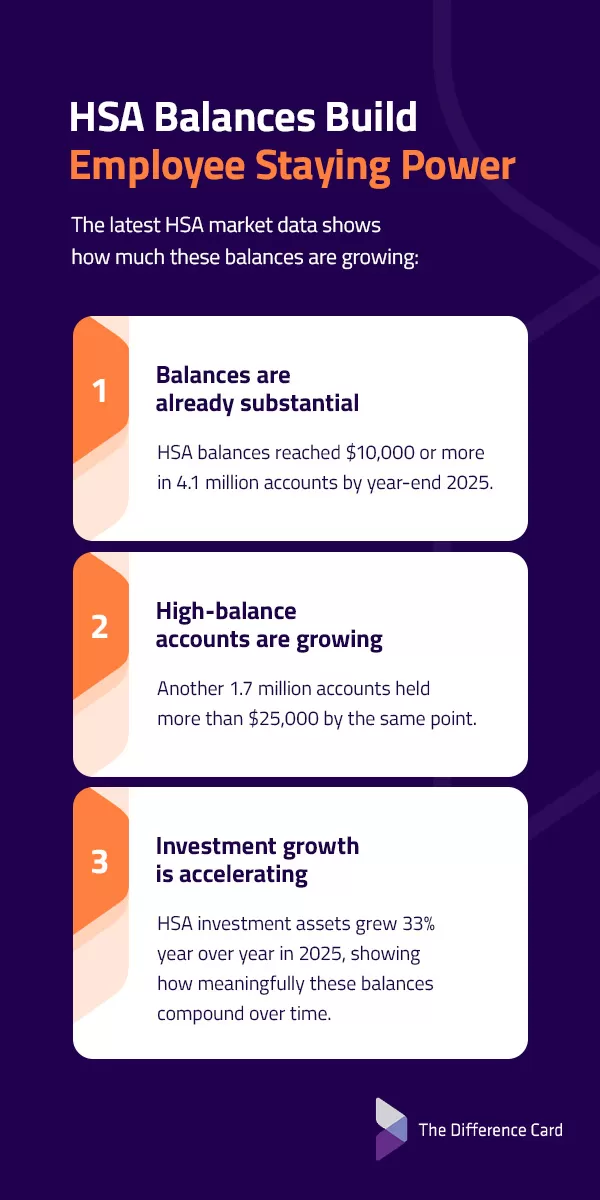
The latest HSA market data shows how much these balances are growing:
- Balances are already substantial: HSA balances reached $10,000 or more in 4.1 million accounts by year-end 2025.
- High-balance accounts are growing: Another 1.7 million accounts held more than $25,000 by the same point.
- Investment growth is accelerating: HSA investment assets grew 33% year over year in 2025, showing how meaningfully these balances compound over time.
For a broker, every year an employer stays on this design strengthens the retention case, since the employee's own financial stake in staying put grows right along with it. That built-in loyalty equally benefits the employer's retention efforts and the broker's relationship with that account, since a happier, more stable workforce rarely goes looking for a new broker either.
MERP and HSA Plan Design Supports Long-Term Client Value
A custom benefits strategy can also strengthen the broker’s long-term role with the employer. When a plan is built around the employer’s specific carrier plan, workforce, and claims strategy, it becomes more than a standard quote. It becomes a solution that the broker can continue to refine as the employer’s needs change.
A MERP makes this customization possible by allowing multiple member plan designs to be built from a single underlying carrier plan. It also gives employers the flexibility to switch carriers and adjust plan designs over time while maintaining a thoughtful benefits strategy.
For a competing broker, this makes the conversation harder to reduce to price alone. The employer is comparing premiums against a plan design that already fits their workforce.
Building this kind of plan is simply a natural result of creating something valuable for the client, one that happens to strengthen the broker relationship along the way. Brokers looking to build this kind of custom architecture into every account can explore additional plan design strategies for brokers, many of which apply just as well to a smaller employer group as they do to a larger one.
Why the MERP and HSA Combination Outperforms HSA Alone
An HSA alone solves part of the equation, but the deductible gap is what stops many employers from committing to an HDHP in the first place, and it's a common pushback brokers hear from employees. A MERP bridges that gap, even when a flexible spending account (FSA) or a health reimbursement arrangement (HRA) might fall short in terms of flexibility.
How a MERP Solves the Deductible Problem
A MERP layers on top of an HDHP to reimburse employees for eligible out-of-pocket costs, including deductibles and copays, helping reduce the impact of the higher deductible. At the same time, the employer keeps the premium savings already secured. This design differs from an HRA in two important ways. A MERP allows multiple plan designs to be built from a single carrier plan, and it allows employer and employee costs to be shared, something an HRA can't do.
Employer contributions to a MERP can vary by employer, workforce, and plan design. Those contributions can be offset by the premium savings from moving to an HDHP. This structure can also work for employers with fully insured health plans and can be tailored with options like a deductible buydown to help determine how much of the deductible gap the plan covers.
For a broker, that flexibility means the same underlying design can flex to fit a 25-employee client and a 500-employee client alike, without starting from scratch each time a new group comes on board.
The Broker's Renewal Pitch With MERP and HSA
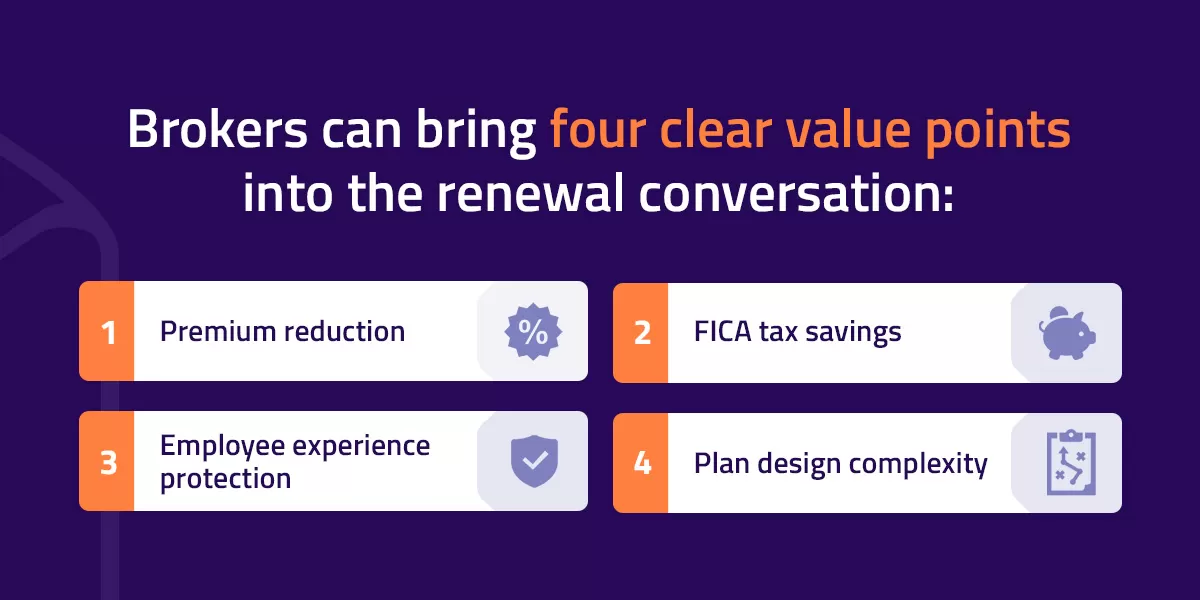
Brokers can bring four clear value points into the renewal conversation:
- Premium reduction: Switching from a PPO to an HDHP typically lowers premiums by 10% to 25% once a MERP is layered in.
- FICA tax savings: Every pretax HSA dollar contributed through a Section 125 plan saves the employer 7.65% in FICA tax.
- Employee experience protection: A MERP can help reduce the impact of the higher deductible for employees.
- Plan design complexity: A custom MERP design gives employers a benefits strategy that is harder to compare against a standard quote.
Here’s one real-world example. A Texas real estate employer achieved $230,000 in guaranteed annual savings after fully funding its MERP, with premium costs dropping by more than $500,000 annually through the HDHP redesign. A MERP health plan gives employers a clear reason to stay with a strategy that is already working for them.
These savings, tax advantages, improvements in employee experience, and plan design details give brokers stronger proof points to bring to renewal. From there, the key is making the plan feel practical for the employer. Brokers can do that by explaining where the savings come from, addressing employee concerns, and tying the plan design back to the employer’s workforce and goals.
How to Position HSA-Paired Plans With Employer Clients
Employers may have questions about how an HSA-paired plan would work for their team. A health insurance broker can explain how employer health insurance plans can use this design to support savings, address employee concerns, and fit the company’s existing benefits strategy.
That makes the conversation about more than price. Instead of comparing line items across proposals, employers can assess whether the plan fits their specific workforce. Over time, that perception becomes part of why the employer stays put at renewal.
Answering the High Deductible Objection
The deductible is often the first concern employers raise when they consider an HDHP paired with an HSA. A MERP helps address that concern by reimbursing eligible out-of-pocket costs, which can reduce the impact of the higher deductible for employees while still allowing the employer to keep the premium savings.
This support matters because many employees may still face higher out-of-pocket costs. In fact, only 3% of HSA-qualified HDHP workers receive employer contributions equal to or greater than their deductible. A MERP can help fill more of that gap by reimbursing eligible expenses and making the HDHP easier for employees to use.
The Difference Guarantee can also give employers more confidence in the plan design. Backed by an A-rated division of Assurant and developed by an in-house actuary and team of underwriters, it helps limit MERP claim exposure to a set amount. That gives employers more financial predictability while still allowing them to capture the savings from the HDHP strategy.
Grow Your Book of Business With The Difference Card
At The Difference Card, we equip brokers with everything needed to bring something genuinely different to a renewal meeting. We work alongside brokers as partners, helping them shape the plan design, explain the savings, and support the account after implementation.
Each client works with a dedicated account manager, sees claims processed within two business days, and reaches a U.S.-based customer service team that answers in under 30 seconds on average. Our proprietary MERP product supports that work by helping brokers build plan designs that can grow with their employer clients.
Since 2001, we’ve helped clients save an average of more than 18% on healthcare costs while preserving the coverage their employees value. For brokers, that track record provides a data-backed proof point for renewal conversations.
Ready to bring employer clients a plan design that saves money and strengthens your relationship with them? Contact us today to learn more about building an HSA-paired program that works for your book.