
How Does a MERP Work With Fully Insured Health Plans?

Key Takeaways A Quick Summary
Key Takeaways
- A MERP (medical expense reimbursement plan) paired with a fully insured health plan is an effective strategy to manage rising healthcare costs, enabling employers to choose lower-premium plans (often HDHPs) while reimbursing employees for higher out-of-pocket expenses.
- A MERP is an employer-sponsored HRA that reimburses covered medical expenses based on plan design; employers set reimbursement limits, contributions are generally tax-deductible, and plans must comply with regulations (IRC, ACA, ERISA, Section 105).
- There are multiple MERP types with different rules and use cases: integrated MERPs (supplement group coverage), stand-alone MERPs (subject to ACA rules), ICHRA (reimburses individual insurance premiums with employee class rules), and QSEHRA (for employers with fewer than 50 full-time employees and IRS contribution limits).
- Integrating a MERP with a fully insured plan offers key benefits—flexibility and customization, tax advantages (e.g., IRC Section 162 treatment and payroll tax reductions), lower employee out-of-pocket costs, and improved healthcare spending transparency.
- Typical MERP operations: employer designs the plan (eligible expenses, limits, claims rules), employees enroll and pay upfront, employees submit proof of expenses, employer (or third-party administrator) reviews and reimburses; third-party admins and MERP cards can simplify administration.
Rising healthcare costs are a challenge for both employers and employees. In 2023 alone, total healthcare spending reached $4.9 trillion in the United States. While a fully insured health plan can offer comprehensive coverage, it doesn’t provide a means to navigate the increasing costs. Employers are also often at the mercy of insurers’ premium prices.
Partnering a fully insured health plan with a medical expense reimbursement plan (MERP) is a great solution. You can structure a MERP in different ways depending on your goals, preferences, and business size. It offers more breathing room to choose a more suitable insurance plan if your current one no longer serves you. The Difference Card explains what a MERP is, how it works, and how it can integrate well with your insurance.
Key Takeaways
There are many reasons to offer a MERP with your fully insured health plan:
- A MERP can integrate with different types of traditional health plans, but you must structure it accordingly.
- Integrating a MERP with the traditional group plan reduces employees' out-of-pocket expenses while enabling employers to opt for insurance with lower premiums.
- Employers improve healthcare spending through reimbursement limits without sacrificing coverage.
- A MERP's customizability enables employers to adjust plans annually based on employee spending habits.
What Is a Fully Insured Health Plan?
A fully insured health plan is a group health plan you get from commercial insurers. As an employer, you pay the insurance premiums to a carrier, which takes on the financial risk of providing coverage. It is the insurers, not your company, who pay for employees’ medical claims. Simply paying premiums can lead to predictable healthcare spending while offering comprehensive coverage to your employees.
The premium rates are fixed annually, often based on the number of enrolled employees. Employees will have to pay the required out-of-pocket costs, such as deductibles and copays, for covered medical expenses. However, insurers don’t refund premiums even if your employees don’t purchase any healthcare products or services.
Offering a fully insured health plan is the traditional way to provide employee coverage. However, it’s not the most flexible method, considering it lacks customization. These plans are often compared against self-insured health plans, which use employer funding to pay for claims. Self-insured plans typically allow you to structure plans uniquely, unlike a group plan that offers a one-size-fits-all approach.
What Is a MERP and How Does It Work?
A MERP is an employer-sponsored benefit and a type of health reimbursement arrangement (HRA) that helps employees pay for covered medical expenses. Employers reimburse employees for their healthcare spending, subject to claim approvals. Specific coverage and reimbursement limits depend on the plan design. You can offer the plan as a stand-alone or provide it alongside a traditional group health plan.
A MERP can reduce healthcare spending for employers and employees without sacrificing coverage. You can design the plan based on your budget, and employer contributions are tax-deductible. Just make sure the plan complies with applicable regulations, such as the Internal Revenue Code (IRC), Affordable Care Act (ACA), and Employee Retirement Income Security Act (ERISA). For instance, a MERP often follows Section 105 of the IRC, which enables employers to enjoy tax-free reimbursement of insurance and medical expenses.
How Does a MERP Integrate With a Fully Insured Health Plan?
A MERP can be structured in different ways. To integrate it with a fully insured health plan, you must design the plan accordingly. A MERP is often paired with a high-deductible health plan (HDHP), which is a traditional insurance plan with a higher deductible but lower monthly premiums. The MERP helps employees pay for the HDHP’s higher out-of-pocket expenses while saving employers on premium costs.
You can also offer a MERP alongside other fully insured health plans, such as:
- Health maintenance organization (HMO).
- Preferred provider organization (PPO).
- Exclusive provider organization (EPO).
- Point of service (POS).
Regardless of which traditional plan you offer, the MERP functions the same way — it helps employees pay for expenses their insurance doesn’t cover. For instance, you may offer a MERP alongside an HMO plan. An HMO plan limits coverage to specific healthcare providers and generally won’t cover out-of-network services, except for emergencies. Employees can use the MERP funds for nonemergency out-of-network provider payments, which they would otherwise have to fully cover.
How Is a MERP Different From a Health Savings Account?
A health savings account (HSA) is a personal savings account that lets employees set aside pretax dollars for doctor’s office visits, prescriptions, and other medical expenses. Employers can also contribute to the account. The funds can be rolled over from year to year. The IRS sets contribution limits annually, and they remain the same whether both employers and employees contribute or not. The 2026 contribution limit is:
- $4,400 for individual contributions.
- $8,750 for family contributions.
Like a MERP, an HSA comes with tax advantages. Contributions reduce taxable income while enabling tax-free growth, as the fund serves as an investment. Employees can only use the funds for eligible medical expenses. Otherwise, they’ll be charged income tax plus 20% of the withdrawn amount as a penalty.
HSA funds belong to the employee, and they keep them even if they leave your company. You can partner the HSA with an HDHP, which is an HSA-eligible plan, to help employees pay for out-of-pocket expenses. However, employees can open an HSA even if you don’t provide an HSA-eligible plan. They can also open more than one HSA, provided they meet the contribution limits.
In contrast, a MERP has no contribution limits. You, as the employer, set the limits. A MERP can also serve as an alternative to a traditional group health coverage, depending on the plan design, unlike an HSA. Both the HSA and MERP require proof of medical expenses due to their eligibility requirements. The IRS sets the HSA eligibility requirements.
MERP Reimbursement Process
Here’s how a MERP’s reimbursement process works:
- You design the plan: As an employer, you must outline the eligible expenses, annual reimbursement limits, and claim submission rules. For instance, you may cover doctor’s office visits, insurance premiums, and prescription medications. You can adjust the reimbursement limits annually based on your budget and employees’ spending patterns.
- Employees enroll in the account while you provide funding: Once the plan is designed, employees can enroll in the MERP while you start providing the funding. The funds become available on the plan’s first date.
- Employees pay for covered medical expenses: Employees pay for healthcare expenses up front. They must keep the documentation that serves as proof of payment, which could include receipts or explanations of benefits.
- You review claims for reimbursement: You'll review the claims to ensure they meet the plan requirements. Then, you reimburse the approved claims directly to the employees, which could be through a check or direct deposit.
Third-party administrators can make the entire process easier by managing the MERP benefits administration for you.
MERP Types
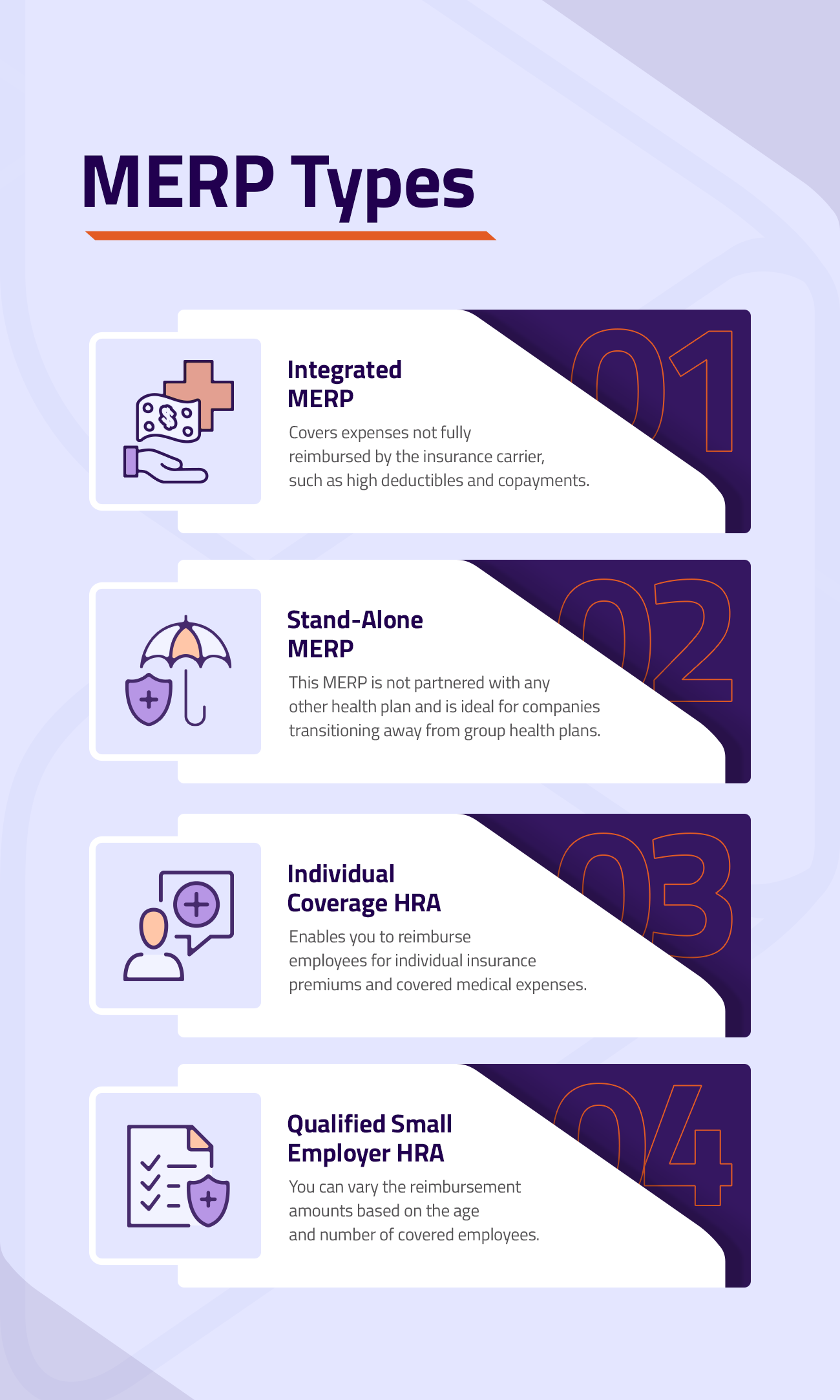
Whether you can partner a MERP with a fully insured health plan depends on the plan’s structure. Before you design a plan, consider the following MERP types:
1. Integrated MERP
An integrated MERP supplements a group health insurance plan. It covers expenses not fully reimbursed by the insurance carrier, such as high deductibles and copayments. It’s a good option if you’re looking to mitigate rising premium costs while maintaining comprehensive coverage.
2. Stand-Alone MERP
A stand-alone MERP is not partnered with any other health plan, which means the plan must comply with certain federal regulations, such as the ACA. The ACA requires companies with 50 or more full-time employees to offer affordable minimum essential coverage. This MERP is ideal for companies transitioning away from group health plans.
3. Individual Coverage HRA
The individual coverage HRA (ICHRA) enables you to reimburse employees for individual insurance premiums and covered medical expenses. The employees must have their own individual health plans, such as those they can get from the Marketplace. This option is suitable for companies looking to offer an alternative to group health plans. Employees can opt out if they prefer traditional group health coverage.
You can offer an ICHRA if you have at least one employee who is not self-employed or is not the spouse of a self-employed owner. You can also offer the plan to all employees or limit it to specific employee classes, as defined by the Departments of Labor, Health and Human Services, and the Treasury. You cannot make up your own employee classes. Examples of employee classes include:
- Full-time, part-time, or seasonal employees.
- Salaried or non-salaried employees.
- Employees covered by a collective bargaining agreement.
- Employees who have yet to satisfy a waiting period.
You may offer the ICHRA to one employee class, then offer a traditional group health plan to another. For instance, you may offer a group health plan to your full-time employees, while offering ICHRA to your part-time employees. Size requirements apply. Employees who belong to the same class cannot choose between an ICHRA and a group health plan. You also cannot combine ICHRA with the group plan.
4. Qualified Small Employer HRA
A qualified small employer HRA (QSEHRA) is a MERP you can offer if you have fewer than 50 full-time employees. You can vary the reimbursement amounts based on the age and number of covered employees, but the same terms must apply to all full-time employees. You also cannot offer a group health plan alongside a QSEHRA.
Unlike other MERP types, a QSEHRA comes with contribution limits set by the IRS. For 2026, the limits include:
- $6,450 for covered employees.
- $13,100 for covered employees and households.
As an employer, you can decide how much to contribute, provided it's within the contribution limits. You can also roll over the funds annually for the period the employee remains with your company.
Benefits of Integrating a MERP With a Fully Insured Health Plan
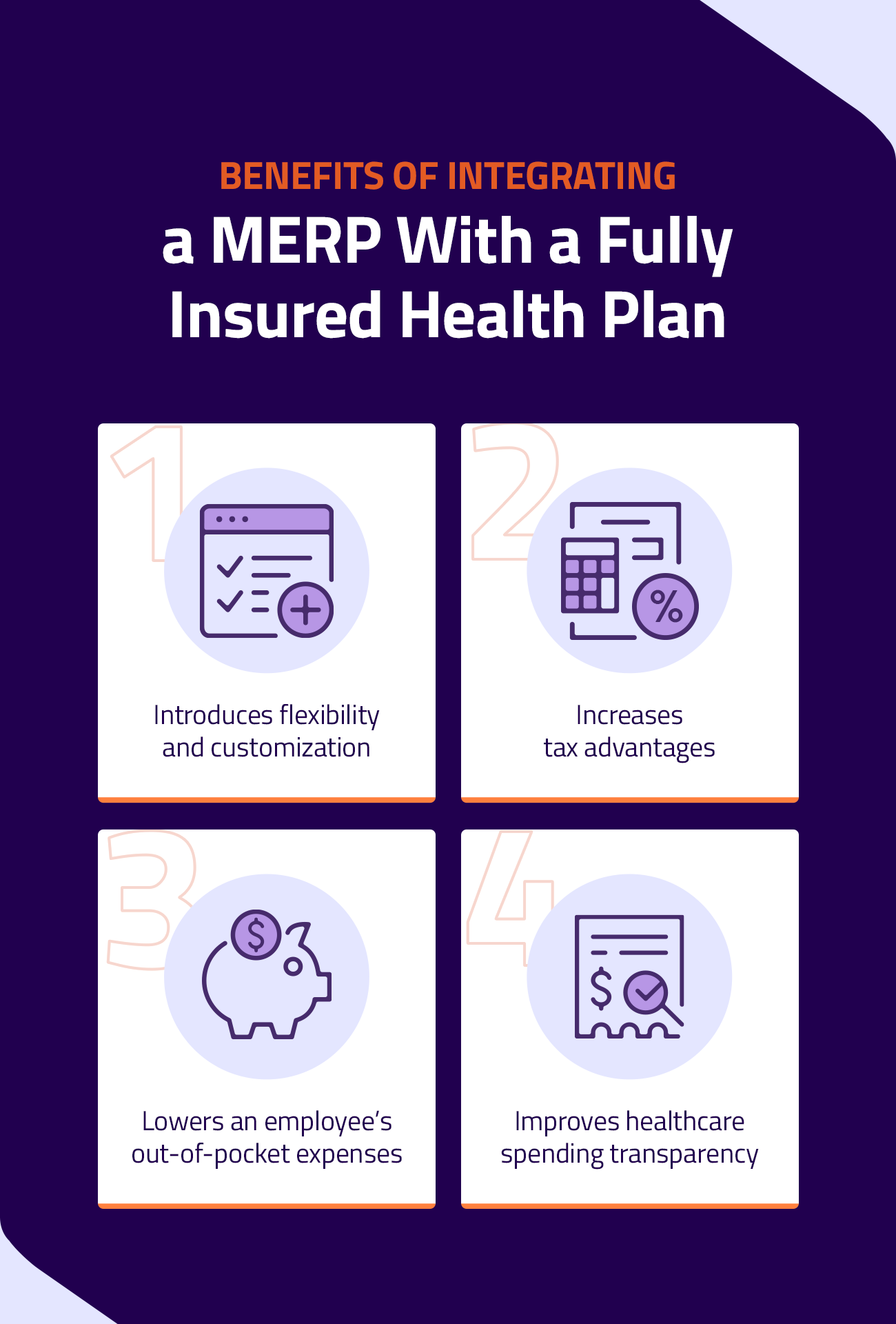
Using MERP as a stand-alone benefit already presents many advantages regarding navigating healthcare spending. However, these benefits improve when partnered with a fully insured health plan. Here’s how:
- Introduces flexibility and customization: Since a MERP is customizable, you can structure the plan based on your budget — unlike the one-size-fits-all approach of traditional health insurance plans.
- Increases tax advantages: Reimbursements count as business expenses under the IRC Section 162. You can enjoy a lower taxable income and reduce your overall tax liability. Reimbursements are also not subject to Social Security or unemployment taxes. You reduce the amount you need to pay in payroll tax contributions.
- Lowers an employee’s out-of-pocket expenses: In 2023, out-of-pocket spending cost $1,514 per person. Since MERP funds reimburse out-of-pocket expenses, employees can reduce their healthcare spending, which can encourage them to seek the care they need before conditions potentially worsen. Long-term, chronic health conditions can exacerbate spending, while also negatively impacting an employee’s well-being and productivity.
- Improves healthcare spending transparency: With a MERP, you can access comprehensive claims data and identify healthcare spending patterns. This information can help you create wellness plans that address health-related issues that may be contributing to absences.
Frequently Asked Questions
A few follow-up questions can come up while you learn more about how MERP works. Here are the common questions other employers ask:
Is MERP Worth It?
Offering a MERP is often worth it, considering the flexibility and savings it can provide. However, you must consider potential drawbacks and company priorities. For instance, offering a MERP makes an HDHP ineligible for an HSA. But without a MERP, you and your employees may struggle to navigate rising healthcare expenses.
Offering a fully insured health plan alone limits you to the conditions posed by insurance carriers. High deductibles can impact employee satisfaction, but higher premiums eat into your company’s bottom line. Integrating a MERP with your group plan balances everyone’s needs and expectations. You can limit healthcare spending based on plan rules, while employees get to keep comprehensive coverage.
What Can I Use My MERP Card For?
A MERP card is a debit card provided by some third-party administrators who manage the claims process. Covered employees use the card to pay for healthcare expenses up front, whether they’re purchasing medications in a pharmacy or swiping payments at a doctor’s office. It’s an efficient way to use your provided funds while keeping track of employees’ healthcare spending.
What Is the 80/20 Rule in Healthcare?
The 80/20 rule in healthcare generally pertains to the spending requirement for insurance companies when managing premium payments. It states that at least 80% of the funds should go toward healthcare spending and quality improvement activities, while 20% can go toward overhead, administrative, and marketing costs. This rule is sometimes called the medical loss ratio.
If the insurer doesn’t meet the 80% requirement for the year, you should get back some of the premium you’ve paid, which can be through a:
- Rebate check.
- Lump sum deposit.
- Reduction in your next premium payment.
Reduce Healthcare Spending Without Sacrificing Coverage
As an employer, it can be challenging to navigate the rising healthcare costs without reducing coverage. However, a MERP makes this possible with its customizable features and tax advantages. You need to apply specific plan designs to integrate the MERP with a fully insured health plan. For instance, you can provide an integrated MERP or ICHRA. You must also ensure compliance with relevant regulations, such as the IRC.
The claims process is simple — employees provide proof of payments for eligible expenses, which you review for compliance. Working with a third-party administrator makes the process even simpler by reviewing the claims for you and ensuring compliance with relevant regulations. This benefit can be most suited for small businesses that have yet to budget for a traditional group health plan. Larger businesses can enjoy it as an alternative offer for specific employee types.