
HSA vs. FSA vs. HRA vs. MERP: Which Benefit Account Is Right for Your Business?

Key Takeaways A Quick Summary
Key Takeaways
- Decide benefits based on eligibility rules, employee needs, target budgets and company size — the wrong choice can raise costs, reduce coverage, create compliance risk, and affect savings.
- HSA: employee-owned, portable savings account with a triple tax advantage (tax-deductible contributions, tax-free growth, tax-free qualified withdrawals); must be paired with an HSA-eligible HDHP and has annual contribution limits.
- FSA: employer-established salary-reduction reimbursement plan with a use-it-or-lose-it rule (limited carryover allowed); includes general-purpose, limited-purpose (vision/dental) and dependent-care FSAs, and has annual contribution limits.
- HRA: employer-funded reimbursement arrangement (employees cannot contribute) that offers budget control and flexibility via types like Integrated HRA, QSEHRA, CHOICE/ICHRA and EBHRA; may reimburse premiums and has variable contribution/rollover rules.
- MERP: employer-designed medical expense reimbursement plan providing high flexibility (including reimbursement of premiums), must meet nondiscrimination rules, and can disqualify HSA eligibility if it provides first-dollar coverage.
Deciding on what benefit to offer can be paralyzing. The wrong option impacts an organization's bottom line and care coverage. Noncompliance with eligibility rules also risks legal liabilities and reputational impact. Whether you're a broker or employer, understanding plan differences enables you to maximize healthcare savings without sacrificing coverage.
A health savings account (HSA), flexible spending account (FSA), health reimbursement arrangement (HRA), and medical expense reimbursement plan (MERP) all offer unique advantages. Your decision factors should include eligibility, employee needs, and target budgets. The Difference Card breaks down these factors so you can structure your offerings accordingly.
Key Takeaways: A Quick Summary
Navigating benefits becomes easier when you remember these guidelines:
- An HSA is a savings account that lets employees pay for qualified medical expenses. Its triple tax advantage makes it an enticing option, especially for employers offering a high-deductible health plan (HDHP).
- An FSA is a reimbursement arrangement that enables employees to save on specific expenses, such as medical, vision, dental, and dependent care expenses. Both employers and employees can contribute to the account.
- An HRA is a reimbursement arrangement purely funded by employers. It can give employees more flexibility, often enabling them to choose their preferred health coverage.
- A MERP is any health plan or arrangement that reimburses employees for out-of-pocket medical expenses. Employers can structure the plan as needed to best fit their needs.
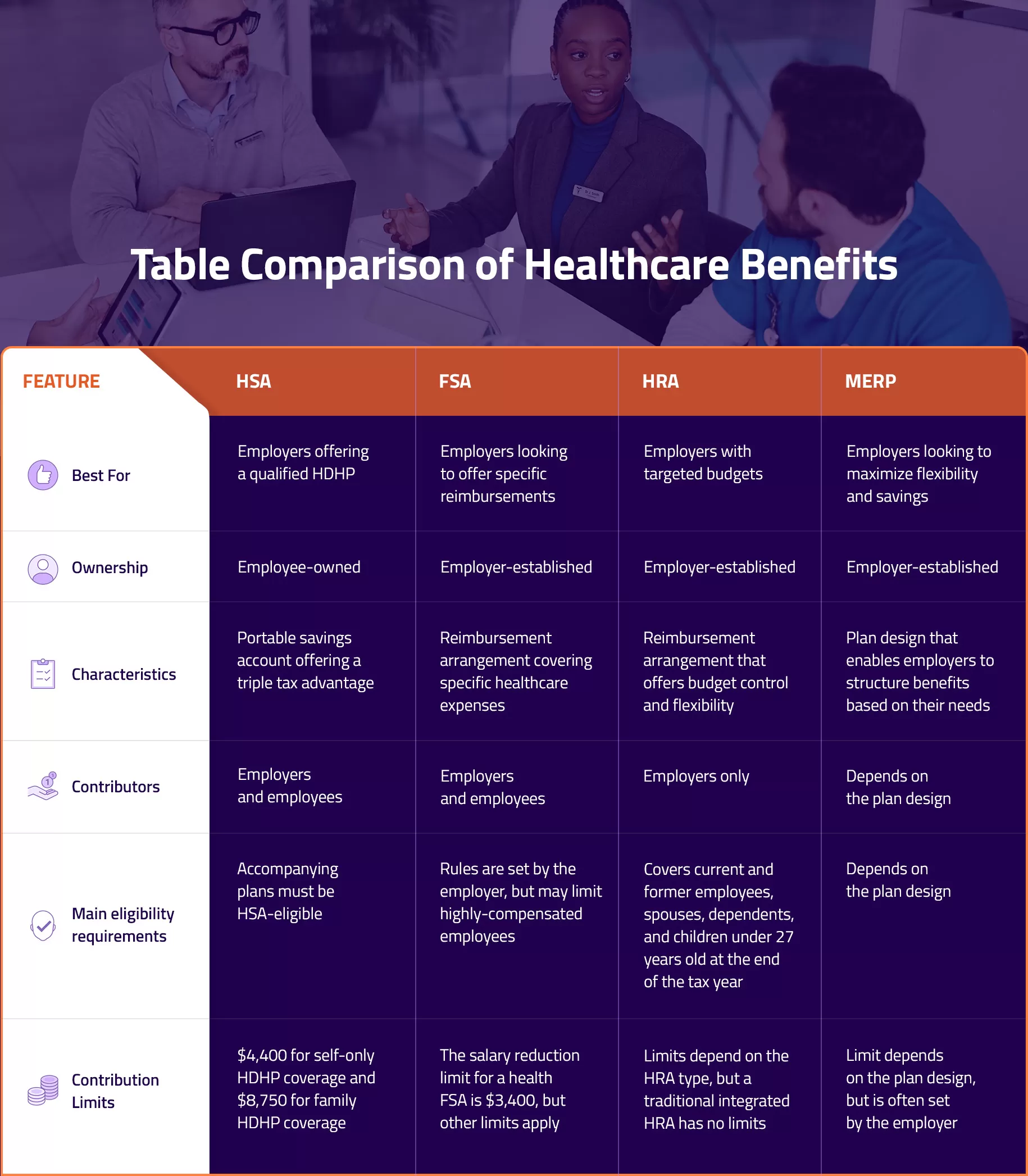
Table Comparison of Healthcare Benefits
The following overview can help you decide whether an HSA, FSA, HRA, or MERP is best for employees:
| HSA | FSA | HRA | MERP | |
|---|---|---|---|---|
| Best For | Employers offering a qualified HDHP | Employers looking to offer specific reimbursements | Employers with targeted budgets | Employers looking to maximize flexibility and savings |
| Ownership | Employee-owned | Employer-established | Employer-established | Employer-established |
| Characteristics | Portable savings account offering a triple tax advantage | Reimbursement arrangement covering specific healthcare expenses | Reimbursement arrangement that offers budget control and flexibility | Plan design that enables employers to structure benefits based on their needs |
| Contributors | Employers and employees | Employers and employees | Employers only | Depends on the plan design |
| Main eligibility requirements | Accompanying plans must be HSA-eligible | Rules are set by the employer, but may limit highly-compensated employees | Covers current and former employees, spouses, dependents, and children under 27 years old at the end of the tax year | Depends on the plan design |
| Contribution Limits | $4,400 for self-only HDHP coverage and $8,750 for family HDHP coverage | The salary reduction limit for a health FSA is $3,400, but other limits apply | Limits depend on the HRA type, but a traditional integrated HRA has no limits | Limit depends on the plan design, but is often set by the employer |
What Is an HSA?
An HSA is a tax-advantaged account that offers reimbursements for qualified medical expenses. Employees set up the account with a qualified HSA trustee, which could be a bank, insurance company, or another IRS-approved entity. Employees don't need permission from the IRS to open the account. The account also doesn't have to come from the same provider as their health plan.
An HSA is popular for its triple tax advantage:
- Tax-deductible contributions
- Tax-free interest and investment earnings
- Tax-free withdrawals for qualified medical expenses
Contributions remain tax-free even without itemizing. Employees make the contributions with pretax dollars through a cafeteria or Section 125 plan. Employers can also make contributions, which are deductible as business expenses.
The employee owns the HSA even if their employer contributes. The account is also fully portable, meaning it stays with employees even if they leave the company.
Eligibility Requirements
An HSA is often partnered with an HDHP. Employers who offer an HDHP can benefit from the lower premiums while enabling employees to save on out-of-pocket expenses through the HSA. However, not all employees with an HDHP are eligible for an HSA. To open an account, employees must not be:
- Covered by a non-HSA-eligible health plan.
- Enrolled in Medicare.
- Claimed as a dependent on someone else's tax return.
Spouses also cannot share a joint HSA.
Contribution Limits
The maximum contribution limits for 2026 are:
| Self-only HDHP coverage | $4,400 |
|---|---|
| Family HDHP coverage | $8,750 |
Eligible employees who are at least 55 years old have increased contribution limits by $1,000. Self-only HDHP coverage would then have a limit of $5,400. Employees can have more than one HSA, but the combined contributions can't exceed the annual contribution limit.
The last month rule offers a caveat. Suppose an employee has had HDHP coverage for three months. Typically, they can only access the prorated rate and not the full annual limit. However, if they've had HDHP coverage by December 1 of the tax year, they can take advantage of the full limit, provided they maintain the HDHP until December 31 of the following year. Otherwise, they must pay back the extra amount as taxable income, plus an additional 10% tax.
Employers and employees can contribute to the account. Family members and other individuals can also contribute on behalf of employees. Self-employed and unemployed individuals can contribute to their own HSA. Unused funds roll over annually.
Qualified Expenses
HSA funds can be used for coinsurance, copayments, deductibles, and other qualified medical expenses. Employees can use them to pay for expenses before they meet the HDHP's deductible. Generally, qualified medical expenses include amounts paid for medical care by the employee, their spouse, and their dependents, provided the amount has not been reimbursed through another means or insurance.
HSA funds can't be used for expenses incurred before the HSA was created and insurance premiums, unless exempted. Premiums that qualify for the funds include:
- Long-term care insurance, subject to age-based limits.
- Healthcare continuation coverage, such as COBRA.
- Health coverage while receiving unemployment compensation.
- Medicare or other coverage premiums once an individual reaches 65 years old, except for Medicare supplemental policies.
After age 65, individuals can use the funds for any purpose, but nonmedical withdrawals come with income tax.
What Is an FSA?
An FSA is an employer-established benefit plan that enables employees to receive reimbursements for medical expenses. At the start of the plan year, employees select an amount that gets withheld from their pay, usually every payday. With this salary reduction agreement, employees generally can't change the amount midyear, unless the plan allows it.
Employees can often access the full amount within the coverage period, even if they haven't yet contributed the same amount through payroll. If employees work with multiple employers, they can use the full annual limit for each employer's FSA. Note that if employers are part of the same affiliated group, they are treated as one employer. Employees must use all the money within the coverage period, since an FSA comes with a "use-it-or-lose-it" rule. Sometimes, a limited carryover applies.
Employers can contribute on top of the salary reduction. Contributions are tax-free, but employer contributions for long-term care coverage must be included in the income. Reimbursements are also tax-free for qualified medical expenses.
FSA Types
Different FSA types are used for varying purposes:
- General-purpose health FSA: This standard FSA reimburses medical, dental, and vision expenses, funded through voluntary salary reduction. Employer contributions are optional.
- Limited-purpose health FSA: A limited-purpose FSA only reimburses dental, vision, and preventive care expenses, except for long-term care. Examples of applicable expenses include vision exams, LASIK surgery, and dental cleanings. Employees can pair the account with an HSA, so they can save their HSA funds for medical costs while still getting a tax break on vision and dental care.
- Dependent care FSA: A dependent care FSA offers reimbursements for child and dependent care expenses that enable employees to perform their work. It covers services such as daycare, preschool, and care for a qualifying spouse or relative who is physically or mentally incapable of self-care.
Eligibility Requirements
The employer establishes the FSA, and they mostly set the eligibility rules. People who are self-employed aren't eligible, and limitations may apply for highly-compensated employees. The FSA can be offered alongside other benefits.
To qualify for a dependent care FSA, the employee and spouse must generally be working or looking for work, or be a full-time student. The dependent must be a qualifying individual who is the employee's:
- Child or dependent under 13 years old.
- Spouse or adult dependent who is physically or mentally incapable of self-care and has lived with the employee for more than half a year.
Contribution Limits
In 2026, the salary-reduction limit for a health FSA is $3,400, with a carryover maximum of $680. Employer contributions must comply with the excepted benefit rule, which limits contributions to the greater of either:
- Twice the employee's elected contributions
- $500 plus the employee's elected contribution amount
An FSA must meet the excepted benefit requirements to avoid being treated as a traditional group health plan.
For a dependent care FSA, the limits apply to both employer and employee contributions:
| Single filers or married filing jointly | $7,500 |
|---|---|
| Married filing separately | $3,750 |
Qualified Expenses
Reimbursements only apply to qualified medical expenses incurred during the coverage period. These expenses are specified in the plan and would typically qualify for medical and dental expense deductions. Eligible expenses can be incurred by employees, spouses, dependents, and children under 27 years old at the end of the tax year. Funds cannot be used for:
- Health insurance premiums.
- Long-term care.
- Amounts covered under another health plan.
What Is an HRA?
An HRA is an employer-funded arrangement that reimburses employees for qualified medical expenses. Unlike in an FSA or HSA, employees cannot contribute. The HRA helps employers control their budget and mitigate financial risks, while offering employees coverage flexibility. Employees choose their own health plans, covering premiums and out-of-pocket costs beforehand. Reimbursements are tax-free.
HRA Types
Different HRA types apply depending on the employer:
- Integrated HRA: An integrated HRA is paired with a group health plan, helping employees cover out-of-pocket costs such as copays, coinsurance, and deductibles. Without minimum value coverage, the employer must offer a group health plan or another plan that's not an excepted benefit, limit the HRA to employees with group coverage, and enable employees to opt out of the HRA annually. An HRA offering minimum value follows the same structure, but can cover a broader range of medical expenses.
- Qualified small employer HRA (QSEHRA): A QSEHRA applies to small employers with less than 50 full-time employees or full-time equivalents that don't offer a group health plan. It reimburses employees who maintain minimum essential coverage.
- Custom health option and individual care expense (CHOICE) arrangement: A CHOICE arrangement, previously known as an individual coverage HRA (ICHRA), applies to employers of any size. It can be offered alongside traditional group health plans if the benefit follows eligibility rules.
- Excepted benefit HRA (EBHRA): An EBHRA lets employers reimburse employees for healthcare costs not covered by the primary group plan. Examples of cost coverage include coinsurance, copayments, and vision and dental care expenses.
Eligibility Requirements
Generally, HRA reimbursements can be offered to:
- Current and former employees.
- Spouses and dependents.
- Children under 27 years old at the end of the tax year.
- Spouses and dependents of deceased employees.
A dependent qualifies if they don't file a joint return and have a gross income less than the exempt amount, which is $5,300 for 2026. If the employee and their spouse file taxes jointly, neither person can be claimed as a dependent on someone else's return.
Other requirements apply for certain HRA types:
- QSEHRA: The employer cannot be considered an applicable large employer (ALE). They must provide the same terms to full-time employees, but reimbursement amounts can vary based on age and the number of covered individuals. Any employee can qualify, but companies may exclude employees with less than 90 days of service, part-time or seasonal employees, or those under 25 years old.
- CHOICE arrangement: Employers must have at least one employee who is not self-employed or their spouse. They can offer the benefit to specific employee classes, but within each class, the same terms should apply. The same employee class shouldn't get to choose between ICHRA and a traditional group plan. Rules on minimum class sizes apply.
- EBHRA: Any employer can offer EBHRA if they also offer a traditional group health plan. EBHRA terms must be similar across similarly situated employees, regardless of health status.
Contribution Limits
Contribution limits depend on the HRA type. An integrated HRA has no contribution limit. For QSEHRA, the 2026 limits are:
| Maximum employee-only contribution | $6,450 or $537.50 per month |
|---|---|
| Maximum for employees and households | $13,100 or $1,091.66 per month |
CHOICE arrangements have no limits, but reimbursement amounts can vary by age and family size.
EBHRA's 2026 contribution limit is set at $2,200. Whether funds roll over annually depends on the plan design. Employers cannot refund any unused amount, and any amount distributed for other than qualified medical expenses counts as income.
Qualified Expenses
The qualified medical expenses are specified in the plan, which generally include medical and dental expenses that qualify for deductions. These expenses can include over-the-counter medicine and menstrual care products. Unlike with an FSA, an HRA plan can allow reimbursement for health insurance premiums and long-term care coverage.
Each HRA type comes with limitations:
- Integrated HRA: In an integrated HRA where a minimum value is not required, reimbursements can be limited to copayments, coinsurance, deductibles, and group coverage premiums. It can also cover medical care that's not considered an essential health benefit. An HRA that offers minimum value has no coverage restrictions.
- QSEHRA: A QSEHRA covers medical expenses incurred by eligible employees and their family members, including health insurance premiums.
- CHOICE arrangement: A CHOICE arrangement generally reimburses medical expenses, such as monthly premiums for individual health insurance, and out-of-pocket costs, such as copayments and deductibles.
- EBHRA: EBHRA can reimburse premiums for health insurance coverage consisting of excepted benefits and continuing coverage, such as COBRA. It can't reimburse other individual health insurance premiums or group health premiums, including Medicare.
What Is a MERP?
A MERP is an employer-sponsored health plan or arrangement that enables reimbursements for out-of-pocket medical expenses. It can be offered with a group health plan or designed as a primary health plan. It's often paired with an HDHP — employers benefit from the lower premiums while enabling employees to mitigate expenses. Contributions and reimbursements are tax-free, and depending on the plan design, employees may be able to contribute alongside the employer.
A MERP may disqualify employees for an HSA if the MERP provides "first-dollar" coverage — that is, it enables employees to reimburse expenses before they meet the HDHP's deductible requirement. However, if employers limit reimbursements to vision and dental expenses, the MERP becomes a limited-purpose plan, maintaining an employee's HSA eligibility. Employers are free to design the plan according to their budget, employee needs, and preferences. Considering the difference between a MERP and an HSA can help employers design benefits accordingly.
Eligibility Requirements
A MERP must follow nondiscrimination rules. The plan cannot favor highly compensated employees in eligibility, contributions, or benefits, or some reimbursements may become taxable for those employees. Highly compensated employees are the:
- Five highest-paid officers.
- People owning more than 10% of the company.
- Employees who are part of the top 25% highest earners.
If a plan discriminates, the highly compensated employees lose their tax break on the excess reimbursement that's considered discriminatory. Regular employees keep their tax-free reimbursements.
Contribution Limits
With a MERP, employers set a monthly allowance per employee. No salary reduction contributions apply if the MERP is structured as an HRA. Whether the funds roll over depends on the plan design.
Qualified Expenses
A MERP can reimburse any qualified medical expense, including health insurance premiums. For instance, an employer may reimburse hospital care, prescriptions, dental expenses, and vision care expenses.
Which Health Benefit Is Right for You?
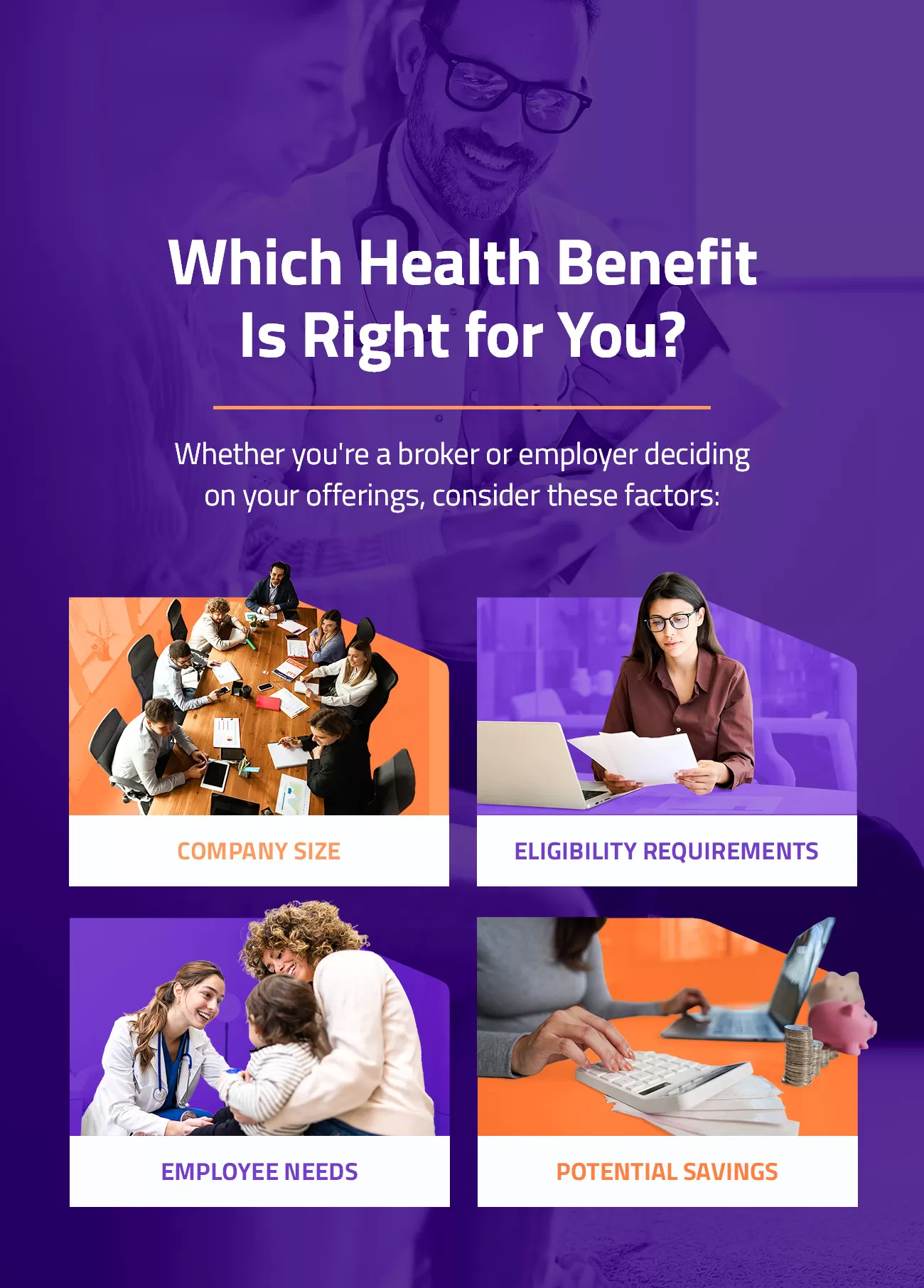
Whether you're a broker or employer deciding on your offerings, consider these factors:
- Company size: Some benefits come with employer size requirements. For instance, once you have more than 50 full-time employees and become an ALE, you can no longer consider QSEHRA.
- Eligibility requirements: Certain benefits come with employer and employee requirements. For instance, just because an employer offers an HDHP doesn't mean they can automatically offer an HSA. If the employer offers ICHRA with a traditional group health plan, the covered employees must meet minimum size requirements.
- Employee needs: Consider how much flexibility is ideal. Do employees have significantly varying health needs that would make them benefit from choosing their own coverage? Would designing a MERP make more sense even if it disqualifies employees from an HSA?
- Potential savings: Each benefit comes with its own tax advantages that can lead to significant savings. Contribution limits and reimbursement arrangements can also help control costs. When evaluating options, consider your budget and savings potential.
The Right Benefit Is Unique to Your Business
To choose between an HSA, FSA, HRA, or MERP, consider each factor that influences coverage and costs. One option is not necessarily better — the right benefit should accommodate your unique business needs. As a general guide, remember that:
- An HSA can work best partnered with an eligible HDHP.
- An FSA makes costs predictable with a salary reduction agreement.
- An HRA can control costs significantly since it's fully employer-funded.
- A MERP offers great flexibility, as employers can design plans based on their priorities.
Working with a third-party administrator can help you assess client or employee needs accordingly while ensuring you optimize for savings.