
What Is a Health Reimbursement Arrangement (HRA)?
Key Takeaways A Quick Summary
Key Takeaways
- HRA is an employer-funded benefit that reimburses employees tax-free for qualified healthcare expenses (not health insurance); employer sets the plan, employee pays then submits proof, and reimbursements are made up to plan limits.
- Main HRA types—ICHRA (individual coverage HRA), QSEHRA (qualified small employer HRA), GCHRA (group coverage HRA), and MERP—have different rules, sizes, and uses: ICHRA/ QSEHRA reimburse individual premiums and expenses, GCHRA integrates with group plans for cost-sharing, and MERP offers broader plan-design flexibility.
- Tax and financial benefits: employer contributions are generally tax-deductible and employee reimbursements are excluded from gross income; HRAs let employers control benefits spending and give employees support without payroll contributions.
- Eligible expenses typically follow IRS Publication 502 (deductibles, copays, coinsurance, prescriptions, dental, vision, mental health); CARES Act allows OTC meds and menstrual products; exclusions include life insurance, nonmedical expenses, and individual premiums under a GCHRA.
- Key differences vs. HSA and FSA: HRAs are employer-funded and generally not portable, HSAs are employee-owned and require an HDHP with indefinite rollovers, and FSAs are primarily employee-funded with use-it-or-lose-it rules; an ICHRA can affect HSA contribution eligibility.
A health reimbursement arrangement (HRA) is an employer-funded benefit that reimburses employees for qualified healthcare expenses on a tax-free basis. As traditional group health plans become more expensive and harder to manage, many employers are looking for more flexible options. An HRA can help employers control costs while giving employees more choice in how they use their healthcare benefits.
An HRA is not health insurance. It is also not an HRA medical plan in the same way a traditional health plan provides coverage. Instead, it gives employers a way to reimburse employees for approved healthcare costs. For employers trying to manage rising benefits costs, an HRA can make spending more predictable while still providing employees with the support they need for care.
This guide covers how an HRA works, the main HRA types available, what expenses qualify for reimbursement, and how an HRA compares to a health savings account (HSA) and a flexible spending account (FSA).
How an HRA Works
Here's how the process usually works from the employer and employee sides:
- Employer establishes the plan: The employer sets up the HRA and chooses how much reimbursement will be available.
- Employee pays for care: The employee pays for an eligible healthcare expense, such as a copay, prescription, or deductible.
- Employee submits proof: The employee sends in a receipt, invoice, or other required documentation.
- The claim is reviewed: The employer or plan administrator checks that the expense is allowed under the plan.
- Employee receives reimbursement: If approved, the employee is reimbursed up to the plan's limit.
One common misconception is that an HRA works like a savings or bank account. In reality, funds are available only after reimbursement is approved. Employees cannot withdraw money or carry a balance in the traditional sense.
One of the most attractive features centers on tax treatment. Employer contributions qualify as tax-deductible business expenses, while employee reimbursements are excluded from gross income under IRS regulations. This tax treatment can benefit both employers and employees.
Rollover policies vary by plan, with some allowing unused balances to roll over to the next year at the employer's discretion. This flexibility sets an HRA plan apart from an FSA, which typically follows use-it-or-lose-it rules. Employers can design rollover policies that align with their budget and retention goals.
Most HRA plans remain with the employer when employment ends. The funds stay with the company rather than following the employee to a new job or personal account.
Health Reimbursement Arrangement Types
Not every HRA works the same way. Some are built for employers that want to keep a group health plan, while others are designed for businesses that want employees to choose their own coverage. The best fit depends on your company's size, budget, and the level of flexibility you want.
Individual Coverage HRA (ICHRA)
An ICHRA gives employees a set reimbursement amount they can use toward individual health insurance and qualified medical expenses. Employers of any size can offer one, which makes it more flexible than a Qualified Small Employer HRA (QSEHRA) for larger organizations.
Adoption has grown significantly. An ICHRA plan covered twice as many people in 2026 than in the previous year. This growth shows that more employers are taking ICHRA plans seriously as an alternative to traditional group plans.
An ICHRA gives employers flexibility, but there are a few rules to keep in mind:
- Individual coverage requirement: Employees must be enrolled in a qualifying individual health insurance plan to receive reimbursements. This includes coverage purchased through HealthCare.gov or off-exchange individual plans from carriers.
- No IRS contribution limits: The employer sets a monthly allowance with no federal cap, giving organizations considerable budget flexibility.
- Customization by employee class: Employers can vary allowance amounts by full-time or part-time status, salaried or hourly designation, or geographic location.
- Restrictions on dual offerings: Employers cannot simultaneously offer an ICHRA and a traditional group plan to the same class of employees.
More employers are also considering an ICHRA for the future. A 2026 survey found that 1 in 3 businesses currently offering health benefits said they were likely to adopt an ICHRA within the next two years. That trend shows employers are looking for more flexible ways to offer health benefits. Because ICHRA and QSEHRA plans are both reimbursement-based options, employers often compare the two when deciding how to offer flexible health benefits.
Qualified Small Employer HRA (QSEHRA)
A QSEHRA is designed specifically for small businesses. The employer cannot offer a group health plan alongside a QSEHRA, making it a stand-alone benefit option.
These rules shape how a QSEHRA works:
- Size restriction: Only employers with fewer than 50 full-time equivalent employees can offer a QSEHRA.
- Minimum essential coverage requirement: Employees must have qualifying minimum essential coverage to receive reimbursements and ensure they maintain health insurance.
- IRS contribution limits: Unlike an ICHRA, a QSEHRA has annual contribution limits that adjust for inflation. For 2026, the self-only limit is $6,450, and the family coverage limit is $13,100 per year.
- Simpler administration: A QSEHRA offers fewer customization options than an ICHRA, making it easier to set up and manage.
For many small businesses, a QSEHRA is a practical first step into offering health benefits. It gives the employer a clear annual limit while letting employees choose coverage that works for them.
Group Coverage HRA (GCHRA)
A GCHRA is also called an integrated HRA or traditional HRA. Here's what employers should know about a GCHRA:
- Integration with group plan: A GCHRA must be offered alongside an employer's group health plan. Employees cannot access funds without enrollment in the group coverage.
- Cost-sharing reimbursement only: A GCHRA reimburses deductibles, copays, and coinsurance under the group plan only.
- No IRS contribution limits: The employer controls the allowance amount based on budget and plan design goals.
- Established structure: This is the most established HRA type, predating the 2020 federal rule changes that introduced the ICHRA.
A GCHRA is usually a better fit for employers who want to keep their group plan while making out-of-pocket costs easier for employees to manage. It can be especially useful when paired with a high-deductible plan.
Medical Expense Reimbursement Plan (MERP)
A MERP is a broader reimbursement structure under IRC Section 105. An HRA falls under the MERP umbrella, but a MERP can give employers more flexibility in how reimbursements are handled.
Key distinctions of a MERP include:
- Maximum plan design flexibility: It offers employers more freedom in plan design than traditional HRA plans allow.
- Multiple plan designs from one carrier plan: Unlike a carrier-integrated HRA, a MERP allows multiple plan designs to be built from a single underlying carrier plan.
- Freedom to move carriers: Employers can change health insurance carriers and adjust plan designs without being locked into one structure.
- Stand-alone or integrated structure: A MERP can be structured as a stand-alone benefit or as part of a traditional group plan, depending on the employer's goals.
Because a MERP offers more flexibility than a traditional HRA, it can be a strong fit for employers that want more control over plan design. It also gives employers room to adjust their reimbursement strategy as their workforce, budget, or carrier options change.
HRA Benefits for Employers and Employees
An HRA appeals to employers because it gives them more control over benefits spending. Employees benefit because they can receive help with healthcare costs without contributing their own payroll dollars to the account.
Employers benefit in several key ways:
- More predictable benefits spending: Employers set the reimbursement amount in advance, making annual costs easier to plan for.
- Control over plan design: Organizations can set allowances based on budget, workforce needs, and employee classes.
- Tax benefits for the business: Employer contributions generally qualify as tax-deductible business expenses.
- More flexibility than a one-size-fits-all plan: Depending on the HRA type, employers can tailor benefits by role, location, or coverage needs.
- Less carrier lock-in: With an ICHRA or a MERP, employers may have more freedom to change carriers without rebuilding their benefits strategy.
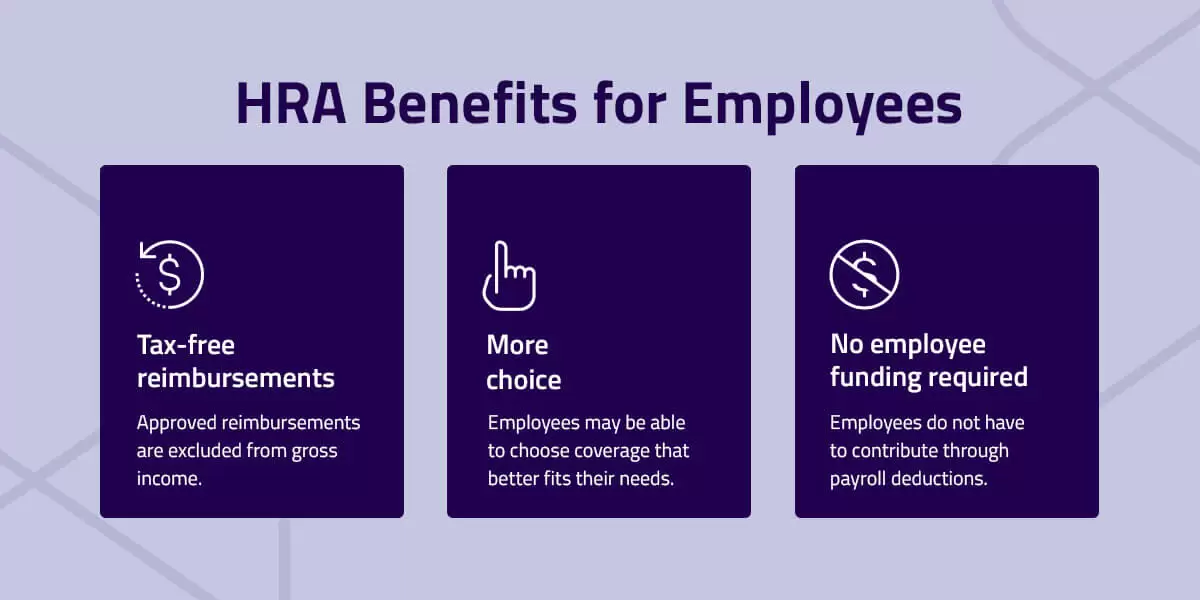
Employees also see clear advantages:
- Tax-free reimbursements: Approved reimbursements are excluded from gross income.
- More choice: Depending on the HRA type, employees may be able to choose coverage that better fits their needs.
- No employee funding required: The employer funds the benefit, so employees do not have to contribute through payroll deductions.
As the workforce becomes more diverse and multigenerational, a one-size-fits-all group plan struggles to meet individual needs. Research shows that workforce demographics are shifting, and employers are responding with more personalized, flexible alternatives. An HRA aligns with this trend by allowing employees to choose coverage that works for their life stage and health circumstances.
Recent benefits trends support this change. According to a 2026 survey of more than 3,700 organizations, 68% of employers agree that voluntary benefits are an important component of a comprehensive financial well-being strategy. Employers of all sizes are adopting HRA-based solutions at a faster rate, reflecting a broader change in how benefits are structured.
HRA Eligible Expenses
Eligible expenses depend on the plan documents, but an HRA can cover common healthcare costs employees already pay throughout the year. Employers usually use IRS Publication 502 as a guide when deciding what their plan will reimburse.
The most common eligible expenses include:
- Deductibles: Amounts paid before insurance coverage begins.
- Copays: Fixed amounts paid for doctor visits, prescriptions, or services.
- Coinsurance: The percentage of costs the employee pays after the deductible is met.
- Prescription medications: Both generic and brand-name drugs prescribed by a licensed provider.
- Dental care: Preventive, restorative, and orthodontic services.
- Vision care: Eye exams, glasses, contact lenses, and corrective surgery.
- Mental health services: Therapy, counseling, and psychiatric care.
For an ICHRA and QSEHRA, individual health insurance premiums are also reimbursable. This makes these HRA types particularly useful for employers who want to support employees purchasing their own coverage.
Under the CARES Act, an HRA can reimburse over-the-counter medications without a prescription and menstrual care products as eligible expenses. This change made reimbursements easier for employees and reduced some administrative work for employers.
Employers use plan documents to define which Section 213(d) expenses qualify for reimbursement. Employees should review those details to understand what their HRA covers.
An HRA cannot reimburse certain expenses:
- Life insurance premiums: HRA funds cannot be used for life insurance coverage.
- Nonmedical expenses: Only qualified medical expenses under IRS Section 213(d) are eligible.
- Individual insurance premiums under a GCHRA: A GCHRA can only reimburse cost-sharing expenses, not individual plan premiums.
Employers design plans with these exclusions in mind to stay compliant with IRS regulations.
HRA vs. HSA vs. FSA
When evaluating healthcare accounts with tax benefits, employers and employees often compare an HRA, an HSA, and an FSA. While all three offer tax benefits, they work very differently.
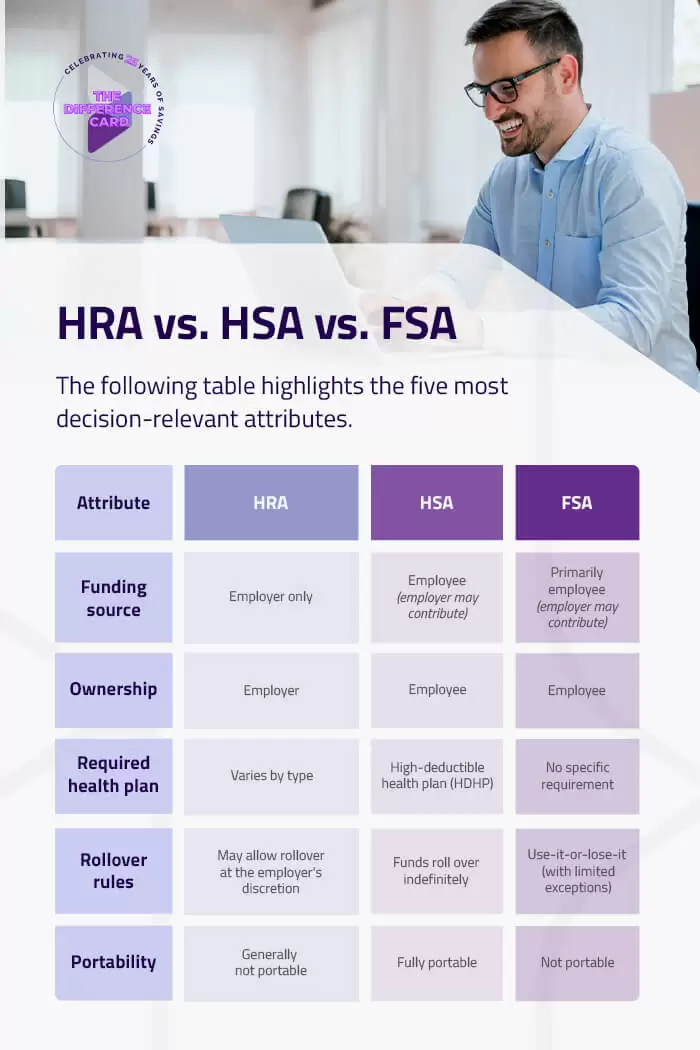
The following table highlights the five most decision-relevant attributes.
| Attribute | HRA | HSA | FSA |
|---|---|---|---|
| Funding source | Employer only | Employee (employer may contribute) | Primarily employee (employer may contribute) |
| Ownership | Employer | Employee | Employer |
| Required health plan | Varies by type — an ICHRA or a QSEHRA requires individual coverage, while a GCHRA requires a group plan | High-deductible health plan (HDHP) | No specific requirement |
| Rollover rules | May allow rollover at the employer's discretion | Funds roll over indefinitely | Use-it-or-lose-it (with limited exceptions) |
| Portability | Generally not portable | Fully portable | Not portable |
A simple way to think about the difference is that an HRA is controlled and funded by the employer, an HSA belongs to the employee, and an FSA is usually funded through employee payroll contributions.
An HSA is employee-owned and portable, meaning it stays with the employee even after leaving the job. This account also requires enrollment in a high-deductible health plan, which works best for employees comfortable with potentially higher out-of-pocket costs.
An FSA is primarily employee-funded and follows use-it-or-lose-it rules. Employees must estimate their annual healthcare spending carefully to avoid forfeiting unused funds at year-end. Some plans offer a grace period or limited carryover, but their structure is less flexible than that of an HRA or HSA.
One important consideration is how an ICHRA can affect HSA eligibility. Employees enrolled in an ICHRA may lose the ability to contribute to an HSA, depending on how the plan is structured. When comparing these tax-advantaged accounts, employees should consult a benefits advisor before combining them.
Employer-sponsored health insurance remains the most common source of coverage in the United States. In 2025, 60% of people under age 65, approximately 165.6 million individuals, had employer-sponsored health insurance. That is why it's important to understand how these accounts differ, whether you are designing benefits or choosing coverage.
Find the Right HRA Solution With The Difference Card
Organizations and brokers ready to explore a smarter benefits strategy will find trusted guidance and proven solutions with The Difference Card.
If your organization wants more control over healthcare costs without reducing the value of employee benefits, The Difference Card can help. Our MERP-based approach gives employers the flexibility to customize plan designs, switch carriers, and build a reimbursement strategy tailored to their workforce and budget.
Whether you're exploring an HRA for the first time or looking to enhance your current benefits strategy, our team can help you design a solution that fits your workforce and your budget. Contact us to learn more about our MERP solution or request a proposal today.