

What Is a Flexible Spending Account (FSA) and How Does It Work?
Key Takeaways A Quick Summary
Key Takeaways
- A flexible spending account (FSA) is an employer‑offered benefit that lets you use pretax paycheck dollars to pay eligible healthcare or dependent care expenses, reducing taxable income; the account is owned by the employer and offered through employer plans.
- FSAs follow three stages — enrollment (annual election during open enrollment or after a qualifying life event), contribution (annual election withheld pretax across paychecks), and spending (use via benefits debit card or reimbursement), with healthcare FSAs often making the full annual election available at the start of the year while dependent care FSAs only allow access as funds are contributed.
- There are several FSA types: healthcare FSA (broad medical, dental, vision), dependent care FSA (daycare, after‑school care, summer day camp; 2026 limits: $7,500 for joint filers / $3,750 for separate filers), and limited‑purpose FSA (dental/vision only to preserve HSA eligibility); 2026 healthcare FSA individual limit is $3,400.
- Eligible expenses (per IRS rules) commonly include copays, deductibles, prescription drugs, over‑the‑counter medications and menstrual products, dental and vision care, and medical supplies; FSA funds generally cannot be used for insurance premiums, cosmetic procedures, or general wellness without a medical purpose.
- FSAs are subject to a use‑it‑or‑lose‑it rule, though employers may offer either a grace period (up to 2.5 months) or a carryover (up to $680 for 2026); keep receipts for verification and consider tools like benefits debit cards or single‑card solutions (e.g., The Difference Card) to simplify spending.
A flexible spending account is one of the more common benefits offered during open enrollment. Yet, many employees choose an amount without fully understanding what the account does or how to use it.
An FSA is designed to help cover eligible healthcare costs, dependent care costs, or both, depending on the type of account you choose. Being informed before you enroll can make that decision easier and more confident. By the end of this article, you'll understand what a flexible spending account is and how to put one to good use.
What Is a Flexible Spending Account (FSA)?
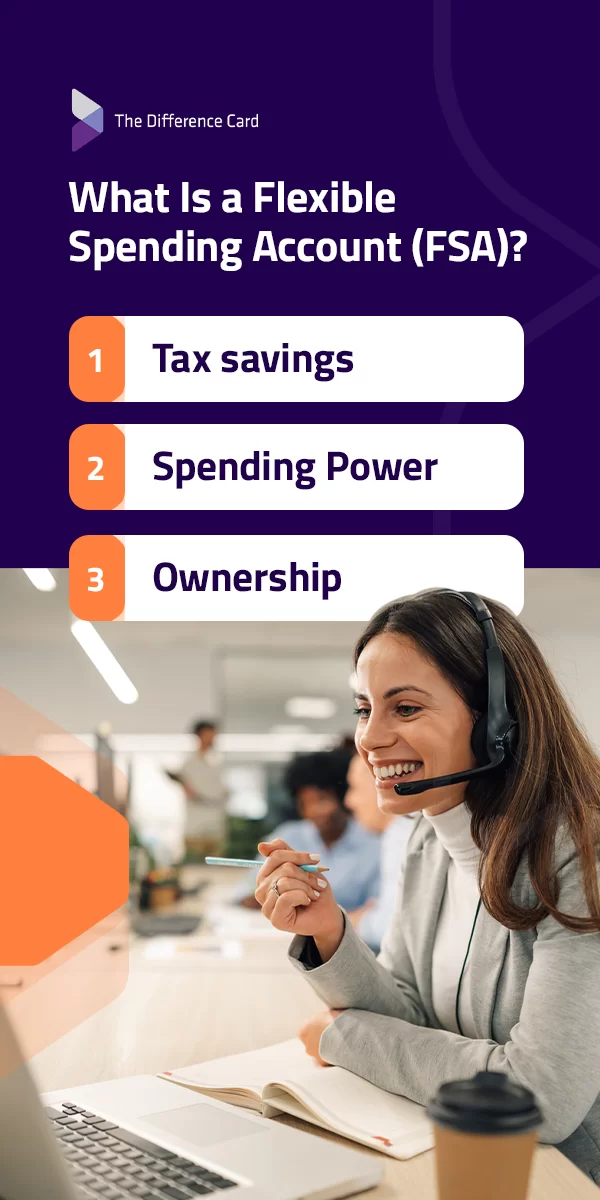
A flexible spending account is a benefit offered by your employer that lets you use pretax paycheck money to cover eligible healthcare or dependent care costs. Here's how the account breaks down:
- Tax savings: Your contributions are taken from your pay ahead of tax calculations, reducing the amount of money you owe in taxes. FSA contributions are not subject to federal income tax, Social Security tax, or Medicare tax, and these pretax contributions can reduce taxable income, which may help employees save on certain healthcare expenses.
- Spending power: With a healthcare FSA, these pretax dollars can help afford eligible medical, dental, and vision coverage, giving you flexibility in how you use them.
- Ownership: This account is owned by your employer, not by you, and it's offered as part of your overall benefits package. You can't create a flexible spending account on your own the way you might open a personal savings account because an FSA is offered through an employer-sponsored benefit plan.
Depending on the account type and plan rules, an FSA may also work with other benefit accounts that help you save on taxes. This can give you another practical way to manage healthcare costs throughout the year without relying solely on your regular paycheck.
How Does an FSA Work?
Each plan year, an FSA moves through three basic stages — enrollment, contribution, and spending. Each stage is simple, and understanding how they connect can make the account easier to use.
Enrollment
You enroll in an FSA when your employer offers open enrollment, which is typically once a year. At this point, you elect how much you want to contribute for the coming plan year based on what you expect to spend on eligible expenses, whether that's routine prescriptions, an upcoming dental procedure, or ongoing care for a family member.
Once you've made your election, you generally can't change it until the next open enrollment period. The one exception is a qualifying life event, such as marriage, divorce, or the birth of a child. These enrollment rules are in place to keep the account fair and predictable for both you and your employer.
Because unused funds typically do not carry over automatically when the plan year is over, it's often wiser to estimate your election conservatively rather than guess high.
Contribution
After you enroll, your annual election is divided equally across each paycheck and deducted before taxes are calculated, which is where the benefits of having an FSA start to add up. In practice, if you elect $1,200 for the year and get paid every two weeks, about $46 is automatically set aside from each paycheck, without any extra effort on your part.
Unlike a dependent care FSA, a healthcare FSA generally makes your full annual election available when the plan year begins. This holds true even if you haven't contributed that full amount through payroll deductions yet. That means your full annual election can go toward a planned January expense, and you can keep contributing through payroll deductions.
Employers may also contribute to an employee's FSA on top of what the employee elects, though they aren't required to.
Spending
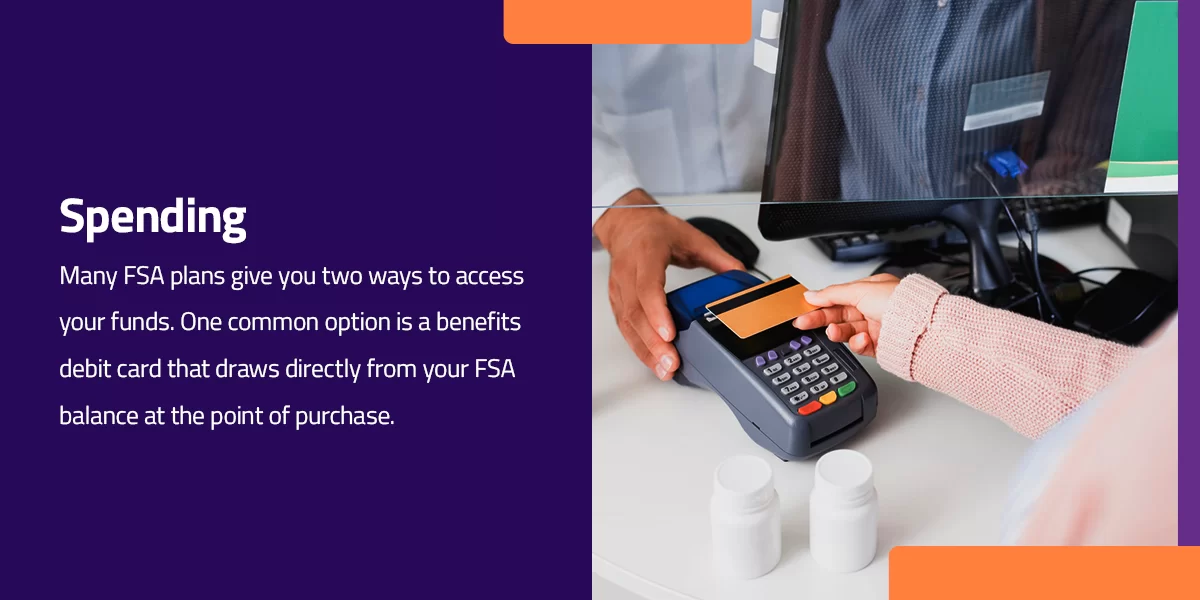
Many FSA plans give you two ways to access your funds. One common option is a benefits debit card that draws directly from your FSA balance at the point of purchase. Another option is to pay out of pocket and submit a reimbursement claim with a receipt.
Even with a debit card, it's smart to hold on to your receipts. Some plans automatically verify that a purchase qualifies, but others may ask you to submit documentation afterward to confirm the expense was FSA-eligible. Keeping a simple folder of receipts, digital or paper, helps you respond quickly if your plan ever asks for proof.
If you are unsure whether an expense qualifies, your plan administrator can usually confirm before you spend the money.
Types of FSA Accounts
Not every FSA works the same way. Employers can offer several types, each designed to cover a specific category of expenses based on your household's needs.
Healthcare FSA
A Healthcare FSA takes care of applicable out-of-pocket medical, vision, and dental costs that your insurance won't cover, from routine checkups to unexpected procedures. Because it's the broadest of the FSA types, many employees choose this option when they want help covering eligible out-of-pocket healthcare costs.
Dependent Care FSA
A dependent care FSA covers eligible expenses related to caring for children under age 13 or adult dependents who can't care for themselves. The purpose is to support you and, if applicable, your spouse so you can continue working or looking for work without worrying about who's watching your dependents during the day.
Common eligible expenses include:
- Daycare: This covers full-day or part-day care for children under 13 while parents are at work.
- After-school programs: Parents can pay for supervised programs that watch over school-age children until they get home from work.
- Summer day camp: You can generally use this money for day camp, but overnight camps don't meet the Internal Revenue Service (IRS) definition of care.
This account type has its own separate contribution limit from a healthcare FSA, and that limit changed significantly under the 2026 FSA contribution limits. The dependent care FSA maximum now sits at $7,500 for individuals or spouses filing together, and $3,750 for spouses filing separately, according to IRS Publication 15-B.
Limited-Purpose FSA
Designed to work alongside a health savings account, the limited-purpose FSA is a specialized option that allows you to add pretax dental and vision coverage without disrupting your health savings account. Unlike a standard healthcare FSA, it covers only these two expense categories.
Generally, the IRS doesn't allow you to build a health savings account and a general healthcare FSA at the same time. A limited-purpose FSA works around that rule by limiting its coverage to dental and vision costs, which helps preserve your HSA eligibility. The result is a practical way to use both an FSA and an HSA simultaneously.
This type of FSA follows the same annual contribution limit as a standard healthcare FSA, so switching to this option doesn't reduce the amount you can put aside pretax.
What Expenses Are FSA-Eligible?
An FSA covers more expenses than most people realize, and the IRS decides what qualifies. Reviewing the IRS-eligible medical and dental expenses list is worthwhile if you want the full picture. Still, these categories cover many everyday FSA-eligible expenses, including:
- Copayments and deductibles: The amounts you pay out of pocket before insurance kicks in, or at the time of a doctor's visit, are FSA-eligible expenses.
- Prescription medications: Many doctor-prescribed medications qualify when they are used to treat or manage a medical condition.
- Over-the-counter substances and medical supplies: Since the 2020 CARES Act, over-the-counter medications no longer require a prescription to qualify, and the same law expanded eligibility to menstrual care products.
- Insulin: Insulin can qualify for FSA reimbursement without having a prescription, making it one of the more straightforward eligible expenses to track and plan around.
- Dental and vision expenses: Cleanings, exams, glasses, and contact lenses generally qualify, along with many orthodontic treatments.
- Medical equipment: Items like crutches, blood pressure monitors, and bandages are typically eligible, along with many other supplies used to manage an ongoing condition.
Wearable devices may also qualify in some cases, depending on whether they're purchased primarily for a medical purpose rather than general fitness tracking, so it's worth double-checking before you buy. FSA funds cannot be used for insurance premiums, cosmetic procedures, or general health and wellness expenses that aren't prescribed for a specific medical condition.
FSA Contribution Limits
For 2026, the healthcare FSA maximum contribution amount is $3,400 per employee. The dependent care FSA limit received an even larger boost this year, as outlined in the Dependent Care FSA section above. Federal tax rules set both limits, though employer plans may set lower maximums. Take a look at your documents during enrollment to confirm the exact amount available to you.
Your best election amount depends on how much you expect to spend, how much risk you're comfortable taking, and whether your employer offers a grace period or carryover. For example, if you expect around $2,000 in dental work next year, electing close to that amount helps you avoid both coming up short and forfeiting unused funds at year's end. Reviewing your prior year's expenses is often the easiest way to land on a realistic number.
Unlike the healthcare FSA, the dependent care FSA doesn't offer day-one availability. Dependent care funds only become available as they're deducted from your paycheck, so you can't draw on the full annual election before you've actually contributed it. For a healthcare FSA, if you're married and both spouses have access to separate employer-sponsored accounts, each spouse may be able to contribute up to the annual individual limit.
Understanding Carryovers and Grace Periods
Under what's known as the FSA use-it-or-lose-it rule, you may lose funds left in your FSA when the year covered by that plan is over. An FSA is meant to help manage eligible expenses during the plan year, meaning the account can't simply serve as a long-term savings tool the way a retirement account does.
To soften that risk, employers can offer one of two relief options, though not both at the same time. The first is an FSA grace period of up to two and a half months following the plan year's end, giving you extra time to spend remaining funds on eligible expenses. Alternatively, employers can offer a carryover of up to $680 for 2026, which automatically rolls a portion of unused funds into the next plan year without any action on your part.
Not every employer offers a grace period or carryover, so it's worth checking your specific plan to see which option, if either, applies to you before you decide how much to contribute next year.
How an FSA Differs From an HSA
A health savings account, or HSA, and FSA are often mentioned in the same breath, and it's easy to mix up the details of each. Both accounts offer valuable tax advantages, but the rules behind them work quite differently in practice. Here's a side-by-side look at the key differences between the two.
| Feature | FSA | HSA |
|---|---|---|
| Ownership | Owned by your employer | Owned by you |
| Eligibility | Available if offered by your employer | Requires a high-deductible health plan |
| Fund rollover | Limited to a grace period or capped carryover | Unused funds roll over in full every year |
| Portability | Generally tied to your employer and plan rules | Moves with you between jobs |
| Contribution limits | Set annually by the IRS and may vary by employer plan | Set annually by the IRS based on coverage type |
Despite these differences, some employees can use both accounts at once. A limited-purpose FSA can run alongside an HSA, letting you cover dental and vision costs with one account while keeping your HSA available for broader medical expenses down the road. Since every household's needs are different, comparing HSA and FSA strategies side by side is the best way to find the right fit.
Get Started With The Difference Card
By now, you know what a flexible spending account is, how contributions and enrollment work, and which expenses your FSA dollars can cover. The one piece left is knowing how to access those dollars without extra paperwork or guesswork.
With The Difference Card, members can use one card to access eligible funds from multiple benefit accounts. When the purchase is eligible, this setup can reduce the guesswork often involved in managing multiple accounts. Whether you're paying a copay or covering a prescription, the card can help apply the right benefit funds at the point of sale. For eligible card transactions, this can mean fewer reimbursement forms and less manual tracking.
If you're ready to make your FSA dollars easier to use, contact The Difference Card to learn how a single-card solution can simplify access to eligible benefit funds.