

What Do Employers Need to Know About Employee Benefits Compliance?
Key Takeaways A Quick Summary
Key Takeaways
- Employee benefits compliance means following federal rules across the employee life cycle by completing required forms, sending mandated notices, maintaining plan documents, and meeting agency deadlines — and determining which laws apply to a given workforce is the first step.
- The cost of noncompliance can be severe: daily fines (e.g., Form 5500 penalties up to $2,739/day as of 2026), audits and investigations by agencies like the DOL/EBSA, and potential civil or criminal liability for willful violations.
- Key federal laws and their core obligations include ERISA (fiduciary duties, disclosures, recordkeeping, SPDs; EBSA audits), the ACA (applicable large employer rules, marketplace notice, SBC, Forms 1094‑C/1095‑C, market reforms), COBRA (continuation coverage and multiple required notices and timelines), HIPAA (special enrollment, privacy/security of PHI), and FMLA (job‑protected leave, continuation of health benefits, and four required notices).
- Critical plan documents and filings employers must manage include the Summary Plan Description (SPD) with distribution and reissuance rules, the Summary of Benefits and Coverage (SBC) with timing rules, annual Form 5500 filings (with Form 5558 extension option), and PCORI fees for self‑insured plans (annual July 31 deadline reported on Form 720).
- Practical support is available: The Difference Card offers ERISA Compliance Services to manage plan documents, amendments, WRAP documents, Form 5500 reporting, non‑discrimination testing, and other compliance tasks to reduce employer risk and administrative burden.
Federal laws govern nearly every stage of the employee life cycle, from retirement security and health coverage mandates to continuation rights, privacy protections, and job-protected leave. In addition to these requirements, employers must maintain specific plan documents and meet annual fee deadlines tied to self-insured coverage. Understanding how the pieces fit together and what's expected at each stage can help employers build a benefits program that meets key documentation and reporting expectations.
What Is Employee Benefits Compliance?
Employee benefits compliance means meeting the federal rules that apply to employer-sponsored benefit plans. In practice, it involves completing the right forms, sending the right notices, and keeping the right documents, all within specific deadlines set by different agencies.
These obligations don't apply uniformly to every business. Some requirements are for employers that offer a group health plan, regardless of size, while others depend on workforce size, plan type, or funding structure. Knowing which laws apply to a given workforce is the first step in building an effective employee benefits compliance checklist.
The Cost of Noncompliance
Noncompliance carries real risk, and not all of it shows up as a simple dollar figure. Missing a filing deadline or failing to distribute a required notice can trigger one or more of the following:
- Daily fines: Many penalties accrue daily, so a single missed deadline can quickly become expensive. For instance, a business that fails to file Form 5500 on time can face a daily Form 5500 penalty of up to $2,739 (as of 2026), with no cap.
- Audits and investigations: The Department of Labor can audit a plan's records at any time, and incomplete documentation can lead to broader scrutiny.
- Civil and criminal penalties: In cases of willful violations, business owners and plan administrators can face personal liability beyond standard fines.
Key Federal Laws Governing Employee Benefits
Several federal laws govern how employers offer, administer, and communicate benefits to their workforce. Each addresses a different compliance area, with varying timelines and enforcement responsibilities.

1. Employee Retirement Income Security Act (ERISA)
ERISA governs how employer-sponsored retirement and health plans must be managed, disclosed, and funded. It sets standards for plan administration, requires fiduciaries to act in participants' best interests, and establishes the disclosure obligations that shape much of employee benefits compliance. Many private employers that sponsor a health plan are subject to ERISA, even if they have a small workforce.
Under ERISA, plan administrators must maintain accurate records, provide participants with required disclosures, and, when a plan is funded through a trust, manage plan assets responsibly. These responsibilities can include decisions about plan investments, service providers, and administrative fees.
The Department of Labor's Employee Benefits Security Administration (EBSA) enforces ERISA and regularly audits plans for compliance. Missing plan documents and outdated summary plan descriptions can be among the issues EBSA flags during these audits, so maintaining an up-to-date ERISA compliance checklist is a helpful starting point for any employer.
2. Affordable Care Act (ACA)
Employers with an average of 50 or more full-time employees, including equivalent employees, also called applicable large employers, must offer minimum essential coverage to at least 95% of their full-time employees (and their dependents). That coverage must be affordable and meet minimum value standards, or the employer may owe shared responsibility payments.
Beyond the coverage mandate, the ACA imposes several notice and reporting obligations, not all of which are limited to applicable large employers:
- Marketplace notice: Employers covered by the Fair Labor Standards Act must provide this notice to new hires at the time of hire — generally within 14 days of their start date — informing them of their coverage options through the health insurance marketplace.
- Summary of Benefits and Coverage: Group health plans of any size must distribute this standardized document to employees at enrollment and renewal. It must outline plan benefits and costs in a consistent format.
- Forms 1094-C and 1095-C: Applicable large employers must file these forms annually with the IRS and furnish copies to employees, reporting the coverage offered throughout the year. Employers can also meet the furnishing requirement by posting a clear, conspicuous website notice that employees may request a copy, and then providing requested copies within 30 days (IRS Notice 2025-15).
Some ACA provisions apply to group health plans regardless of employer size. Group health plans must also comply with ACA market reforms, such as covering dependent children up to age 26 and eliminating lifetime dollar limits on essential health benefits.
3. Consolidated Omnibus Budget Reconciliation Act (COBRA)
Group health coverage doesn't automatically end the moment an employee leaves a company. Employers with 20 or more employees must offer continuation coverage under COBRA after certain qualifying events, including termination of employment, a reduction in hours, divorce, or the death of the covered employee.
Employers subject to COBRA must provide several types of notices throughout the continuation coverage process:
- General notice: Also known as the initial COBRA notice, this notice informs employees and their spouses of their continuation coverage rights upon first enrollment in the plan.
- Qualifying event notice: The employer or qualified beneficiary must notify the plan administrator when a qualifying event occurs.
- Election notice: The plan administrator must send this notice to eligible individuals, outlining how to elect continuation coverage.
- Notice of unavailability: If an individual isn't eligible for continuation coverage, the administrator must explain why.
Standard continuation coverage lasts 18 months for termination or reduced hours, and 36 months for events like divorce, death, Medicare entitlement, or loss of dependent status. The general notice is due within 90 days of coverage. The election notice must be sent within 14 days after the plan administrator learns of the qualifying event (or within 44 days of the qualifying event or loss of coverage, depending on plan terms, if the employer is also the plan administrator).
4. Health Insurance Portability and Accountability Act (HIPAA)
Employers have two main sets of obligations under HIPAA: portability-related protections, such as special enrollment rights for employees who lose other coverage or have a qualifying life event, and privacy and security rules governing the handling of protected health information.
The privacy and security rules often create more direct responsibilities for self-insured plans, especially when the employer or plan sponsor handles protected health information. Fully insured plan sponsors generally carry lighter obligations under HIPAA, since the insurance carrier manages most privacy and security requirements on the plan's behalf.
Even with lighter obligations, employers must still provide employees with a special enrollment rights notice at or before their initial opportunity to enroll in the plan. Employers that distribute a Notice of Privacy Practices must update and redistribute it within 60 days of any material change. Employees must be reminded that the notice is available at least once every three years.
5. Family and Medical Leave Act (FMLA)
The FMLA may cover private-sector employers with 50 or more employees. Employees are eligible only if they meet several requirements, including working at a site where the employer has at least 50 employees within 75 miles.
For eligible employees, the FMLA generally provides up to 12 weeks of unpaid, job-protected leave each year for qualifying reasons. Military caregiver leave can extend that allowance to 26 weeks. Throughout any FMLA leave, employers must continue group health benefits on the same terms as if the employee had kept working.
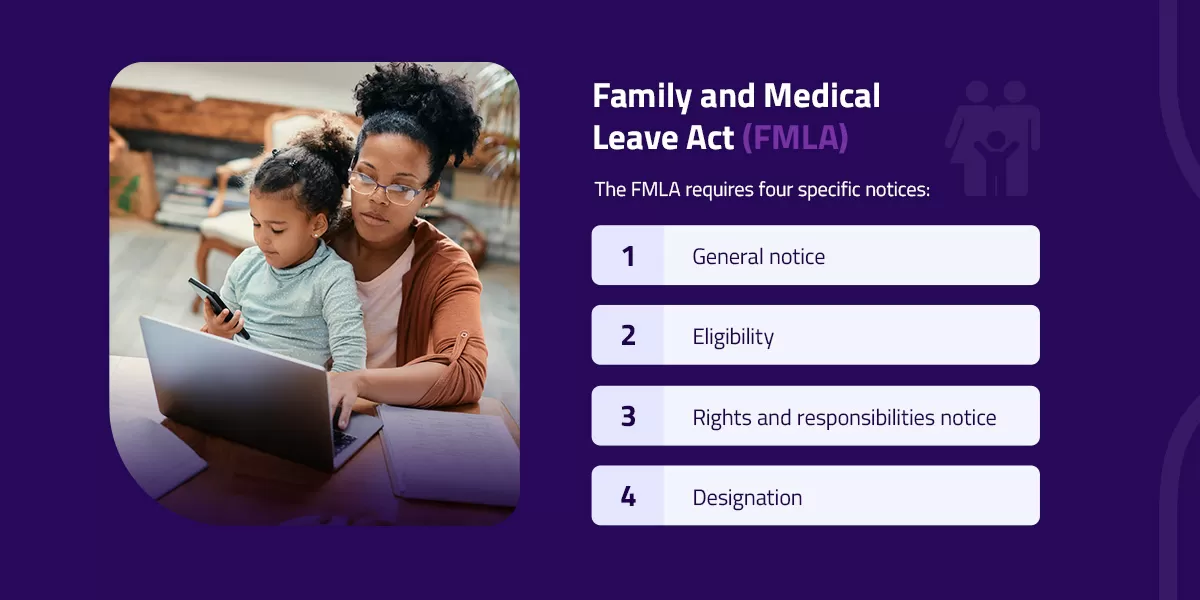
The FMLA requires four specific notices:
- General notice: Posted in the workplace and included in the employee handbook, this notice informs all employees of their FMLA rights.
- Eligibility notice: Once an employee requests leave, the employer must confirm within five business days whether that employee qualifies under the FMLA.
- Rights and responsibilities notice: This notice details the employee's specific rights and obligations during the leave period.
- Designation notice: A designation notice confirms whether the requested leave qualifies as FMLA leave.
Employers, not employees, are responsible for designating leave as FMLA-qualifying once they have enough information to make that determination. An employee doesn't need to mention the FMLA by name for the leave to qualify when first requesting leave for that reason.
Required Plan Documents and Filings
To maintain full compliance, employers need to have specific documents on file and ready to produce.
Summary Plan Description (SPD)
An SPD explains a benefit plan's terms in language participants can understand, covering eligibility, benefits, and how to file a claim. Meeting SPD requirements means distributing the SPD to new participants and, under ERISA, reissuing it every five years if the plan has changed or every 10 years if it hasn't.
If a participant requests plan documents in writing, the plan administrator must deliver them, including the latest SPD, within 30 days. Failing to do so can result in a court-assessed penalty of up to $110 per day, per person.
When a group health plan materially reduces covered benefits, employers must notify participants within 60 days of adopting the change. Other material modifications must be described in a Summary of Material Modifications within 210 days after the end of the plan year in which they're adopted. Distributing an updated SPD that incorporates the change within the same deadline also satisfies this requirement.
Summary of Benefits and Coverage (SBC)
The SBC is a federally required document that summarizes a group health plan's benefits and cost-sharing in a consistent format. It's required in addition to the SPD since it serves a different purpose: helping employees compare coverage options at a glance.
Distribution timing for SBC documents depends on the circumstances:
- Initial enrollment: The SBC must be provided when an employee first becomes eligible to enroll in the plan.
- Annual re-enrollment: Employers must distribute an updated SBC during each open enrollment period.
- Special enrollment: Employees who qualify for special enrollment must receive the SBC within 90 days of enrolling.
- Employee request: Upon request, the SBC must go out within seven business days.
Mid-year material changes to the plan that affect the SBC's content require 60 days' advance notice through an updated SBC or a separate notice of modification. This period gives employees time to understand how the change affects their coverage.
Form 5500
Form 5500 is an annual Department of Labor report that shares important details about a benefit plan's operations, funding, and compliance. Accurate filing helps employers document their plan activity and avoid late-filing penalties.
Plan size largely determines Form 5500 filing requirements. Most plans with 100 or more participants must file, though welfare plans with fewer than 100 participants may qualify for a small-plan exemption if they are unfunded, fully insured, or a combination of the two. Pension plans, such as 401(k) plans, generally must file regardless of size. For calendar-year plans, the standard filing deadline is July 31, the last day of the seventh month after the plan year ends.
Employers who need more time can file Form 5558 to request a 2.5-month automatic extension, pushing the deadline to mid-October for most calendar-year plans. Filing for an extension doesn't require an explanation, but it must be submitted on or before the original due date to be valid.
Patient-Centered Outcomes Research Institute (PCORI) Fees
The PCORI fee is an annual, per-covered-life fee that supports research comparing healthcare treatment options and is paid by sponsors of self-insured health plans. Sponsors include employers using a Health Reimbursement Arrangement as well as those using the Medical Expense Reimbursement Plan. Fully insured plan sponsors don't pay this fee directly on the insured coverage, since the insurance carrier handles that obligation on their behalf.
Self-insured plan sponsors must pay PCORI fees annually by July 31 and report them on IRS Form 720. The per-covered-life rate adjusts annually based on national health expenditure data.
Get Compliance Support From The Difference Card

Staying ahead of employee benefits compliance takes more than good intentions. It requires accurate plan documents, timely notices, and a clear understanding of which rules apply to a given workforce.
The Difference Card's ERISA Compliance Services give employers and brokers a reliable way to manage these obligations without adding administrative burden. Our team helps manage plan documents, amendments, restatements, and WRAP documents, which combine multiple welfare benefit plans into a single ERISA plan, allowing them to be reported on one Form 5500 where a filing is required. Non-discrimination testing is also available for Section 125 and Section 105 plans, rounding out a complete toolkit alongside support for Premium Only Plans.
Employers who want to reduce compliance risk and simplify plan administration can request a proposal to see how The Difference Card's compliance services fit their current benefits program.